AI Website Audit: How Trustoryx Performs a Complete AI-First SEO, AEO, Entity, Knowledge Graph, and Technical Website Analysis
Introduction For years, website audits focused on a limited set of SEO metrics such as page speed, metadata, backlinks, and keyword rankings. Learn how Trustoryx conducts full AI-first audits.
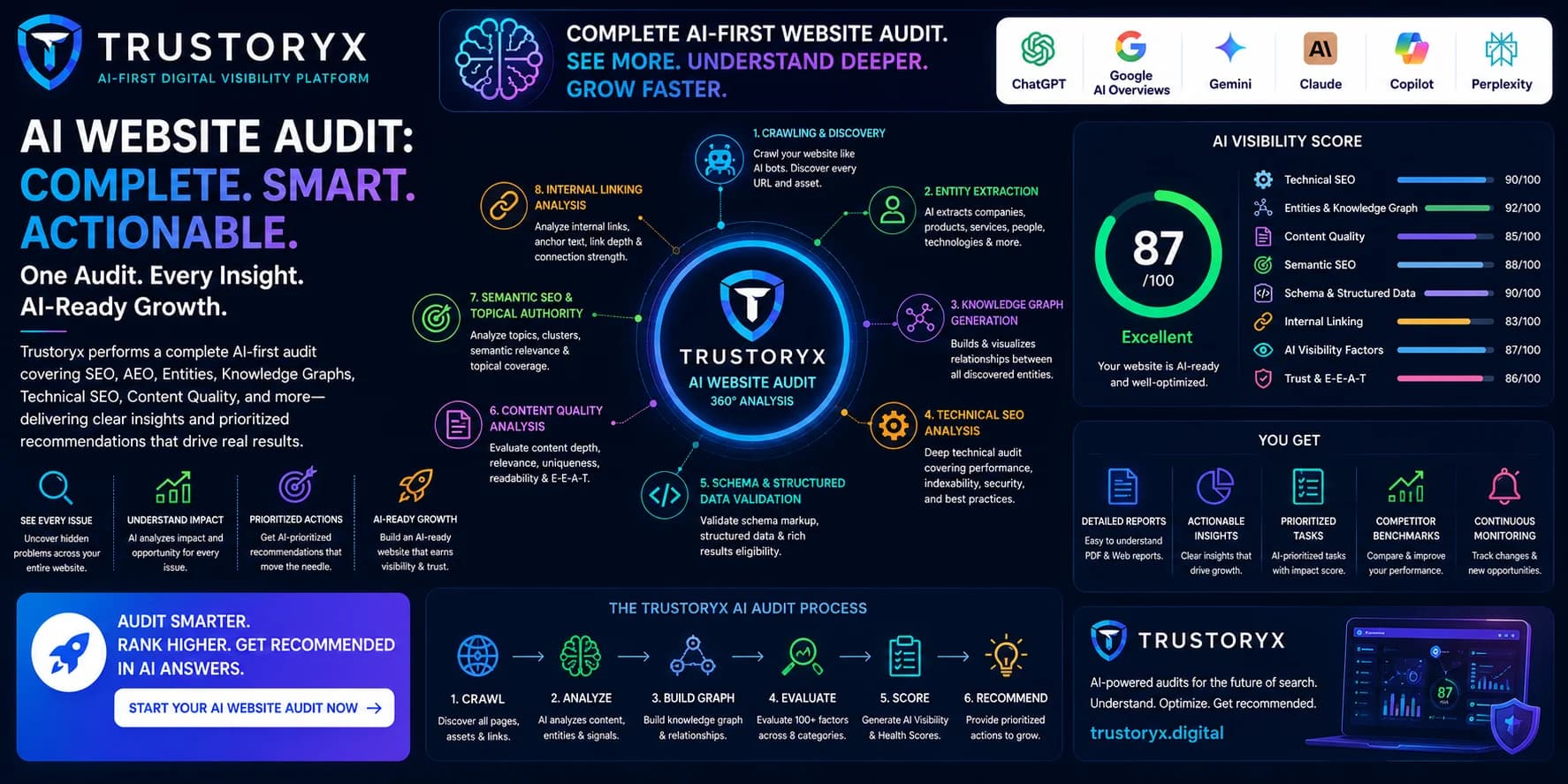
[!IMPORTANT]
Executive Summary: This document provides an in-depth technical analysis and strategic roadmap for AI Website Audit: How Trustoryx Performs a Complete AI-First SEO, AEO, Entity, Knowledge Graph, and Technical Website Analysis. Designed for technology leaders, engineering teams, and growth strategists aiming for maximum search authority and AI readiness.
System Architecture & Process Workflow
Introduction
For years, website audits focused on a limited set of SEO metrics such as page speed, metadata, backlinks, and keyword rankings. While these remain important, they no longer provide a complete picture of how a website performs in the age of artificial intelligence.
Today's search landscape is different.
Users increasingly discover businesses through AI-powered systems like ChatGPT, Google AI Overviews, Gemini, Claude, Microsoft Copilot, and Perplexity. These systems evaluate much more than keywords. They analyse entities, structured data, semantic relationships, technical quality, trust signals, topical authority, and overall website understanding.
A website may rank well in traditional search while still being difficult for AI systems to interpret.
Trustoryx was built to solve this problem.
The Trustoryx AI Website Audit is an AI-first analysis platform that evaluates every important aspect of a website from the perspective of both search engines and intelligent answer engines. Instead of simply listing problems, it identifies why they matter, how they affect AI understanding, and what actions should be taken first.
What Is an AI Website Audit?
An AI Website Audit is a comprehensive evaluation of how well a website can be:
- Crawled
- Indexed
- Understood
- Connected
- Trusted
- Recommended
Unlike traditional SEO audits, AI-first audits focus on machine understanding rather than only rankings.
The objective is simple:
Help AI understand your business as accurately as your customers do.
Why Traditional SEO Audits Are No Longer Enough
A typical SEO audit checks:
- Title tags
- Meta descriptions
- Page speed
- Broken links
- XML sitemaps
These are important, but AI systems also ask:
- Who is this business?
- Which products does it offer?
- Which services does it provide?
- Which industries does it specialise in?
- Is the content trustworthy?
- How are topics connected?
- Can this information answer user questions?
Traditional audits rarely answer these questions.
Trustoryx does.
The Trustoryx AI Audit Pipeline
Every website follows a structured analysis pipeline.
Website

↓

Crawling

↓

Technical Analysis

↓

Entity Extraction

↓

Knowledge Graph Generation

↓

Schema Validation

↓

Semantic Analysis

↓

Content Quality Analysis

↓

Internal Linking Analysis

↓

Trust Evaluation

↓

AI Visibility Score

↓

Prioritised Recommendations
Each stage builds on the previous one.
Step 1: Website Crawling
Everything begins with crawling.
Trustoryx discovers:
- Pages
- Images
- PDFs
- Documentation
- Blog posts
- Products
- Services
- Resources
The crawler maps the complete website structure before analysis begins.
Unlike many traditional crawlers, Trustoryx prepares the website for semantic analysis rather than only technical inspection.
Step 2: Technical SEO Analysis
Trustoryx performs a complete technical review.
Checks include:
- Crawlability
- Indexability
- Core Web Vitals
- HTTPS
- Mobile responsiveness
- XML Sitemap
- Robots.txt
- Canonical tags
- Redirect chains
- Broken links
- Duplicate pages
- Server errors
Each issue is scored according to its impact on both users and AI systems.
Step 3: Entity Extraction
Next, Trustoryx identifies every meaningful entity across the website.
Examples include:
Organisation
Products
Services
Technologies
Industries
People
Authors
Locations
Resources
Documentation
Case Studies
FAQs
Rather than treating pages as plain text, Trustoryx converts them into structured knowledge.
Step 4: Knowledge Graph Generation
After extracting entities, Trustoryx builds an AI-ready Knowledge Graph.
Example:
Trustoryx

↓

Provides

↓

Answer Engine Optimisation

↓

Uses

↓

Schema Markup

↓

Supports

↓

Knowledge Graph SEO

↓

Improves

↓

AI Visibility
The platform also identifies:
- Missing relationships
- Weak connections
- Duplicate entities
- Semantic gaps
Step 5: Schema Validation
Structured data is then analysed.
Trustoryx validates:
- Organization
- Product
- Service
- FAQ
- Article
- Person
- Breadcrumb
- Review
- SoftwareApplication
- LocalBusiness
The audit highlights:
- Missing schema
- Validation errors
- Incorrect implementation
- Rich result opportunities
Step 6: Semantic SEO Analysis
AI understands meaning rather than keywords.
Trustoryx evaluates:
- Topic coverage
- Semantic relevance
- Entity relationships
- Search intent alignment
- Context completeness
- Content hierarchy
Instead of keyword density, the platform measures semantic understanding.
Step 7: Content Quality Analysis
Every article is analysed using AI-first criteria.
Trustoryx measures:
- Clarity
- Readability
- Structure
- Answer completeness
- Entity coverage
- Examples
- FAQs
- Supporting resources
- Topical authority
The goal is to identify whether content genuinely helps users and AI systems understand the topic.
Step 8: Internal Linking Analysis
Internal links communicate relationships.
Trustoryx evaluates:
- Contextual links
- Topic clusters
- Orphan pages
- Anchor text
- Link depth
- Hub pages
- Content silos
Weak architecture often reduces AI understanding.
Step 9: Trust Analysis
Trust is essential for modern AI search.
Trustoryx reviews:
- Author pages
- Organisation information
- Contact details
- Privacy Policy
- Terms of Service
- Transparency
- Testimonials
- Case studies
- Structured author data
These elements contribute to an overall AI Trust Score.
Step 10: AI Visibility Score
All findings are combined into a single AI Visibility Score.
The score includes:
- Technical Health
- Entity Health
- Knowledge Graph Health
- Semantic SEO
- Content Quality
- Internal Linking
- Trust Signals
- Schema Quality
- AI Readability
- Retrieval Readiness
Businesses receive both an overall score and category-specific insights.
AI Visibility Dashboard
Trustoryx presents results in a visual dashboard.
Example sections include:
Overall AI Visibility
Technical Health
Entity Coverage
Knowledge Graph
Schema
Content Authority
Trust
Internal Links
Semantic SEO
AI Readability
The dashboard provides a quick overview while allowing deeper investigation into each category.
Prioritised Recommendations
Not every issue has equal importance.
Trustoryx classifies findings into:
Critical
Problems that significantly reduce crawlability, indexing, or AI understanding.
High Priority
Improvements with strong impact on visibility and semantic clarity.
Medium Priority
Enhancements that improve quality and completeness.
Low Priority
Minor refinements that contribute to long-term optimisation.
This helps teams focus on the most valuable work first.
Reports for Different Teams
Different stakeholders need different information.
Executive Report
Designed for business leaders.
Includes:
- Overall AI Visibility Score
- Key risks
- Business impact
- Strategic recommendations
Marketing Report
Designed for content teams.
Includes:
- Topic gaps
- Content opportunities
- FAQ recommendations
- Semantic improvements
- Internal linking suggestions
Technical Report
Designed for developers.
Includes:
- Crawl issues
- Schema validation
- Performance recommendations
- Technical errors
- Implementation guidance
AI Readiness Report
Designed for organisations preparing for AI-powered search.
Includes:
- Entity coverage
- Knowledge Graph maturity
- Retrieval readiness
- Trust analysis
- AI optimisation roadmap
Competitive Benchmarking
Understanding your own website is important.
Understanding competitors is equally valuable.
Trustoryx can compare websites based on:
- AI Visibility Score
- Technical Health
- Entity Coverage
- Content Authority
- Schema Quality
- Knowledge Graph Strength
- Trust Signals
This helps businesses identify opportunities to differentiate themselves.
Continuous Monitoring
Websites evolve continuously.
Trustoryx supports ongoing monitoring by tracking:
- New pages
- Technical issues
- Entity growth
- Knowledge Graph changes
- Schema improvements
- Content expansion
- AI Visibility trends
Regular monitoring helps organisations adapt as search technologies evolve.
Why Businesses Need AI Website Audits
Modern websites must communicate effectively with both humans and intelligent systems.
An AI Website Audit helps organisations:
- Understand how AI interprets their content
- Improve website structure
- Strengthen semantic relationships
- Build trust
- Expand topical authority
- Prepare for AI-powered search experiences
Rather than replacing traditional SEO, AI-first auditing extends it.
How Trustoryx Is Different
Most website auditing platforms focus on isolated technical metrics.
Trustoryx combines multiple disciplines into a single AI-first platform:
- Technical SEO
- Answer Engine Optimisation
- Entity SEO
- Knowledge Graph SEO
- Semantic SEO
- Content Intelligence
- Structured Data
- Trust Analysis
- AI Visibility
The result is a more complete understanding of how a website performs in modern search environments.
The Future of Website Audits
As AI continues to reshape digital discovery, website audits must evolve beyond rankings and keywords.
Future audits will increasingly focus on:
- Machine understanding
- Knowledge organisation
- Semantic relationships
- Trustworthiness
- Structured information
- AI readiness
Businesses that adopt these principles early will be better prepared for the next generation of search.
Conclusion
The way websites are evaluated is changing.
Traditional SEO remains an essential foundation, but AI-powered search requires a broader understanding of content, entities, trust, and relationships.
The Trustoryx AI Website Audit provides that broader perspective by combining technical diagnostics, semantic analysis, entity extraction, knowledge graph generation, structured data validation, and AI visibility measurement into one comprehensive platform.
Instead of producing long lists of isolated issues, Trustoryx delivers clear, prioritised insights that help businesses improve their websites for both people and AI systems.
As answer engines become an increasingly important source of online discovery, organisations that understand how AI interprets their websites will be better positioned to build authority, increase visibility, and earn long-term trust in the future of search.
Frequently Asked Questions (FAQ)
What makes ai website audit: how trustoryx performs a complete ai-first seo, aeo, entity, knowledge graph, and technical website analysis critical for digital success in 2026?
With search evolving towards direct answer generation by AI assistants (ChatGPT, Claude, Gemini, Perplexity) and Google AI Overviews, optimizing for ai website audit: how trustoryx performs a complete ai-first seo, aeo, entity, knowledge graph, and technical website analysis ensures your brand is understood, trusted, and recommended directly as the primary answer rather than lost in traditional link results.
How does Trustoryx implement solutions for ai website audit: how trustoryx performs a complete ai-first seo, aeo, entity, knowledge graph, and technical website analysis?
Trustoryx applies an engineering-first methodology combining structured data schema, entity extraction, knowledge graph modeling, performance tuning, and AI readability optimization to ensure full machine comprehension and authority.
How long does it take to see measurable results from ai website audit: how trustoryx performs a complete ai-first seo, aeo, entity, knowledge graph, and technical website analysis optimization?
Most websites experience noticeable improvements in AI discovery, crawl efficiency, and citation frequency within 30 to 90 days following technical implementation and knowledge graph alignment.
Technical Schema & Structured Data
{
  "@context": "https://schema.org",
  "@type": "TechArticle",
  "headline": "AI Website Audit: How Trustoryx Performs a Complete AI-First SEO, AEO, Entity, Knowledge Graph, and Technical Website Analysis",
  "description": "AI Website Audit: How Trustoryx Performs a Complete AI-First SEO, AEO, Entity, Knowledge Graph, and Technical Website Analysis",
  "author": {
    "@type": "Person",
    "name": "Nikhil Kumar",
    "jobTitle": "Principal Architect & Founder",
    "worksFor": {
      "@type": "Organization",
      "name": "Trustoryx",
      "url": "https://www.trustoryx.digital"
    }
  },
  "publisher": {
    "@type": "Organization",
    "name": "Trustoryx",
    "url": "https://www.trustoryx.digital",
    "logo": "https://www.trustoryx.digital/logo.png"
  },
  "mainEntityOfPage": "https://www.trustoryx.digital/blog/ai-website-audit-complete-analysis",
  "inLanguage": "en-US"
}Frequently Asked Questions
Need Expert Help with ai website audit: how trustoryx performs a complete ai-first seo, aeo, entity, knowledge graph, and technical website analysis?
Get a free 30-point audit from our engineering team.
Get Free AuditRelated Articles
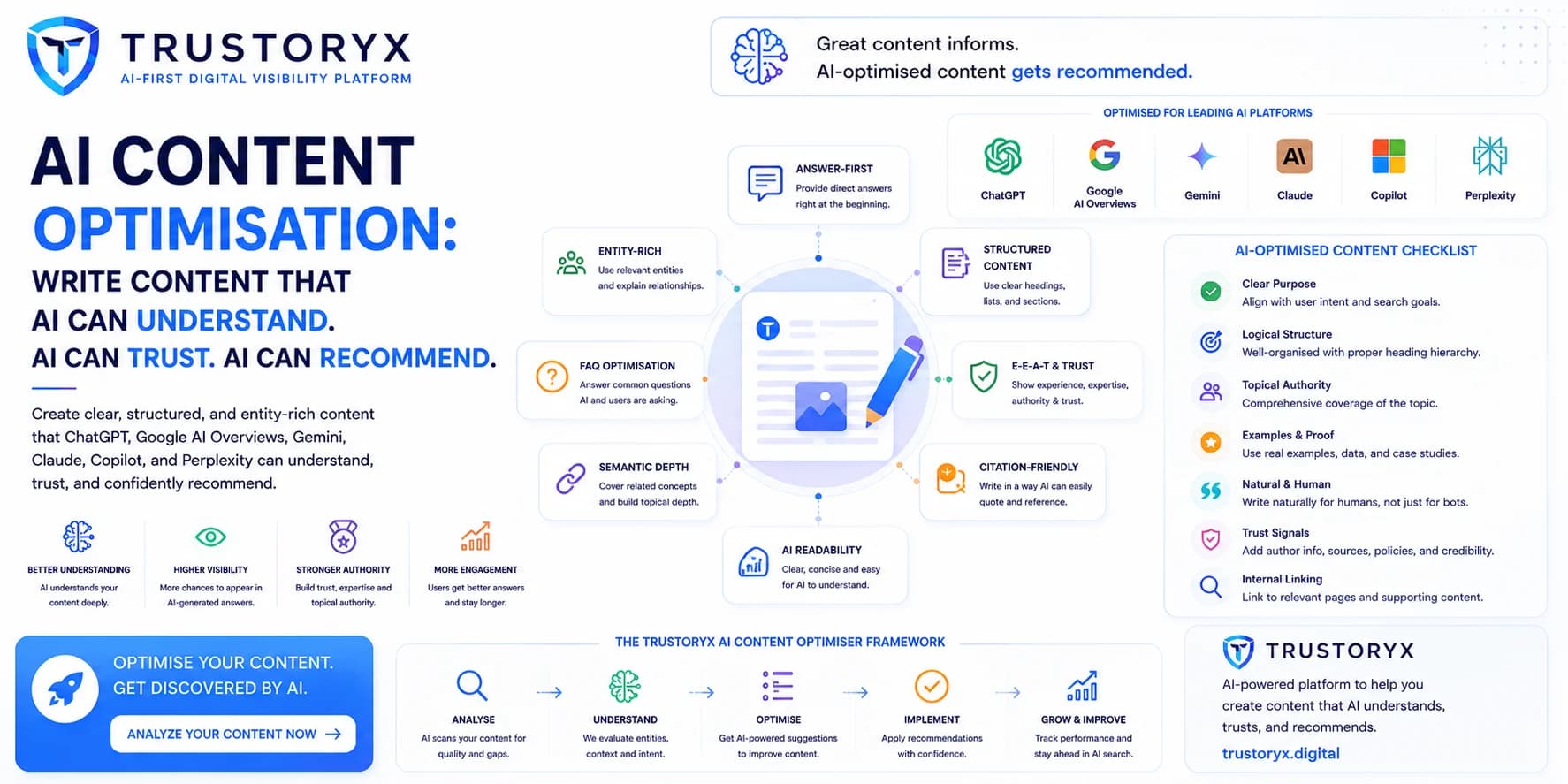
AI Content Optimisation: How to Write Content That ChatGPT, Google AI Overviews, Gemini, Claude, Copilot, and Perplexity Can Understand and Recommend
Introduction The internet is entering a new era. For decades, businesses created content primarily for search engines. Success depended on keywords, backli...
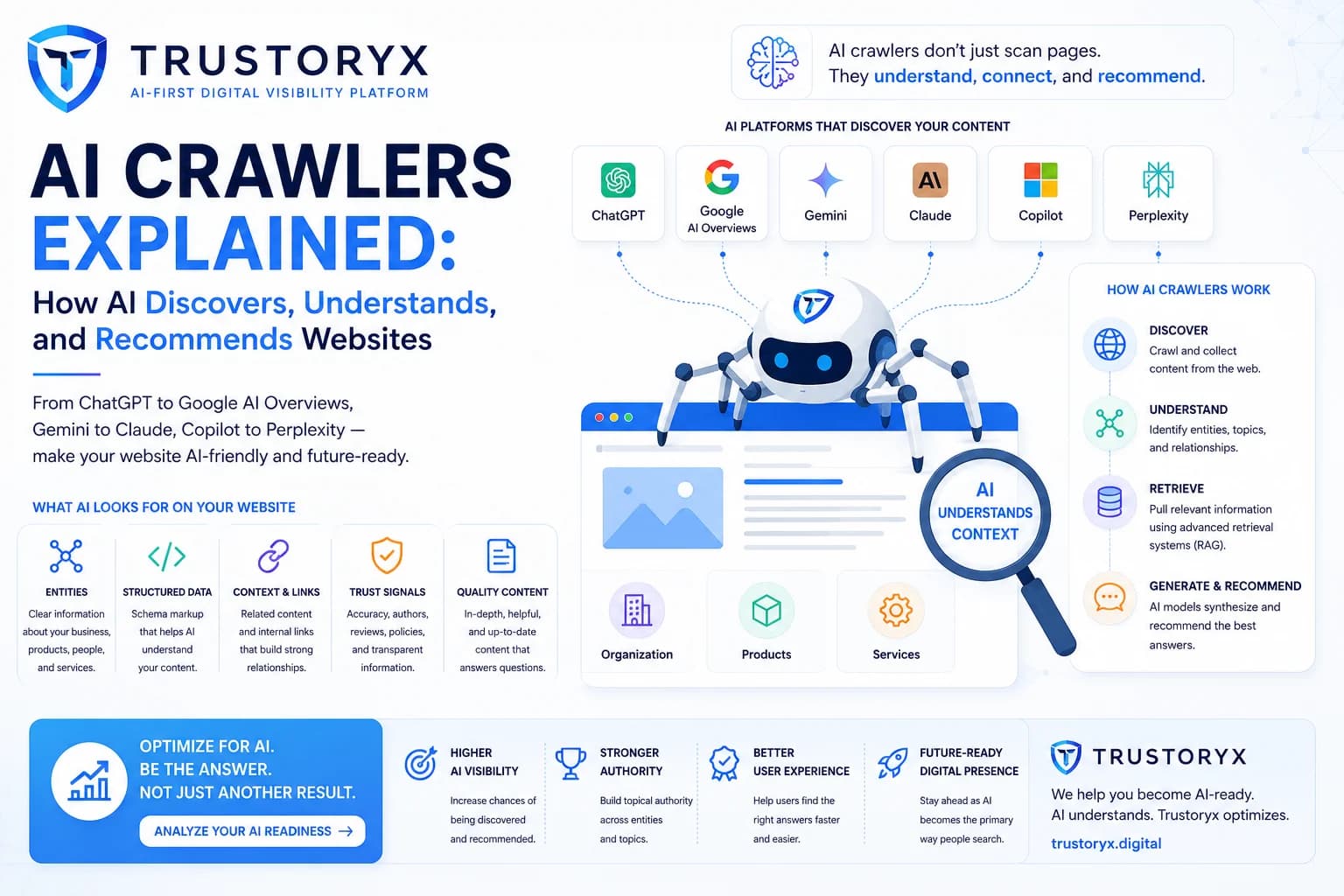
AI Crawlers Explained: How ChatGPT, Google AI Overviews, Gemini, Claude, Copilot, and Perplexity Discover and Understand Websites
Introduction For more than two decades, website owners optimised for one primary crawler: Googlebot. The objective was simple. Make your website easy to cr...
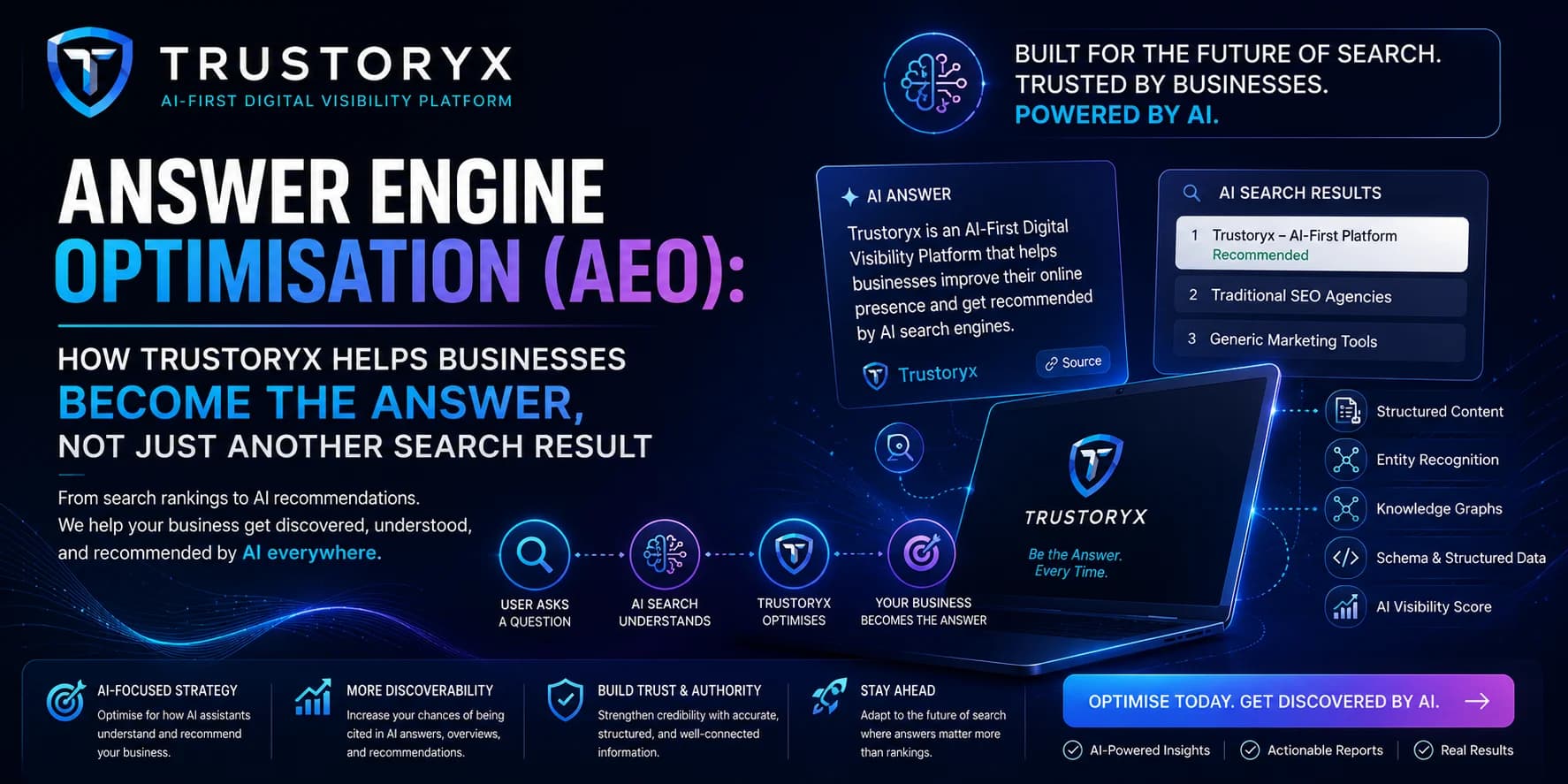
Answer Engine Optimisation (AEO): How Trustoryx Helps Businesses Become the Answer, Not Just Another Search Result
Introduction For over twenty years, businesses have competed for one goal: ranking on the first page of search engines. Entire industries were built around...
Ready to Scale Your Search & Revenue?
Attract, Convert & Dominate Globally.
Get a complimentary 30-point SEO and Growth Audit. We identify competitor gaps, technical bottlenecks, and actionable quick wins in 48 hours.