Entity Extraction Engine: How Trustoryx Uses AI to Discover Every Company, Product, Service, Technology, Person, and Industry on Your Website
Introduction Every website contains valuable information. Company names. Products. Services. Technologies. Industries. People. Locations. Articles. Case st...
[!IMPORTANT]
Executive Summary: This document provides an in-depth technical analysis and strategic roadmap for Entity Extraction Engine: How Trustoryx Uses AI to Discover Every Company, Product, Service, Technology, Person, and Industry on Your Website. Designed for technology leaders, engineering teams, and growth strategists aiming for maximum search authority and AI readiness.
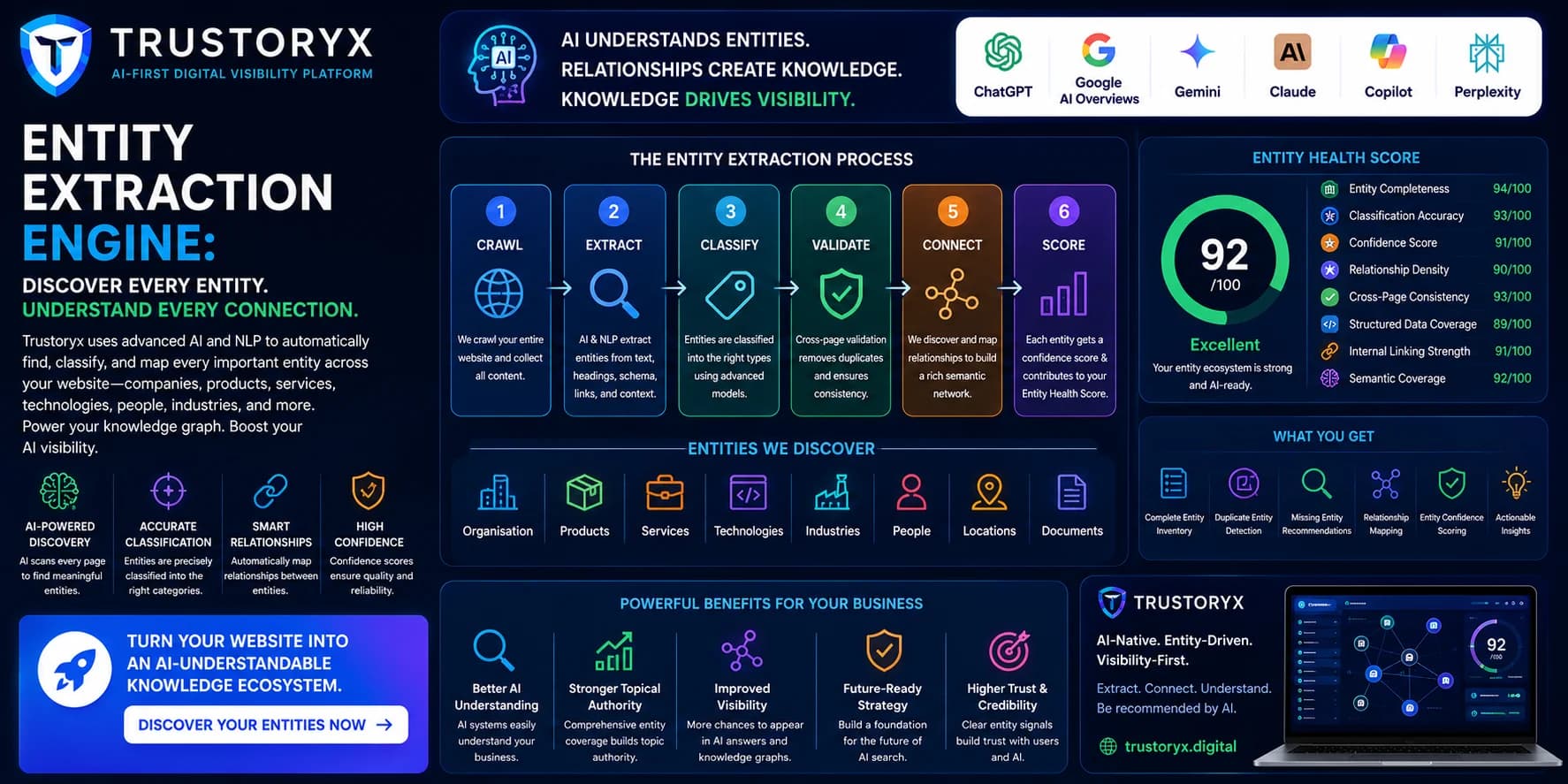
System Architecture & Process Workflow
Introduction
Every website contains valuable information.
Company names.
Products.
Services.
Technologies.
Industries.
People.
Locations.
Articles.
Case studies.
Documentation.
To humans, identifying these is straightforward.
Artificial intelligence, however, needs structured understanding.
Before an AI system can recommend your business, it must first answer questions such as:
- Who owns this website?
- What products does it offer?
- Which services does it provide?
- What technologies does it use?
- Which industries does it serve?
- Who are its authors?
- What topics does it specialise in?
The process of automatically identifying these important pieces of information is called Entity Extraction.
Entity Extraction is one of the most important building blocks of modern Answer Engine Optimisation (AEO), Knowledge Graph SEO, and Semantic Search.
Trustoryx includes an AI-powered Entity Extraction Engine that automatically discovers, classifies, validates, and connects every important entity across a website.
What Is Entity Extraction?
Entity Extraction is the process of identifying meaningful objects within content.
These objects are called entities.
Instead of reading text like humans do, AI identifies structured concepts.
Example:
Trustoryx provides Answer Engine Optimisation services using Knowledge Graphs and Schema Markup.
The Entity Extraction Engine identifies:
Organisation
→ Trustoryx
Service
→ Answer Engine Optimisation
Technology
→ Knowledge Graph
Technology
→ Schema Markup
Rather than seeing one sentence, AI sees structured knowledge.
Why Entity Extraction Matters
Modern AI systems understand relationships.
Before relationships can exist, entities must first be discovered.
Without entities:
Website
↓
Text
↓
No structure
With entities:
Organisation
↓
Services
↓
Products
↓
Technologies
↓
Relationships
↓
Knowledge Graph
↓
AI Understanding
Entity Extraction transforms content into knowledge.
Types of Entities Trustoryx Discovers
Trustoryx automatically detects multiple categories.
Organisation
Business name
Parent company
Subsidiary
Brand
Startup
Agency
Products
Software
Applications
Chrome Extensions
Platforms
APIs
Tools
SaaS Products
Services
Technical SEO
Answer Engine Optimisation
Entity SEO
Knowledge Graph SEO
Content Optimisation
Website Audits
Consulting
Development
Technologies
Flutter
React
Node.js
Python
PostgreSQL
Docker
Kubernetes
JSON-LD
Schema Markup
Industries
Healthcare
Finance
Retail
Education
Manufacturing
Government
SaaS
E-commerce
People
Founders
Authors
Engineers
Researchers
Consultants
Leadership
Locations
Countries
Cities
Regions
Headquarters
Branches
Service Areas
Documents
Articles
Documentation
Case Studies
Whitepapers
FAQs
Guides
Tutorials
Named Entity Recognition (NER)
Entity Extraction relies on techniques commonly known as Named Entity Recognition (NER).
NER helps distinguish between different kinds of entities.
Example:
Apple
Could mean:
Fruit
or
Technology Company
Context determines the meaning.
Trustoryx analyses surrounding content before classifying entities.
Entity Classification
Finding an entity is only the first step.
Trustoryx also determines what type of entity it is.
Example:
Trustoryx
↓
Organisation
Answer Engine Optimisation
↓
Service
Trustoryx SEO Analyzer
↓
Software Product
Flutter
↓
Technology
Correct classification improves semantic understanding.
Cross-Page Validation
One mention of an entity may not be enough.
Trustoryx validates entities across the entire website.
Example:
Homepage
↓
Trustoryx SEO Analyzer
Product Page
↓
Trustoryx SEO Analyzer
Documentation
↓
Trustoryx SEO Analyzer
Blog
↓
Trustoryx SEO Analyzer
The platform confirms that all references describe the same entity.
Entity Confidence Score
Not every extracted entity has the same certainty.
Trustoryx calculates a confidence score using signals such as:
- Heading placement
- Structured data
- Internal links
- Frequency
- Semantic context
- Cross-page consistency
- Relationship density
Higher confidence means the entity is more clearly defined.
Duplicate Entity Detection
Many websites accidentally create duplicate entities.
Example:
AI SEO
Artificial Intelligence SEO
AI Search Optimisation
Generative SEO
If these terms are intended to describe the same concept, inconsistent naming can reduce clarity.
Trustoryx detects duplicate or overlapping entities and recommends consistent terminology.
Entity Relationships
Entities become more valuable when connected.
Example:
Trustoryx
↓
Provides
↓
Answer Engine Optimisation
↓
Uses
↓
Knowledge Graphs
↓
Improves
↓
AI Visibility
↓
Benefits
↓
Businesses
Relationship mapping forms the basis of a Knowledge Graph.
Entity Health Score
Trustoryx measures overall entity quality.
The Entity Health Score evaluates:
- Completeness
- Classification accuracy
- Confidence
- Relationships
- Structured data
- Consistency
- Internal linking
- Semantic coverage
This helps organisations understand how effectively AI can interpret their website.
Missing Entity Detection
Many businesses overlook important entities.
Examples include:
Missing Products
Missing Authors
Missing Industries
Missing Services
Missing Technologies
Missing Documentation
Missing FAQs
Trustoryx highlights these gaps automatically.
Entity Recommendations
After analysis, Trustoryx suggests improvements.
Examples:
Create a dedicated service page.
Add Product Schema.
Expand documentation.
Link related articles.
Create author profiles.
Publish industry pages.
Strengthen internal linking.
These recommendations improve semantic clarity.
Building AI-Ready Content
Entity-rich content helps AI understand expertise.
Instead of writing:
"We help businesses."
Write:
"Trustoryx provides Answer Engine Optimisation, Entity SEO, Knowledge Graph SEO, Technical SEO, and AI Visibility Audits for SaaS companies, enterprises, and e-commerce businesses."
The second version contains identifiable entities and relationships.
Visual Entity Maps
Trustoryx generates visual entity diagrams.
Organisation
↓
Products
↓
Services
↓
Technologies
↓
Industries
↓
Articles
↓
Documentation
↓
FAQs
Users can immediately understand the structure of their website.
Entity Extraction for Different Industries
SaaS
Products
APIs
Documentation
Pricing
Integrations
Healthcare
Treatments
Specialists
Conditions
Facilities
E-commerce
Products
Brands
Categories
Collections
Education
Courses
Instructors
Subjects
Learning Resources
Professional Services
Services
Industries
Case Studies
Methodologies
AI Search Depends on Entities
When users ask AI:
Which companies provide Knowledge Graph SEO?
The answer depends on whether AI can identify:
Organisation
↓
Trustoryx
Service
↓
Knowledge Graph SEO
Without entity recognition, AI cannot confidently connect the business with the service.
Common Entity Problems
Trustoryx frequently identifies:
- Missing entities
- Duplicate entities
- Weak descriptions
- Inconsistent naming
- No structured data
- Poor internal linking
- Missing relationships
- Thin documentation
These issues reduce AI understanding.
How Trustoryx Helps
The Entity Extraction Engine automatically:
- Scans every webpage
- Identifies entities
- Classifies entities
- Calculates confidence scores
- Detects duplicates
- Finds missing entities
- Builds relationships
- Generates Knowledge Graphs
- Recommends improvements
- Measures entity health
The process requires minimal manual effort while providing a structured view of the website's knowledge.
The Future of Entity-Based Search
Search engines and AI systems are moving away from keyword matching and toward understanding entities and relationships.
As AI becomes a primary interface for discovering information, businesses that clearly define and connect their entities will have a stronger foundation for visibility, trust, and semantic understanding.
Entity Extraction is becoming a core capability for AI-ready websites.
Conclusion
Entity Extraction transforms unstructured website content into organised knowledge that AI systems can understand.
By identifying organisations, services, products, technologies, industries, people, and their relationships, Trustoryx helps businesses build a stronger semantic foundation for modern search.
Combined with Knowledge Graphs, Schema Markup, Technical SEO, and Answer Engine Optimisation, the Trustoryx Entity Extraction Engine enables websites to communicate their expertise more clearly to both humans and intelligent systems.
As AI-powered search continues to evolve, businesses that organise their information around entities rather than keywords will be better positioned to earn visibility, credibility, and long-term digital authority.
Frequently Asked Questions (FAQ)
What makes entity extraction engine: how trustoryx uses ai to discover every company, product, service, technology, person, and industry on your website critical for digital success in 2026?
With search evolving towards direct answer generation by AI assistants (ChatGPT, Claude, Gemini, Perplexity) and Google AI Overviews, optimizing for entity extraction engine: how trustoryx uses ai to discover every company, product, service, technology, person, and industry on your website ensures your brand is understood, trusted, and recommended directly as the primary answer rather than lost in traditional link results.
How does Trustoryx implement solutions for entity extraction engine: how trustoryx uses ai to discover every company, product, service, technology, person, and industry on your website?
Trustoryx applies an engineering-first methodology combining structured data schema, entity extraction, knowledge graph modeling, performance tuning, and AI readability optimization to ensure full machine comprehension and authority.
How long does it take to see measurable results from entity extraction engine: how trustoryx uses ai to discover every company, product, service, technology, person, and industry on your website optimization?
Most websites experience noticeable improvements in AI discovery, crawl efficiency, and citation frequency within 30 to 90 days following technical implementation and knowledge graph alignment.
Technical Schema & Structured Data
{
  "@context": "https://schema.org",
  "@type": "TechArticle",
  "headline": "Entity Extraction Engine: How Trustoryx Uses AI to Discover Every Company, Product, Service, Technology, Person, and Industry on Your Website",
  "description": "Entity Extraction Engine: How Trustoryx Uses AI to Discover Every Company, Product, Service, Technology, Person, and Industry on Your Website",
  "author": {
    "@type": "Person",
    "name": "Nikhil Kumar",
    "jobTitle": "Principal Architect & Founder",
    "worksFor": {
      "@type": "Organization",
      "name": "Trustoryx",
      "url": "https://www.trustoryx.digital"
    }
  },
  "publisher": {
    "@type": "Organization",
    "name": "Trustoryx",
    "url": "https://www.trustoryx.digital",
    "logo": "https://www.trustoryx.digital/logo.png"
  },
  "mainEntityOfPage": "https://www.trustoryx.digital/blog/entity-extraction-engine",
  "inLanguage": "en-US"
}Frequently Asked Questions
Need Expert Help with entity extraction engine: how trustoryx uses ai to discover every company, product, service, technology, person, and industry on your website?
Get a free 30-point audit from our engineering team.
Get Free AuditRelated Articles
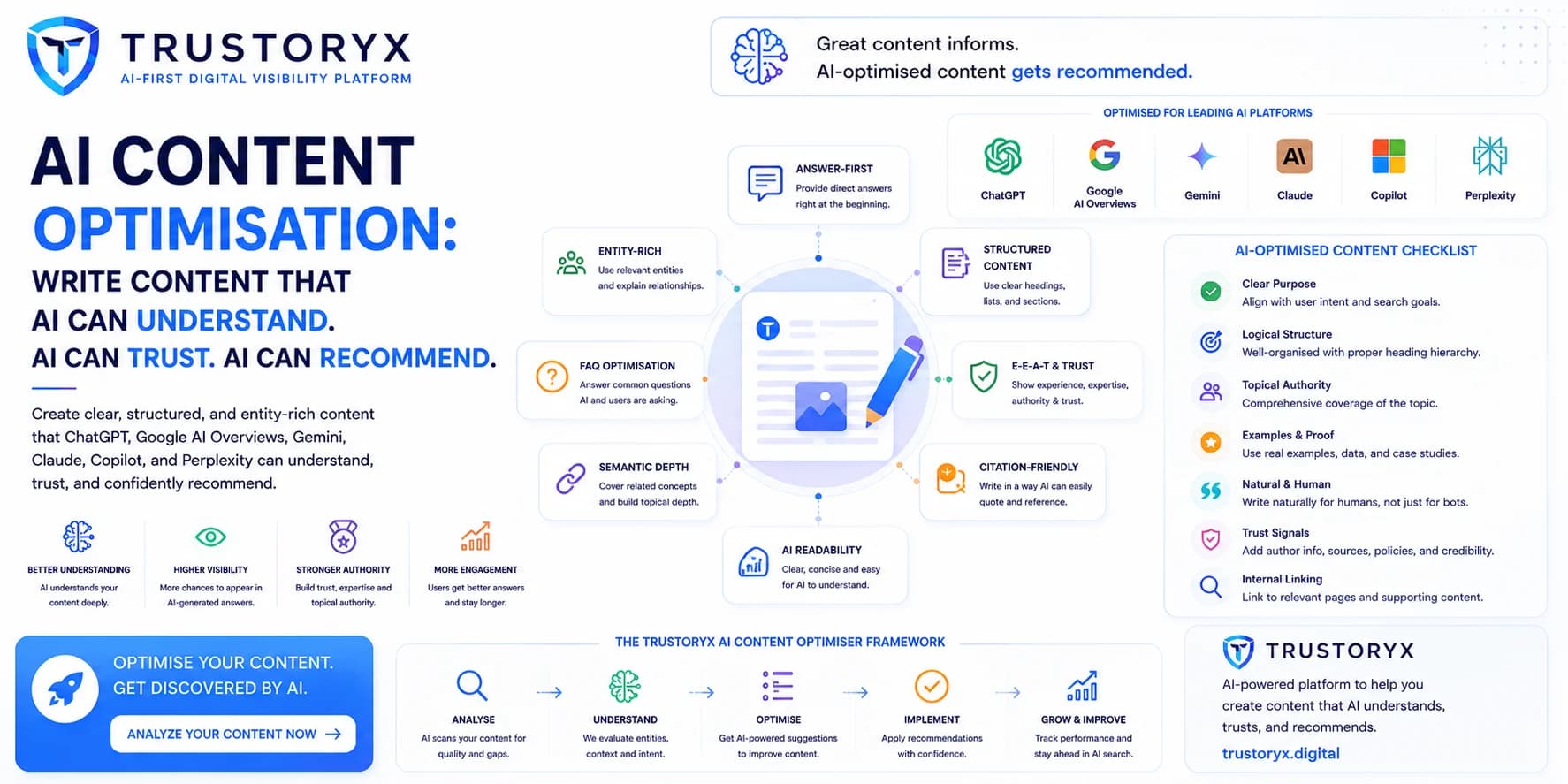
AI Content Optimisation: How to Write Content That ChatGPT, Google AI Overviews, Gemini, Claude, Copilot, and Perplexity Can Understand and Recommend
Introduction The internet is entering a new era. For decades, businesses created content primarily for search engines. Success depended on keywords, backli...
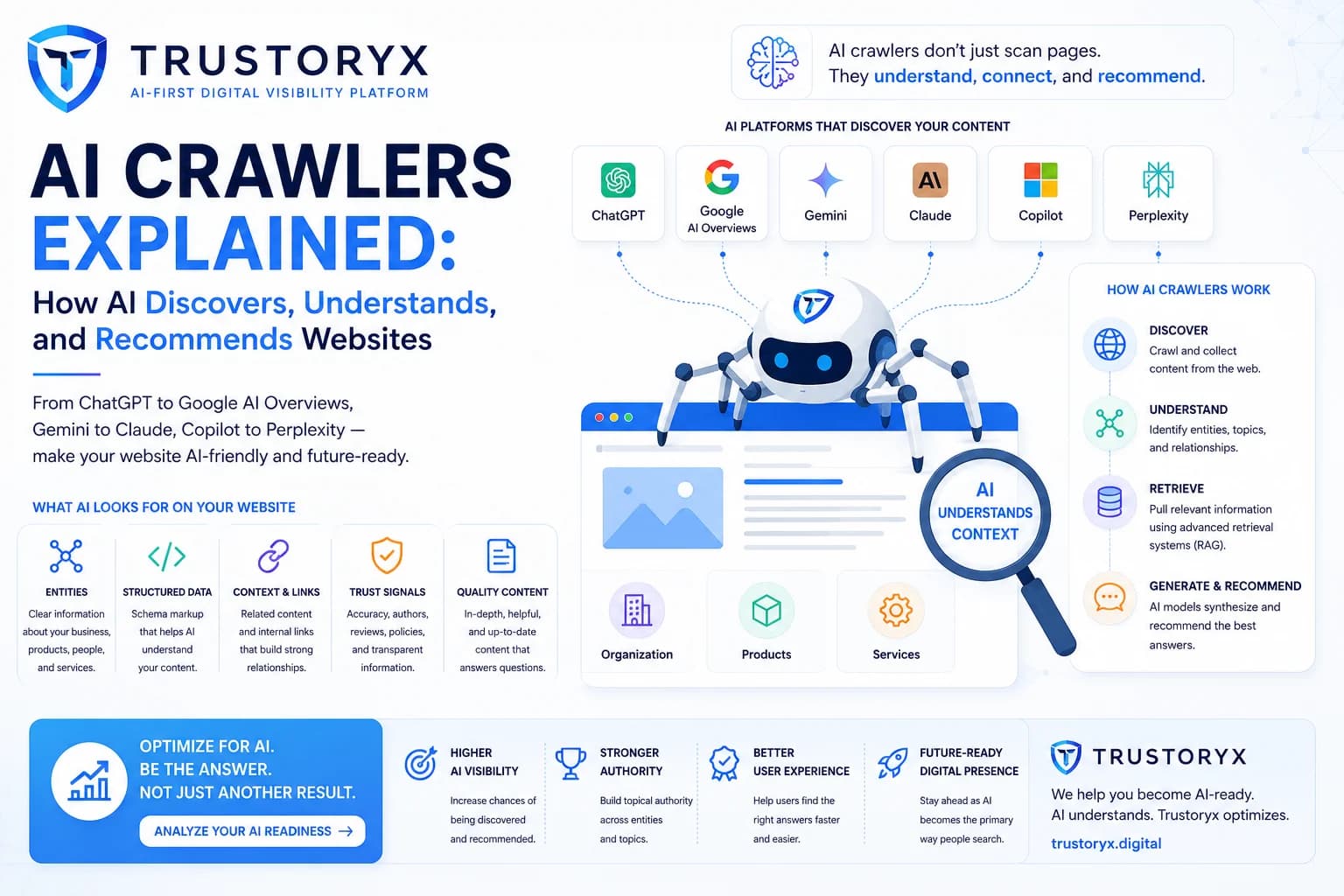
AI Crawlers Explained: How ChatGPT, Google AI Overviews, Gemini, Claude, Copilot, and Perplexity Discover and Understand Websites
Introduction For more than two decades, website owners optimised for one primary crawler: Googlebot. The objective was simple. Make your website easy to cr...
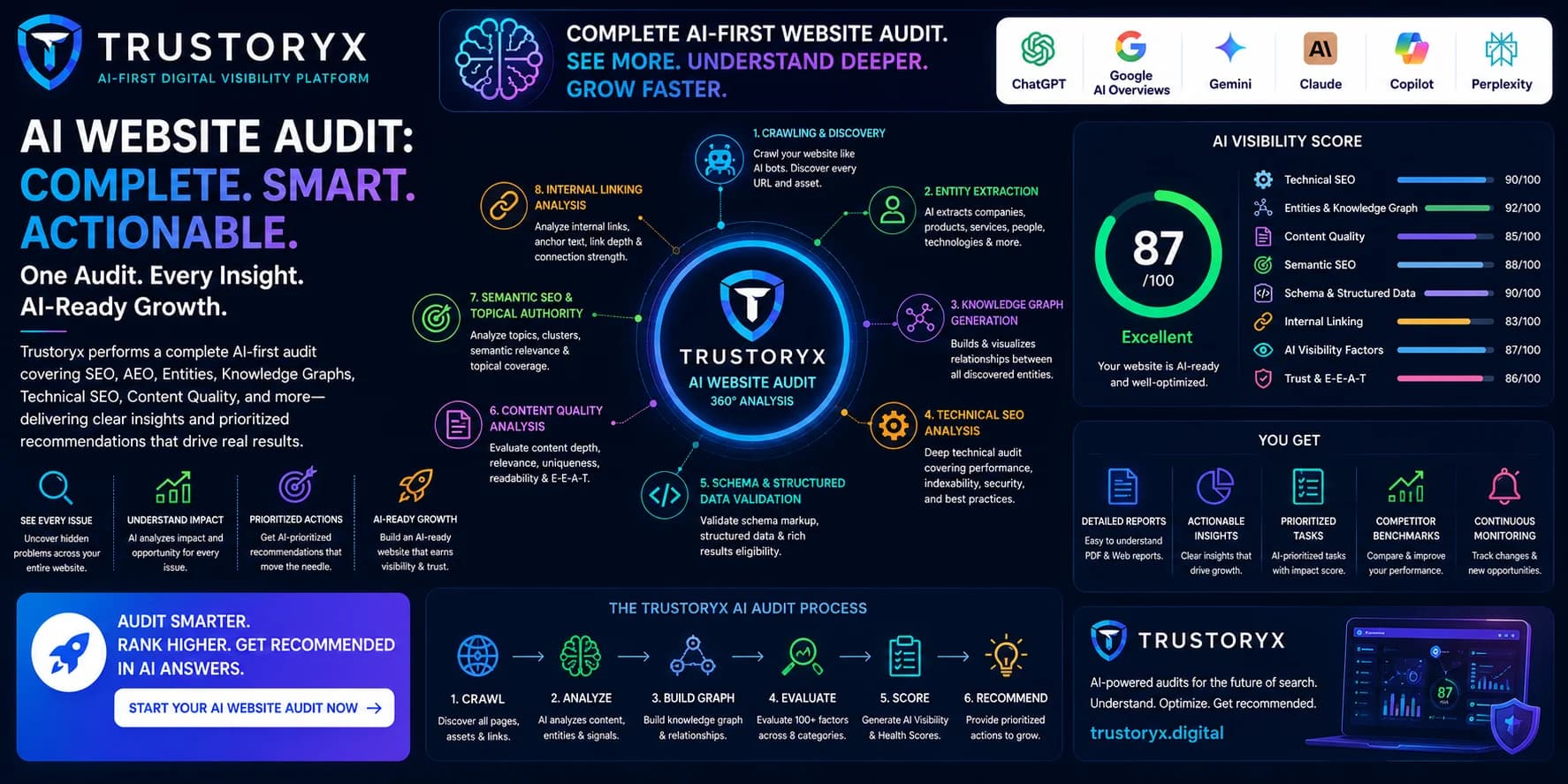
AI Website Audit: How Trustoryx Performs a Complete AI-First SEO, AEO, Entity, Knowledge Graph, and Technical Website Analysis
Introduction For years, website audits focused on a limited set of SEO metrics such as page speed, metadata, backlinks, and keyword rankings. Learn how Trustoryx conducts full AI-first audits.
Ready to Scale Your Search & Revenue?
Attract, Convert & Dominate Globally.
Get a complimentary 30-point SEO and Growth Audit. We identify competitor gaps, technical bottlenecks, and actionable quick wins in 48 hours.