Entity SEO: The Complete Guide to How AI Identifies Companies, Products, Services, and Brands
Introduction Search engines are no longer limited to matching keywords with web pages. Modern AI systems understand the world through entities and the rela...
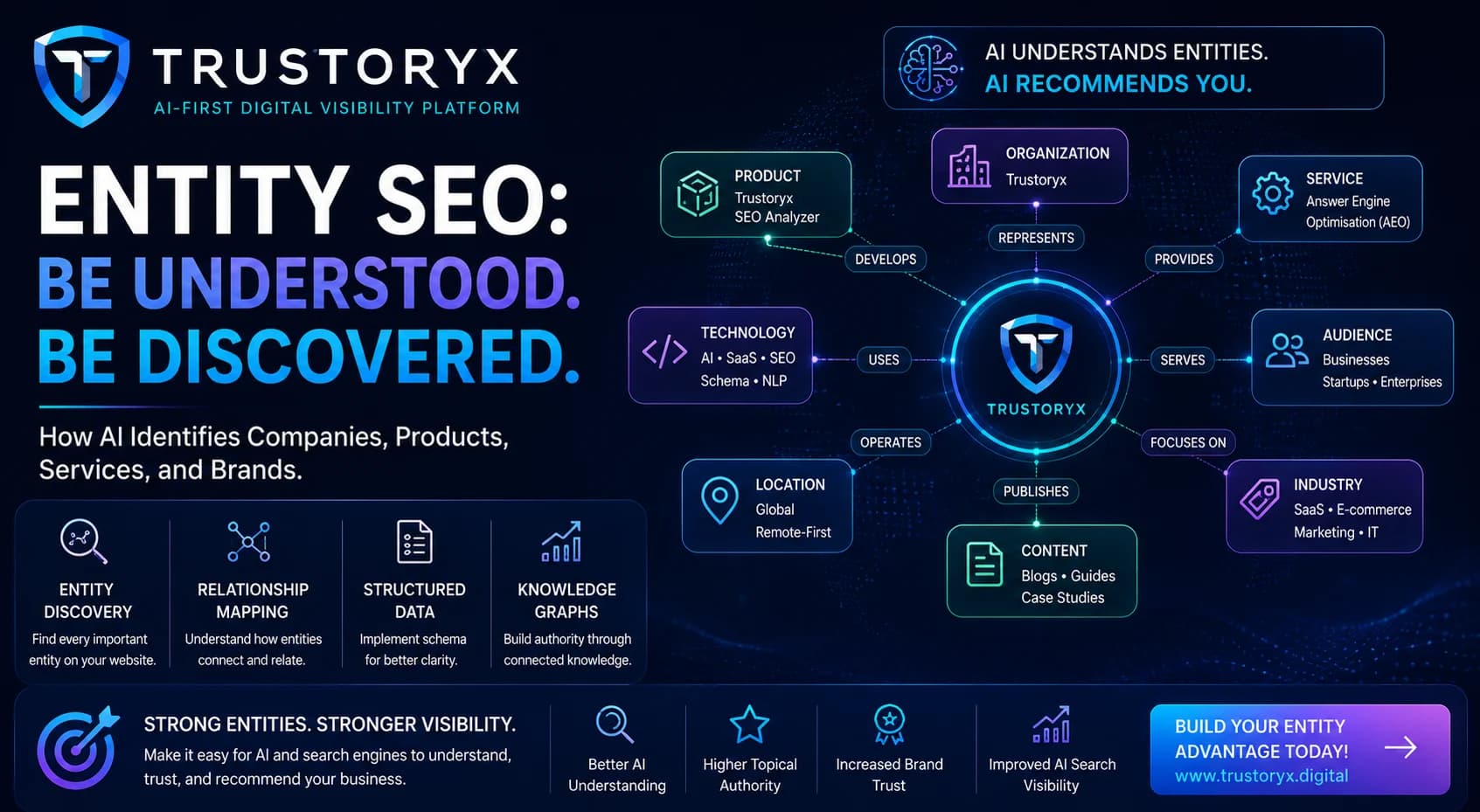
[!IMPORTANT]
Executive Summary: This document provides an in-depth technical analysis and strategic roadmap for Entity SEO: The Complete Guide to How AI Identifies Companies, Products, Services, and Brands. Designed for technology leaders, engineering teams, and growth strategists aiming for maximum search authority and AI readiness.
System Architecture & Process Workflow
Introduction
Search engines are no longer limited to matching keywords with web pages. Modern AI systems understand the world through entities and the relationships between them. Every company, product, service, technology, location, person, and concept can become an entity within an AI knowledge graph.
When someone asks ChatGPT:
"Which companies provide Answer Engine Optimisation?"
The AI is not simply looking for pages containing the phrase "Answer Engine Optimisation." Instead, it identifies organisations that are strongly associated with that service, evaluates their expertise, and generates an answer based on structured knowledge.
This is why Entity SEO has become one of the most important foundations of Answer Engine Optimisation (AEO).
Trustoryx helps businesses transform their websites into structured knowledge bases where every important entity is clearly defined, connected, and optimised for AI understanding.
What Is Entity SEO?
Entity SEO is the process of organising and optimising information so search engines and AI systems can clearly identify and understand every important entity related to a business.
Unlike traditional SEO, which focuses heavily on keywords, Entity SEO focuses on meaning.
For example, consider these two sentences:
Keyword-focused:
We provide the best SEO services for businesses looking for SEO services.
Entity-focused:
Trustoryx provides Technical SEO, Answer Engine Optimisation (AEO), schema implementation, AI visibility consulting, and website auditing for SaaS companies, e-commerce businesses, and enterprises.
The second version clearly identifies:
- Organisation
- Services
- Industries
- Technologies
- Business relationships
This provides AI with much richer information.
What Is an Entity?
An entity is anything that has a unique identity.
Examples include:
Organisations
- Trustoryx
- OpenAI
- Microsoft
Products
- Trustoryx SEO Analyzer
- ChatGPT
- Google Workspace
Services
- Technical SEO
- Mobile App Development
- AI Consulting
- Cloud Migration
Technologies
- Flutter
- React
- Kubernetes
- PostgreSQL
Industries
- Healthcare
- FinTech
- Education
- Retail
People
- Founders
- Authors
- Developers
- Consultants
Locations
- Delhi
- London
- New York
AI systems use these entities to build a structured understanding of your business.
Why Keywords Are No Longer Enough
For years, SEO strategies revolved around repeating target keywords throughout a page.
Modern AI systems look beyond repetition.
They evaluate:
- Context
- Relationships
- Expertise
- Consistency
- Authority
- Structured data
For example, if your article mentions:
- Flutter
- Dart
- Android
- Firebase
- Material Design
AI understands the article is genuinely about Flutter development, even if the keyword "Flutter App Development" appears only a few times.
How AI Builds Knowledge
Imagine your website contains the following information:
Company
Trustoryx
Offers
Technical SEO
Offers
Answer Engine Optimisation
Develops
Trustoryx SEO Analyzer
Uses
Knowledge Graphs
Implements
Schema Markup
Supports
Google AI Overviews
Every connection strengthens AI understanding.
Instead of isolated pages, AI builds a network of knowledge.
The Role of Knowledge Graphs
Knowledge graphs connect entities together.
Example:
Trustoryx
↓
Provides
↓
Technical SEO
↓
Improves
↓
Website Visibility
↓
Uses
↓
Schema Markup
↓
Supports
↓
AI Search
Knowledge graphs allow AI to answer questions such as:
- Which companies provide AI SEO?
- Which software supports schema markup?
- Which services improve AI visibility?
How Trustoryx Identifies Entities
Trustoryx analyses every page on a website and extracts entities from multiple categories.
Organisation Entities
Business names
Brands
Parent companies
Subsidiaries
Business descriptions
Product Entities
Product names
Software
Applications
Tools
Platforms
Pricing pages
Documentation
Service Entities
Consulting
Development
Marketing
Design
Support
Maintenance
Training
Technology Entities
Programming languages
Frameworks
Databases
Cloud providers
APIs
Libraries
Platforms
Industry Entities
Healthcare
Education
Retail
Government
Manufacturing
Finance
Entity Relationships
An entity alone has limited value.
Relationships provide meaning.
Example:
Trustoryx
Provides
↓
Answer Engine Optimisation
Uses
↓
Entity SEO
Uses
↓
Schema
Improves
↓
AI Visibility
Supports
↓
Businesses
AI understands both the entities and how they interact.
Common Entity SEO Mistakes
Many businesses unintentionally reduce AI visibility by making avoidable mistakes.
Examples include:
- Using different company names across pages
- Changing terminology frequently
- Mixing product and service names
- Missing author information
- No organisation schema
- Duplicate service pages
- Poor internal linking
- No FAQs
These inconsistencies make it harder for AI to build confidence.
Structured Data and Entities
Structured data provides explicit information about entities.
Examples include:
Organisation Schema
Service Schema
Product Schema
Person Schema
SoftwareApplication Schema
FAQ Schema
Article Schema
Review Schema
Event Schema
Trustoryx recommends the most appropriate schema based on page content.
Internal Linking Strengthens Entities
Every important entity should connect to related content.
Example:
Technical SEO
↓
Links to
↓
Schema Markup
↓
Links to
↓
Knowledge Graphs
↓
Links to
↓
Answer Engine Optimisation
↓
Links to
↓
AI Search
These connections strengthen topical authority.
Building Topic Authority
Entity SEO is not just about one page.
AI evaluates your expertise across an entire subject.
For example, if you offer AEO services, your website should also include articles about:
- Entity SEO
- Semantic Search
- Schema Markup
- AI Crawlers
- Google AI Overviews
- Knowledge Graphs
- AI Visibility
- Content Optimisation
- Technical SEO
Together, these articles demonstrate comprehensive expertise.
Measuring Entity Coverage
Trustoryx evaluates:
- Number of recognised entities
- Missing entity categories
- Duplicate entities
- Orphan entities
- Relationship strength
- Internal linking quality
- Structured data coverage
- Semantic consistency
These metrics help businesses understand how effectively AI can interpret their website.
Benefits of Entity SEO
Businesses that invest in Entity SEO can improve:
- AI understanding
- Content discoverability
- Topical authority
- Knowledge graph completeness
- AI search visibility
- Content relevance
- User experience
- Information consistency
Entity SEO also complements traditional SEO by providing stronger semantic signals to search engines.
How Trustoryx Helps
Trustoryx automates much of the Entity SEO process.
The platform can:
- Identify every organisation, product, service, technology, and location on a website.
- Detect missing entities and inconsistent naming.
- Recommend structured data implementation.
- Suggest internal links that strengthen semantic relationships.
- Generate entity-focused content recommendations.
- Build an AI-ready knowledge graph.
- Measure entity coverage and AI visibility over time.
Rather than relying on keyword density, Trustoryx focuses on helping businesses communicate their expertise in a way that both humans and AI systems can understand.
The Future of Entity SEO
As AI assistants become a primary gateway to information, Entity SEO will become increasingly important.
Businesses that clearly define who they are, what they offer, and how their services relate to user needs will have a stronger chance of being recognised and recommended by AI-powered answer engines.
Entity SEO is no longer an advanced optimisation technique reserved for large organisations. It is becoming a core requirement for any business that wants to remain visible in the era of AI search.
Conclusion
Entity SEO forms the foundation of modern Answer Engine Optimisation. By focusing on entities, relationships, structured data, and semantic clarity, businesses can make their websites easier for AI systems to understand and trust.
Trustoryx helps organisations build that foundation through intelligent entity extraction, knowledge graph generation, structured data recommendations, and AI-first website analysis.
The result is a website that is not only easier to discover through traditional search engines but is also better prepared for the future of AI-powered search, recommendations, and conversational discovery.
Frequently Asked Questions (FAQ)
What makes entity seo: the complete guide to how ai identifies companies, products, services, and brands critical for digital success in 2026?
With search evolving towards direct answer generation by AI assistants (ChatGPT, Claude, Gemini, Perplexity) and Google AI Overviews, optimizing for entity seo: the complete guide to how ai identifies companies, products, services, and brands ensures your brand is understood, trusted, and recommended directly as the primary answer rather than lost in traditional link results.
How does Trustoryx implement solutions for entity seo: the complete guide to how ai identifies companies, products, services, and brands?
Trustoryx applies an engineering-first methodology combining structured data schema, entity extraction, knowledge graph modeling, performance tuning, and AI readability optimization to ensure full machine comprehension and authority.
How long does it take to see measurable results from entity seo: the complete guide to how ai identifies companies, products, services, and brands optimization?
Most websites experience noticeable improvements in AI discovery, crawl efficiency, and citation frequency within 30 to 90 days following technical implementation and knowledge graph alignment.
Technical Schema & Structured Data
{
  "@context": "https://schema.org",
  "@type": "TechArticle",
  "headline": "Entity SEO: The Complete Guide to How AI Identifies Companies, Products, Services, and Brands",
  "description": "Entity SEO: The Complete Guide to How AI Identifies Companies, Products, Services, and Brands",
  "author": {
    "@type": "Person",
    "name": "Nikhil Kumar",
    "jobTitle": "Principal Architect & Founder",
    "worksFor": {
      "@type": "Organization",
      "name": "Trustoryx",
      "url": "https://www.trustoryx.digital"
    }
  },
  "publisher": {
    "@type": "Organization",
    "name": "Trustoryx",
    "url": "https://www.trustoryx.digital",
    "logo": "https://www.trustoryx.digital/logo.png"
  },
  "mainEntityOfPage": "https://www.trustoryx.digital/blog/entity-seo",
  "inLanguage": "en-US"
}Frequently Asked Questions
Need Expert Help with entity seo: the complete guide to how ai identifies companies, products, services, and brands?
Get a free 30-point audit from our engineering team.
Get Free AuditRelated Articles
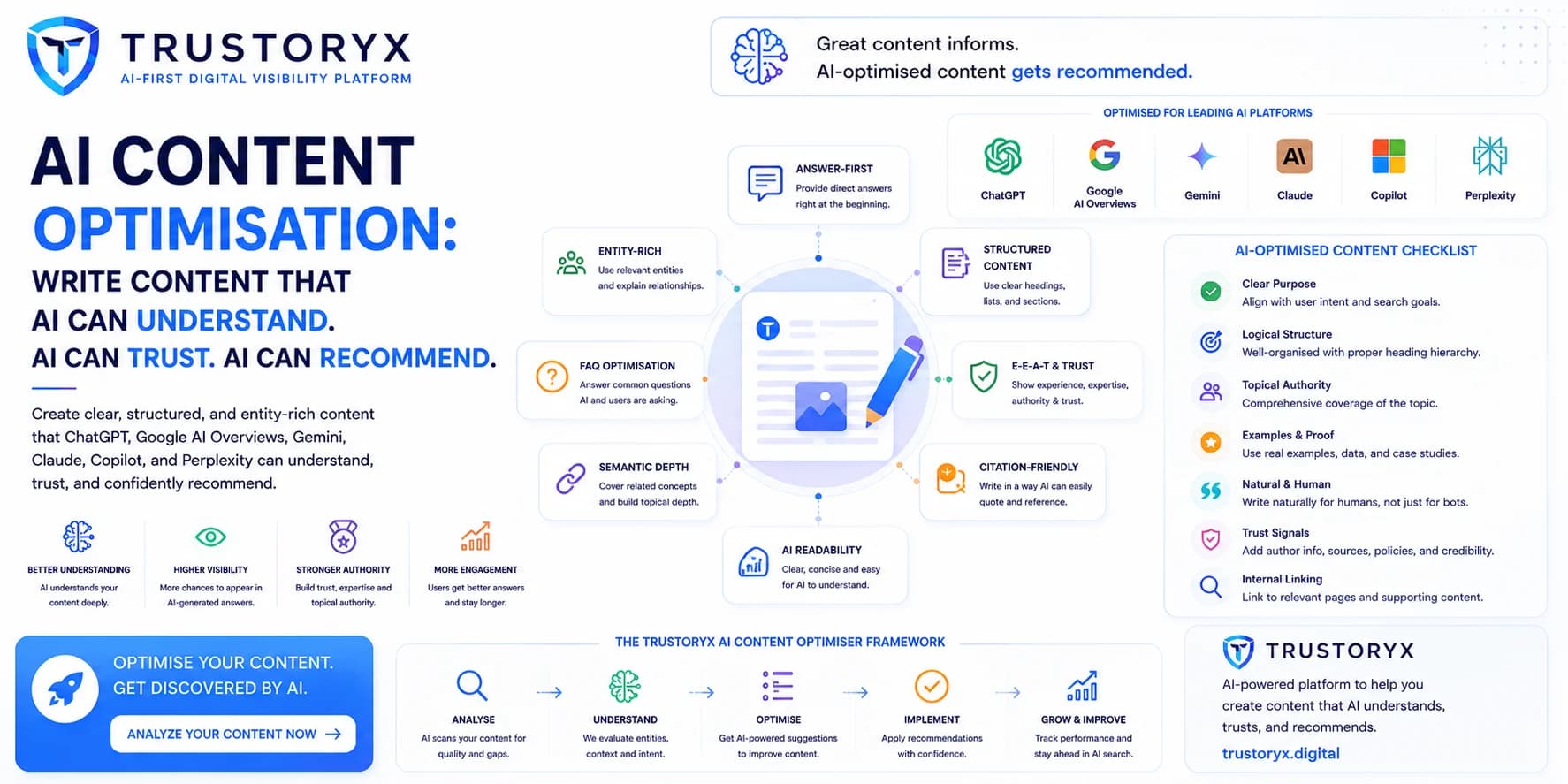
AI Content Optimisation: How to Write Content That ChatGPT, Google AI Overviews, Gemini, Claude, Copilot, and Perplexity Can Understand and Recommend
Introduction The internet is entering a new era. For decades, businesses created content primarily for search engines. Success depended on keywords, backli...
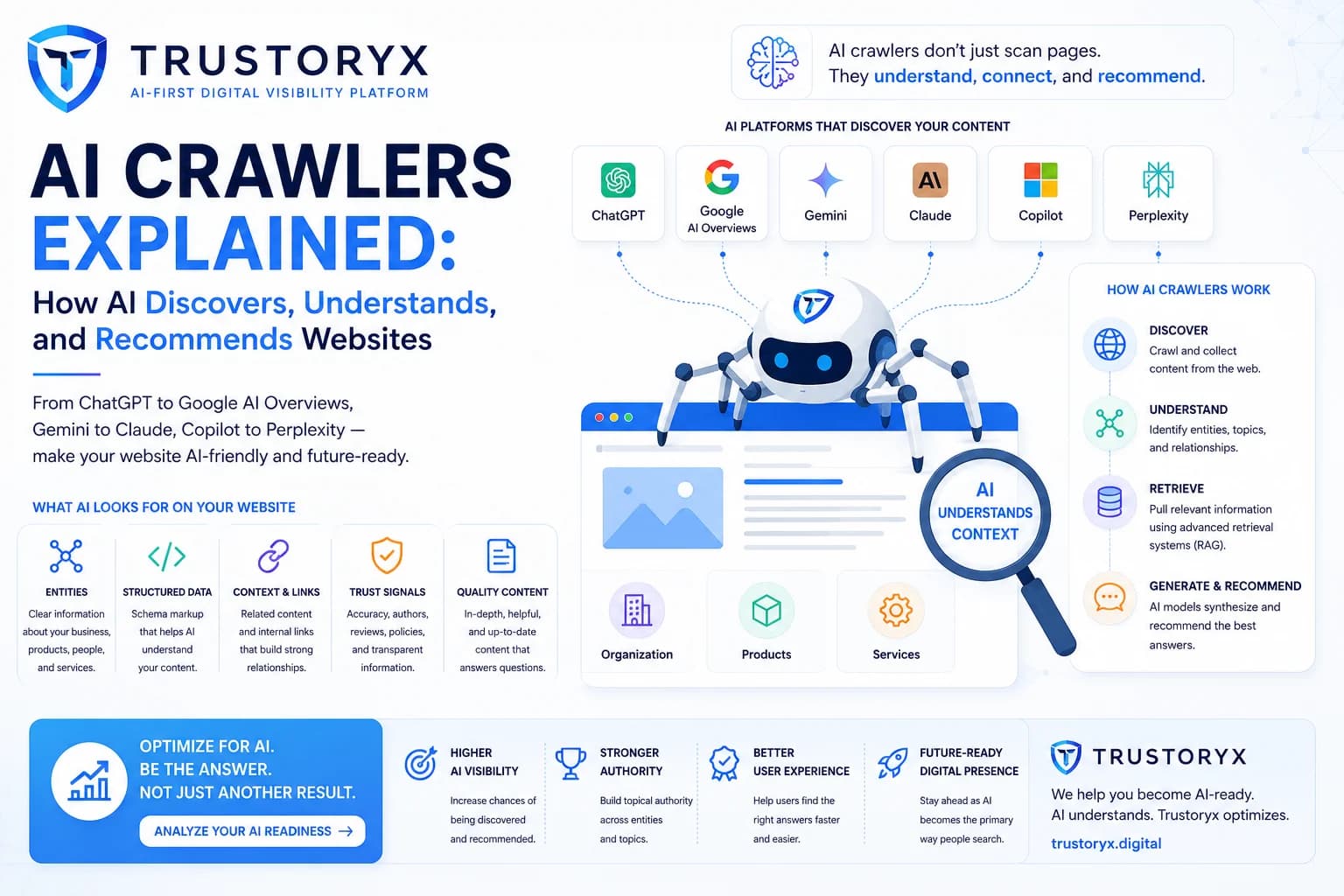
AI Crawlers Explained: How ChatGPT, Google AI Overviews, Gemini, Claude, Copilot, and Perplexity Discover and Understand Websites
Introduction For more than two decades, website owners optimised for one primary crawler: Googlebot. The objective was simple. Make your website easy to cr...
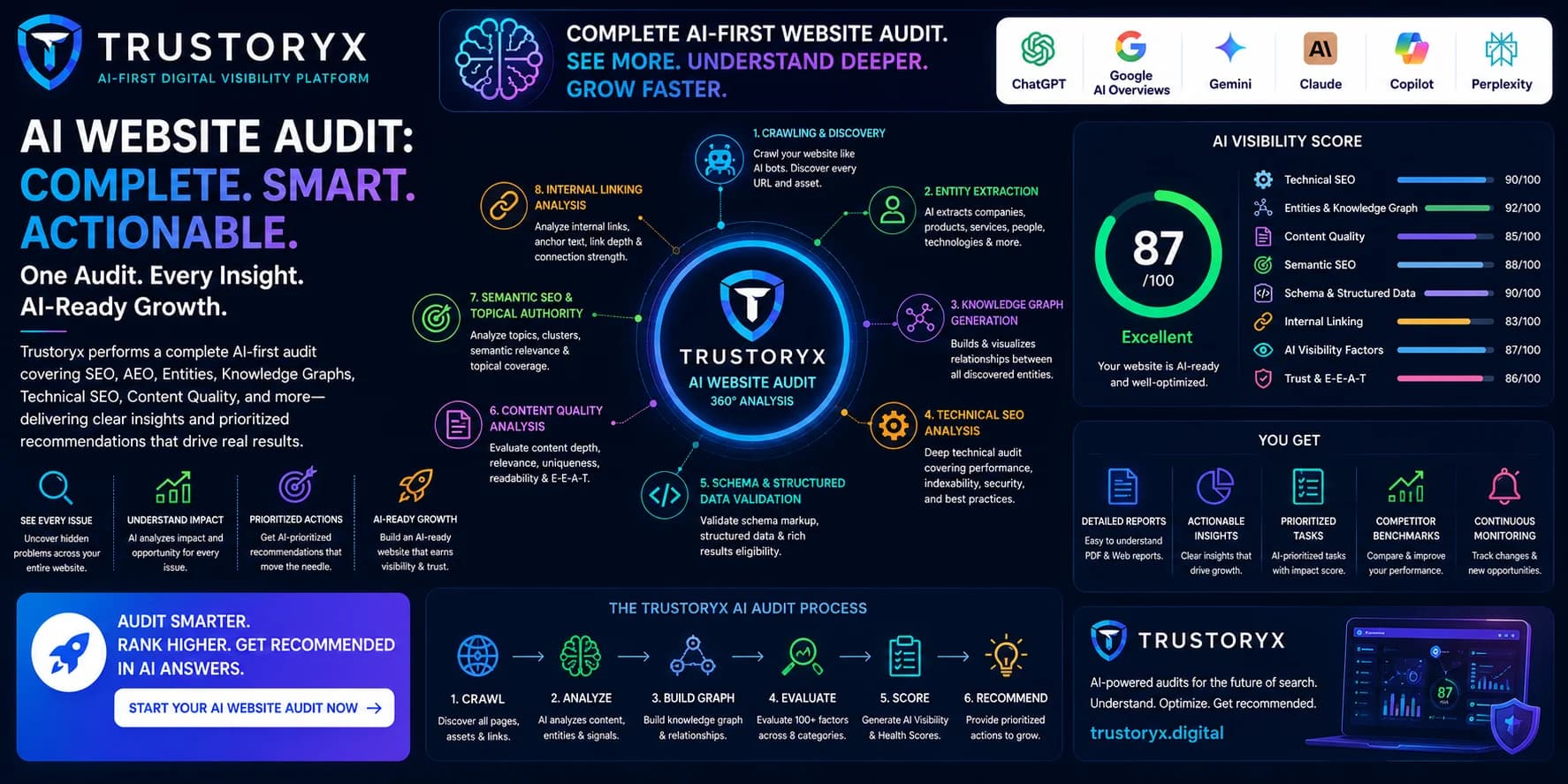
AI Website Audit: How Trustoryx Performs a Complete AI-First SEO, AEO, Entity, Knowledge Graph, and Technical Website Analysis
Introduction For years, website audits focused on a limited set of SEO metrics such as page speed, metadata, backlinks, and keyword rankings. Learn how Trustoryx conducts full AI-first audits.
Ready to Scale Your Search & Revenue?
Attract, Convert & Dominate Globally.
Get a complimentary 30-point SEO and Growth Audit. We identify competitor gaps, technical bottlenecks, and actionable quick wins in 48 hours.