Internal Linking for AI Search: Building Semantic Website Architecture That Answer Engines Understand
Introduction Most businesses think of internal links as simple navigation. A "Read More" button. A link to another blog. A menu item. In reality, internal...
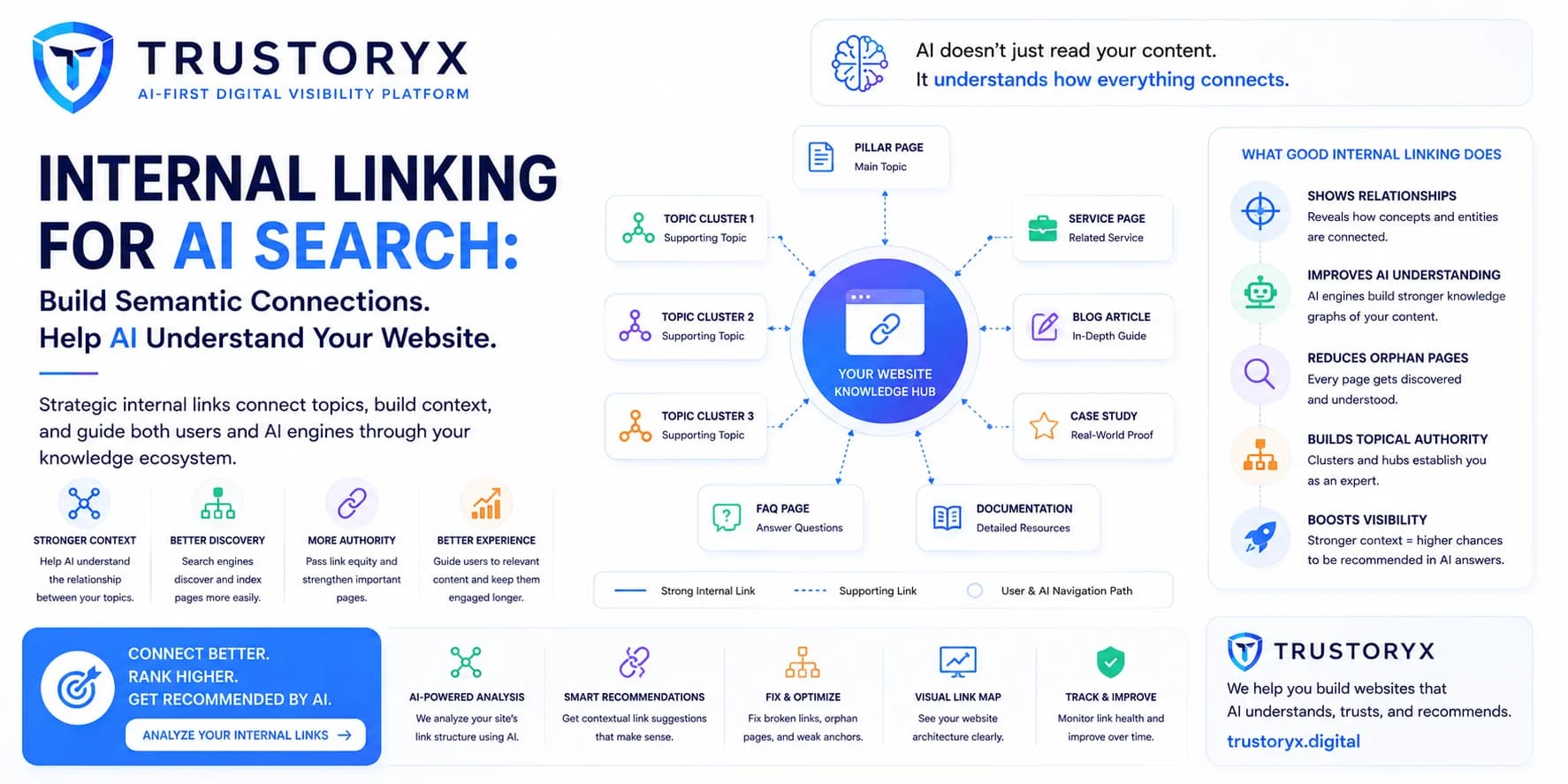
[!IMPORTANT]
Executive Summary: This document provides an in-depth technical analysis and strategic roadmap for Internal Linking for AI Search: Building Semantic Website Architecture That Answer Engines Understand. Designed for technology leaders, engineering teams, and growth strategists aiming for maximum search authority and AI readiness.
System Architecture & Process Workflow
Introduction
Most businesses think of internal links as simple navigation.
A "Read More" button.
A link to another blog.
A menu item.
In reality, internal linking is one of the strongest signals that helps both search engines and AI systems understand how knowledge is organised across a website.
For traditional SEO, internal links distribute authority and improve crawlability.
For Answer Engine Optimisation (AEO), internal links create semantic relationships that help AI understand how topics, entities, products, services, and documentation connect.
Trustoryx analyses internal links as part of a website's knowledge architecture, helping businesses build websites that AI can navigate, understand, and trust.
What Is Internal Linking?
Internal linking is the practice of connecting pages within the same website.
Examples include:
Homepage
↓
Services
↓
Answer Engine Optimisation
↓
Schema Markup
↓
Knowledge Graph SEO
↓
Entity SEO
↓
Case Studies
↓
Documentation
↓
FAQ
Each link teaches AI how one concept relates to another.
Why Internal Links Matter
Imagine reading a book where every chapter exists independently.
No references.
No index.
No table of contents.
Understanding the complete subject becomes difficult.
Many websites are organised this way.
AI faces the same challenge.
Without semantic links, pages become isolated documents instead of connected knowledge.
Search Engines Follow Links
Traditional search engines use internal links to discover:
- new pages
- page hierarchy
- crawl priority
- content importance
Good internal linking improves indexing efficiency.
AI Understands Relationships
Modern AI systems go beyond discovering pages.
They identify relationships.
Example:
Trustoryx
↓
Provides
↓
Technical SEO
↓
Supports
↓
Answer Engine Optimisation
↓
Requires
↓
Schema Markup
↓
Strengthens
↓
Knowledge Graph SEO
↓
Improves
↓
AI Visibility
These relationships often become visible through internal linking.
Semantic Website Architecture
A website should resemble a knowledge system.
Example:
Home
↓
Solutions
↓
Services
↓
Technical SEO
↓
Entity SEO
↓
Knowledge Graph SEO
↓
Schema Markup
↓
Content Clusters
↓
AI Search
Every section supports another.
Hub and Spoke Model
One of the strongest architectures for AI is the Hub and Spoke model.
Example:
Hub
Answer Engine Optimisation
Spokes
Entity SEO
Knowledge Graph SEO
Schema Markup
Semantic SEO
AI Crawlers
Content Clusters
AI Visibility
Every spoke links back to the hub.
The hub links to every spoke.
This strengthens topical authority.
Topic Silos
Another common architecture is the Topic Silo.
Example:
Technical SEO
↓
- Crawlability: Ensuring search engine and AI crawlers can discover, access, and parse page content without obstacles.
↓
- Robots.txt: Configuring crawling directives to guide AI scrapers and search bots effectively.
↓
- XML Sitemap: Maintaining accurate, auto-updating site indices for rapid crawler discovery.
↓
- Canonical URLs: Explicitly declaring preferred URL destinations to prevent duplicate content indexing.
↓
- Core Web Vitals: Meeting strict threshold limits for Largest Contentful Paint (LCP), Interaction to Next Paint (INP), and Cumulative Layout Shift (CLS).
Everything remains within one subject.
Trustoryx can recommend when a silo structure is appropriate and when a broader cluster provides greater value.
Pillar Pages
Pillar pages should become the centre of every important topic.
Example:
Semantic SEO
↓
Internal Linking
↓
Knowledge Graph SEO
↓
Entity SEO
↓
Schema
↓
Case Studies
↓
FAQs
↓
Implementation Guides
AI recognises these relationships naturally.
Contextual Links
Not every internal link has equal value.
Example:
"This guide explains Schema Markup, which strengthens Knowledge Graph SEO and supports Answer Engine Optimisation."
The surrounding text provides context.
Contextual links help AI understand why two pages are related.
Orphan Pages
An orphan page has no internal links pointing to it.
Problems include:
- difficult to discover
- weak authority
- poor navigation
- reduced semantic value
Trustoryx automatically detects orphan pages and recommends relevant connections.
Link Depth
Important pages should not be buried deep within the website.
Ideal structure:
Homepage
↓
Category
↓
Service
↓
Supporting Guide
↓
FAQ
If valuable pages require many clicks to reach, they may receive less attention from both users and crawlers.
Anchor Text
Anchor text describes the destination.
Weak example:
Click Here
Better example:
Learn more about Knowledge Graph SEO
Descriptive anchors provide clearer semantic signals.
Internal Linking Between Services
Suppose a business offers:
Technical SEO
AEO
Schema Implementation
Website Audits
Entity SEO
These services naturally support one another.
Trustoryx recommends logical relationships rather than random links.
Product Relationships
Products should also connect.
Example:
Trustoryx SEO Analyzer
↓
Generates
↓
AI Visibility Report
↓
Includes
↓
Schema Analysis
↓
Entity Analysis
↓
Knowledge Graph Analysis
↓
Content Gap Analysis
Users and AI understand the complete workflow.
Documentation Links
Documentation often becomes isolated.
Instead:
API
↓
Authentication
↓
Examples
↓
Tutorials
↓
Troubleshooting
↓
FAQs
↓
SDK
This creates a stronger documentation ecosystem.
Blog Relationships
Instead of publishing independent articles, connect them.
Example:
What Is AEO?
↓
Entity SEO
↓
Knowledge Graph SEO
↓
Semantic SEO
↓
Schema Markup
↓
AI Crawlers
↓
Content Clusters
↓
AI Visibility
This strengthens topical authority.
Measuring Internal Link Quality
Trustoryx analyses:
- Link relevance
- Link hierarchy
- Topic relationships
- Anchor quality
- Orphan pages
- Link depth
- Semantic clusters
- Broken links
- Circular references
These insights help businesses improve both navigation and AI understanding.
Common Internal Linking Mistakes
Many websites unintentionally weaken their architecture.
Examples include:
Too few links
Too many links
Generic anchor text
Broken links
Duplicate navigation
Disconnected articles
No topic hierarchy
No pillar pages
No content clusters
Trustoryx highlights these issues automatically.
AI Navigation
AI systems increasingly benefit from websites that have:
Clear hierarchy
Consistent terminology
Logical navigation
Supporting documentation
Strong contextual links
Structured knowledge
Rather than scanning isolated pages, AI can move naturally through connected topics.
Internal Linking and Knowledge Graphs
Internal links strengthen Knowledge Graph SEO.
Example:
Trustoryx
↓
Provides
↓
AEO
↓
Uses
↓
Schema
↓
Improves
↓
Entity Recognition
↓
Supports
↓
AI Search
Every connection increases semantic understanding.
Internal Linking and User Experience
Strong internal links also improve the visitor experience.
Benefits include:
- easier navigation
- more time on site
- faster discovery of related resources
- smoother learning journeys
- reduced dead ends
The same architecture that helps AI often benefits people as well.
Trustoryx Internal Link Intelligence
Trustoryx analyses internal links using AI-first principles.
The platform can:
- discover missing relationships
- identify orphan pages
- recommend contextual links
- strengthen content clusters
- improve pillar pages
- optimise anchor text
- connect entities
- visualise website architecture
Rather than simply counting links, Trustoryx evaluates whether those links communicate meaningful relationships.
Building an AI-First Website
A future-ready website resembles a connected knowledge ecosystem.
Homepage
↓
Solutions
↓
Services
↓
Products
↓
Documentation
↓
Case Studies
↓
FAQs
↓
Glossary
↓
Resources
↓
Blog
Every page supports another.
Nothing exists in isolation.
The Future of Website Architecture
As AI becomes a primary method of discovering information, website architecture will become increasingly important.
Businesses that organise their content through semantic internal links, topic clusters, and clear hierarchies will make it easier for AI systems to understand and recommend their expertise.
Internal linking is evolving from a navigation technique into a core component of AI-ready website design.
Conclusion
Internal linking is no longer just a technical SEO best practice. It is a key part of how modern search engines and AI systems understand the relationships between topics, products, services, and expertise.
Trustoryx helps organisations build intelligent website architectures by analysing semantic relationships, identifying missing connections, strengthening content clusters, and improving internal link quality.
The result is a website that functions as an interconnected knowledge network—one that is easier for users to explore, easier for AI to understand, and better positioned for the future of search.
Frequently Asked Questions (FAQ)
What makes internal linking for ai search: building semantic website architecture that answer engines understand critical for digital success in 2026?
With search evolving towards direct answer generation by AI assistants (ChatGPT, Claude, Gemini, Perplexity) and Google AI Overviews, optimizing for internal linking for ai search: building semantic website architecture that answer engines understand ensures your brand is understood, trusted, and recommended directly as the primary answer rather than lost in traditional link results.
How does Trustoryx implement solutions for internal linking for ai search: building semantic website architecture that answer engines understand?
Trustoryx applies an engineering-first methodology combining structured data schema, entity extraction, knowledge graph modeling, performance tuning, and AI readability optimization to ensure full machine comprehension and authority.
How long does it take to see measurable results from internal linking for ai search: building semantic website architecture that answer engines understand optimization?
Most websites experience noticeable improvements in AI discovery, crawl efficiency, and citation frequency within 30 to 90 days following technical implementation and knowledge graph alignment.
Technical Schema & Structured Data
{
  "@context": "https://schema.org",
  "@type": "TechArticle",
  "headline": "Internal Linking for AI Search: Building Semantic Website Architecture That Answer Engines Understand",
  "description": "Internal Linking for AI Search: Building Semantic Website Architecture That Answer Engines Understand",
  "author": {
    "@type": "Person",
    "name": "Nikhil Kumar",
    "jobTitle": "Principal Architect & Founder",
    "worksFor": {
      "@type": "Organization",
      "name": "Trustoryx",
      "url": "https://www.trustoryx.digital"
    }
  },
  "publisher": {
    "@type": "Organization",
    "name": "Trustoryx",
    "url": "https://www.trustoryx.digital",
    "logo": "https://www.trustoryx.digital/logo.png"
  },
  "mainEntityOfPage": "https://www.trustoryx.digital/blog/internal-linking-for-ai-search",
  "inLanguage": "en-US"
}Frequently Asked Questions
Need Expert Help with internal linking for ai search: building semantic website architecture that answer engines understand?
Get a free 30-point audit from our engineering team.
Get Free AuditRelated Articles
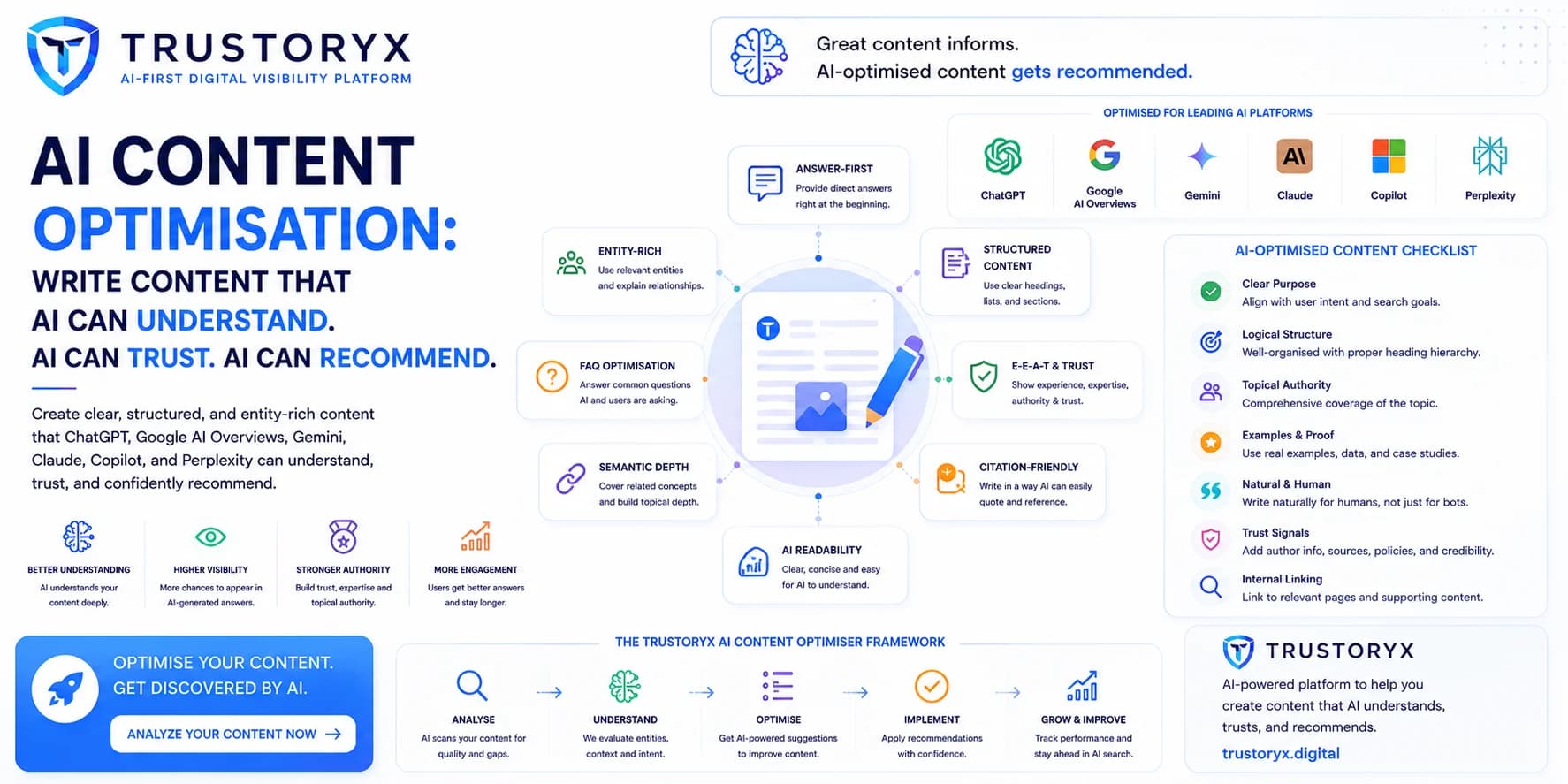
AI Content Optimisation: How to Write Content That ChatGPT, Google AI Overviews, Gemini, Claude, Copilot, and Perplexity Can Understand and Recommend
Introduction The internet is entering a new era. For decades, businesses created content primarily for search engines. Success depended on keywords, backli...
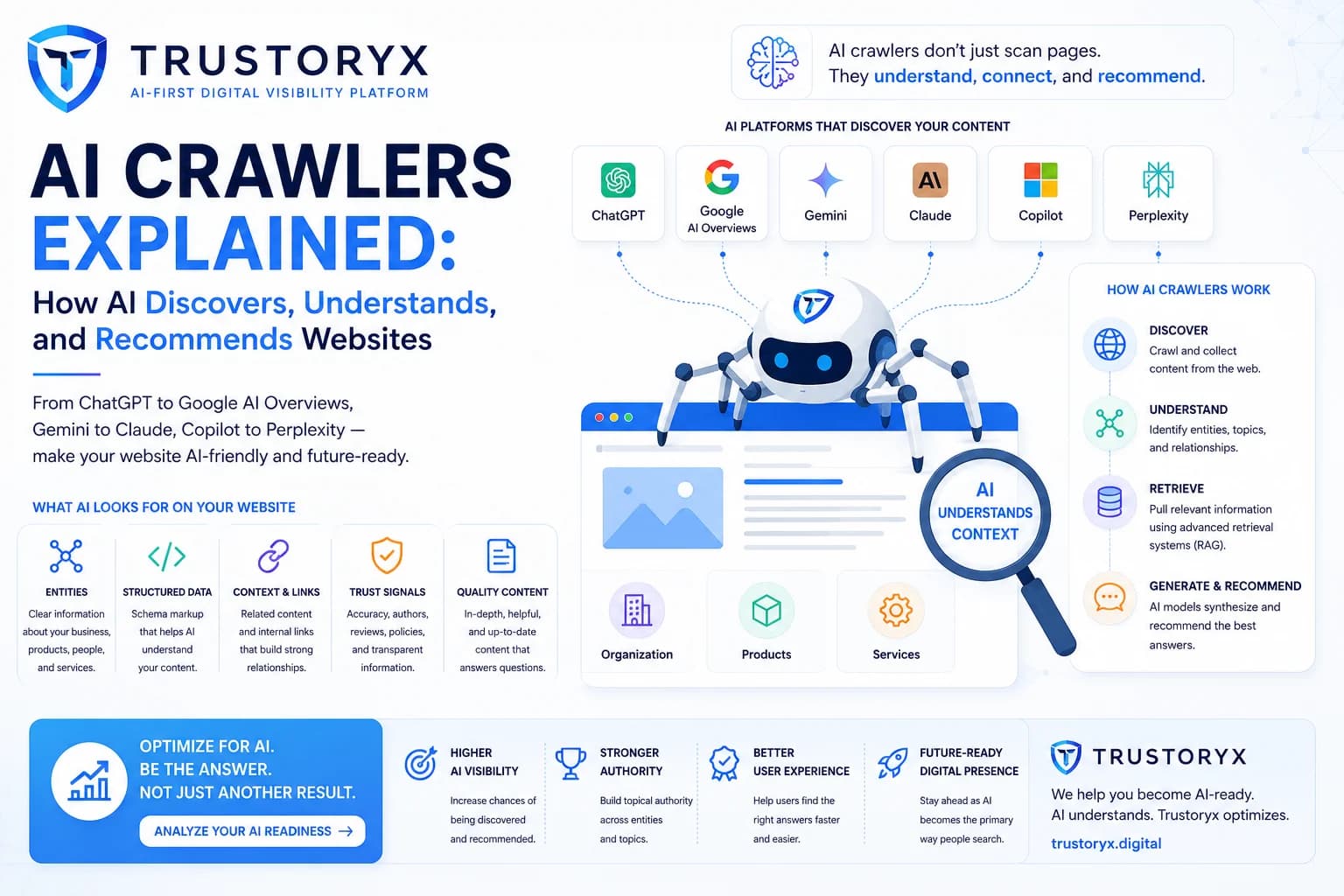
AI Crawlers Explained: How ChatGPT, Google AI Overviews, Gemini, Claude, Copilot, and Perplexity Discover and Understand Websites
Introduction For more than two decades, website owners optimised for one primary crawler: Googlebot. The objective was simple. Make your website easy to cr...
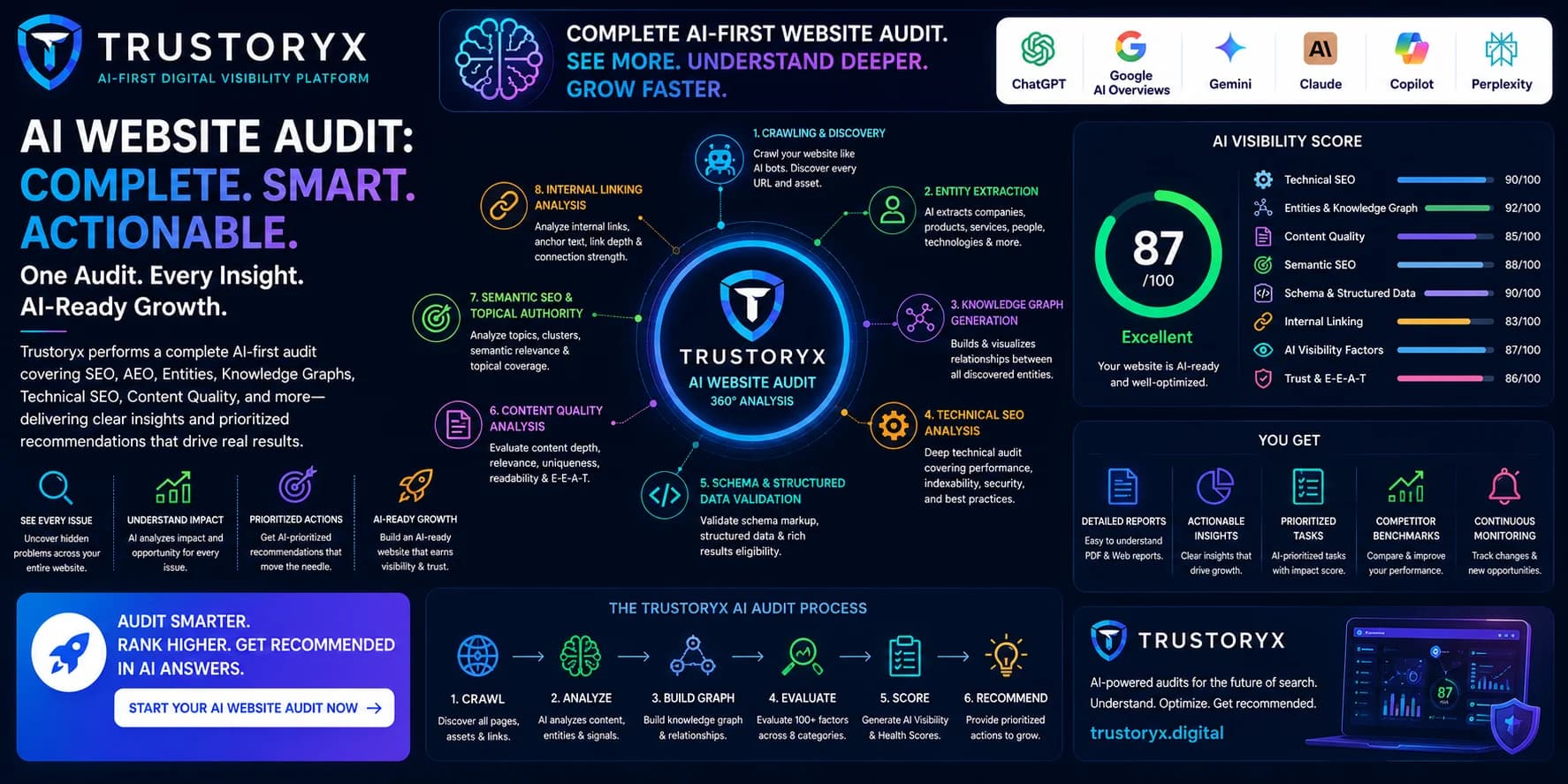
AI Website Audit: How Trustoryx Performs a Complete AI-First SEO, AEO, Entity, Knowledge Graph, and Technical Website Analysis
Introduction For years, website audits focused on a limited set of SEO metrics such as page speed, metadata, backlinks, and keyword rankings. Learn how Trustoryx conducts full AI-first audits.
Ready to Scale Your Search & Revenue?
Attract, Convert & Dominate Globally.
Get a complimentary 30-point SEO and Growth Audit. We identify competitor gaps, technical bottlenecks, and actionable quick wins in 48 hours.