Technical SEO for AI Search: Building Fast, Crawlable, and AI-Ready Websites
Introduction The future of search is powered by artificial intelligence. Modern search engines and AI assistants such as ChatGPT, Google AI Overviews, Gemi...
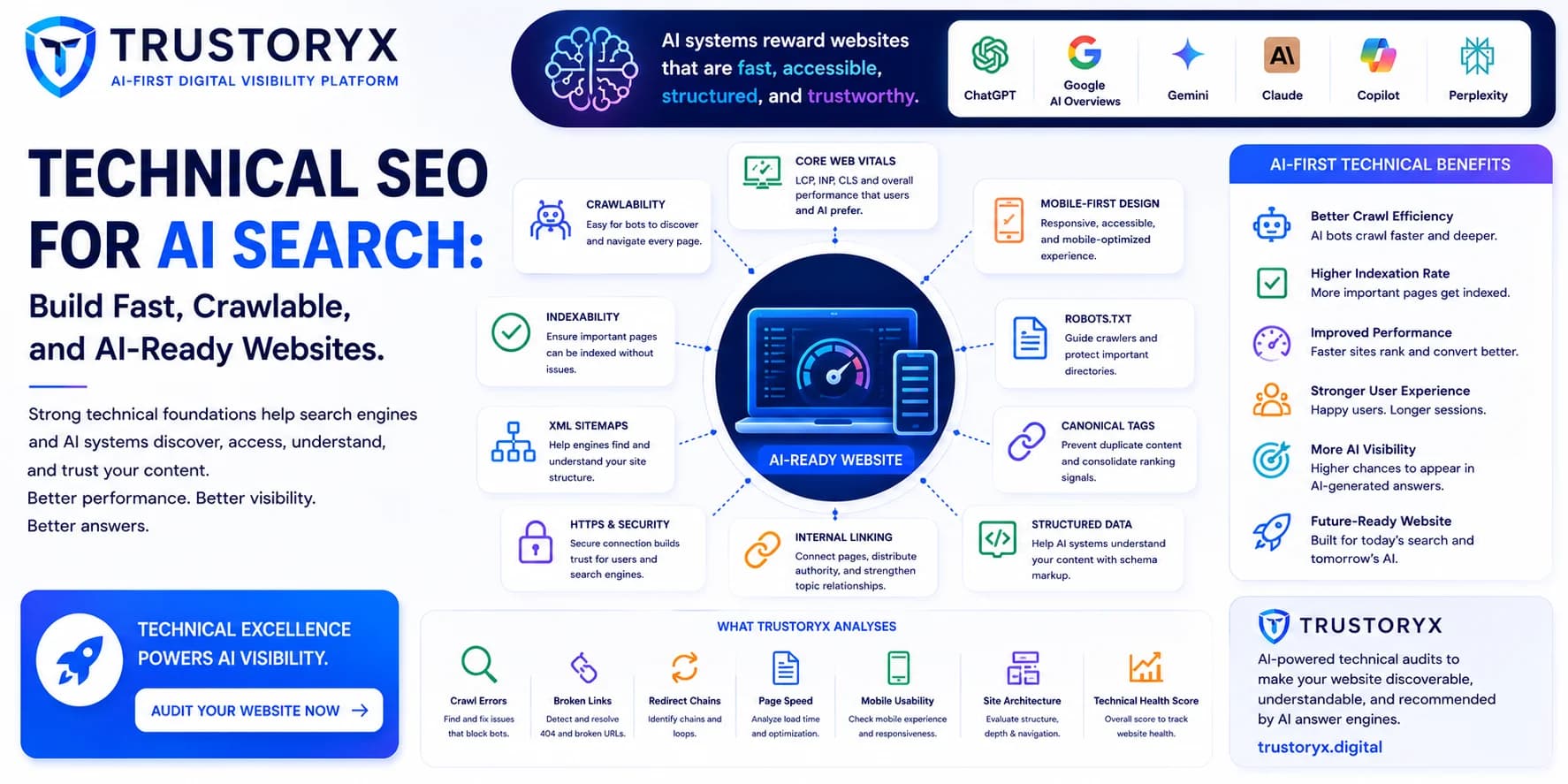
[!IMPORTANT]
Executive Summary: This document provides an in-depth technical analysis and strategic roadmap for Technical SEO for AI Search: Building Fast, Crawlable, and AI-Ready Websites. Designed for technology leaders, engineering teams, and growth strategists aiming for maximum search authority and AI readiness.
System Architecture & Process Workflow
Introduction
The future of search is powered by artificial intelligence.
Modern search engines and AI assistants such as ChatGPT, Google AI Overviews, Gemini, Claude, Microsoft Copilot, and Perplexity depend on websites that are not only informative but also technically accessible.
A beautifully written article is of little value if AI systems cannot reliably discover, crawl, interpret, and understand it.
Technical SEO provides the foundation that supports every other optimisation strategy, including Answer Engine Optimisation (AEO), Entity SEO, Semantic SEO, and Knowledge Graph SEO.
Trustoryx helps businesses analyse their technical infrastructure through an AI-first perspective, ensuring websites are not only search-engine friendly but also prepared for the next generation of AI-powered discovery.
What Is Technical SEO?
Technical SEO is the process of improving a website's infrastructure so search engines and AI systems can efficiently discover, access, understand, and organise its content.
Unlike content optimisation, Technical SEO focuses on the underlying architecture of a website.
This includes:
- Crawlability
- Indexability
- Website speed
- Mobile responsiveness
- Structured data
- Internal linking
- Security
- Site architecture
- Core Web Vitals
Together, these elements create the technical foundation for digital visibility.
Why Technical SEO Matters for AI Search
AI systems rely on high-quality technical foundations to access and interpret information.
Technical optimisation helps by:
- making pages easier to discover
- reducing access errors
- improving content organisation
- supporting structured data
- enabling efficient retrieval
While technical SEO alone does not guarantee visibility in AI-generated answers, poor technical quality can make it harder for systems to understand and use your content.
Crawlability
Before a page can be understood, it must first be discovered.
Crawlability refers to how easily automated systems can navigate a website.
Trustoryx evaluates:
- Broken links
- Crawl errors
- Navigation structure
- Internal links
- Redirect chains
- Orphan pages
- Robots.txt configuration
Every page should be reachable through logical navigation.
Indexability
Discovery alone is not enough.
Important pages must also be eligible for indexing.
Common problems include:
- Incorrect noindex tags
- Canonical conflicts
- Duplicate pages
- Blocked resources
- Redirect loops
Trustoryx identifies pages that may be difficult for search engines to process correctly.
Website Architecture
Modern websites should follow a logical hierarchy.
Example:
Home
↓
Solutions
↓
Services
↓
Products
↓
Documentation
↓
Resources
↓
Blog
↓
Case Studies
↓
FAQs
A clear structure benefits both visitors and automated systems.
Core Web Vitals
Performance contributes to user experience.
Important metrics include:
Largest Contentful Paint (LCP)
Measures loading performance.
Interaction to Next Paint (INP)
Measures responsiveness to user interactions.
Cumulative Layout Shift (CLS)
Measures visual stability.
Trustoryx analyses these metrics and provides optimisation recommendations.
Page Speed
Slow websites reduce usability.
Performance improvements may include:
- Image optimisation
- Code minification
- Browser caching
- Compression
- Content delivery networks (CDNs)
- Lazy loading
Faster websites create a better experience for users.
Mobile Optimisation
Many visitors access websites using mobile devices.
A mobile-friendly website should provide:
- Responsive layouts
- Readable typography
- Accessible navigation
- Fast loading
- Touch-friendly interfaces
Trustoryx evaluates mobile usability alongside desktop performance.
HTTPS and Security
Security builds trust.
Every modern website should use HTTPS.
Additional considerations include:
- Secure certificates
- Mixed-content prevention
- Safe forms
- Secure authentication
- Regular software updates
Trust signals benefit both users and search systems.
XML Sitemaps
An XML sitemap provides a structured list of important pages.
Benefits include:
- Easier discovery
- Improved crawl efficiency
- Better organisation
- Faster identification of new content
Trustoryx validates sitemap quality and identifies missing pages.
Robots.txt
The robots.txt file provides crawling instructions.
Common uses include:
- Allowing public content
- Blocking private directories
- Preventing unnecessary crawling
Incorrect configuration can unintentionally hide valuable content.
Trustoryx checks robots.txt for common issues.
Canonical Tags
Duplicate content creates confusion.
Canonical tags help identify the preferred version of a page.
Examples include:
- HTTPS vs HTTP
- Trailing slash variations
- URL parameters
- Print versions
Correct canonical implementation improves clarity.
Structured Navigation
Navigation communicates website hierarchy.
Effective navigation includes:
- Clear menus
- Breadcrumbs
- Logical categories
- Internal links
- Consistent terminology
AI systems benefit from predictable organisation.
Structured Data
Technical SEO extends beyond performance.
Structured data helps machines understand:
- Organisations
- Services
- Products
- Articles
- Authors
- FAQs
Trustoryx analyses schema implementation alongside technical health.
Image Optimisation
Images should include:
- Descriptive filenames
- Alternative text
- Appropriate compression
- Responsive formats
Optimised media improves accessibility and performance.
Internal Linking
Internal links strengthen both navigation and semantic understanding.
Trustoryx evaluates:
- Link hierarchy
- Contextual relevance
- Orphan pages
- Anchor text
- Link depth
Strong internal architecture improves discoverability.
Error Detection
Technical issues reduce website quality.
Trustoryx identifies:
- 404 errors
- Redirect chains
- Server errors
- Broken resources
- Duplicate pages
- Missing metadata
Resolving these issues improves website reliability.
Accessibility
Accessible websites benefit everyone.
Important considerations include:
- Alternative text
- Keyboard navigation
- Colour contrast
- Semantic HTML
- Accessible forms
- Screen reader compatibility
Many accessibility improvements also support clearer website structure.
AI-Friendly Website Architecture
An AI-ready website should function like a structured knowledge system.
Homepage
↓
Solutions
↓
Services
↓
Products
↓
Documentation
↓
Tutorials
↓
Resources
↓
FAQs
↓
Case Studies
↓
Glossary
↓
Blog
Every page should connect logically to related information.
Technical Health Score
Trustoryx measures multiple technical dimensions.
Examples include:
- Crawlability
- Indexability
- Performance
- Security
- Navigation
- Structured data
- Internal linking
- Accessibility
- Mobile usability
- Technical consistency
These measurements contribute to an overall Technical Health Score.
Common Technical SEO Mistakes
Businesses frequently encounter issues such as:
- Slow pages
- Broken links
- Duplicate URLs
- Missing schema
- Incorrect canonical tags
- Poor mobile experience
- Missing XML sitemaps
- Weak internal architecture
Trustoryx highlights these issues with prioritised recommendations.
Trustoryx Technical Audit
Trustoryx performs AI-first technical analysis by combining traditional SEO diagnostics with semantic evaluation.
The platform provides:
- Technical Health Score
- Performance reports
- Crawl analysis
- Structured data validation
- Internal architecture review
- Mobile analysis
- Accessibility recommendations
- AI readiness assessment
This creates a complete technical picture rather than focusing on isolated metrics.
Preparing for the Future of AI Search
Technical SEO is becoming increasingly important as AI systems continue to evolve.
Future-ready websites will combine:
- Strong performance
- Structured information
- Logical architecture
- Clear navigation
- Secure infrastructure
- Semantic organisation
Together, these elements support both users and intelligent systems.
Conclusion
Technical SEO remains the foundation of modern digital visibility.
Without strong technical architecture, even the best content may be difficult for search engines and AI systems to discover, interpret, and organise.
Trustoryx helps businesses build AI-ready websites through comprehensive technical analysis, structured data validation, semantic architecture reviews, and actionable recommendations.
As search continues to evolve toward AI-powered experiences, investing in technical excellence ensures that content is not only accessible but also positioned for long-term visibility in the next generation of search.
Frequently Asked Questions (FAQ)
What makes technical seo for ai search: building fast, crawlable, and ai-ready websites critical for digital success in 2026?
With search evolving towards direct answer generation by AI assistants (ChatGPT, Claude, Gemini, Perplexity) and Google AI Overviews, optimizing for technical seo for ai search: building fast, crawlable, and ai-ready websites ensures your brand is understood, trusted, and recommended directly as the primary answer rather than lost in traditional link results.
How does Trustoryx implement solutions for technical seo for ai search: building fast, crawlable, and ai-ready websites?
Trustoryx applies an engineering-first methodology combining structured data schema, entity extraction, knowledge graph modeling, performance tuning, and AI readability optimization to ensure full machine comprehension and authority.
How long does it take to see measurable results from technical seo for ai search: building fast, crawlable, and ai-ready websites optimization?
Most websites experience noticeable improvements in AI discovery, crawl efficiency, and citation frequency within 30 to 90 days following technical implementation and knowledge graph alignment.
Technical Schema & Structured Data
{
  "@context": "https://schema.org",
  "@type": "TechArticle",
  "headline": "Technical SEO for AI Search: Building Fast, Crawlable, and AI-Ready Websites",
  "description": "Technical SEO for AI Search: Building Fast, Crawlable, and AI-Ready Websites",
  "author": {
    "@type": "Person",
    "name": "Nikhil Kumar",
    "jobTitle": "Principal Architect & Founder",
    "worksFor": {
      "@type": "Organization",
      "name": "Trustoryx",
      "url": "https://www.trustoryx.digital"
    }
  },
  "publisher": {
    "@type": "Organization",
    "name": "Trustoryx",
    "url": "https://www.trustoryx.digital",
    "logo": "https://www.trustoryx.digital/logo.png"
  },
  "mainEntityOfPage": "https://www.trustoryx.digital/blog/technical-seo-for-ai-search",
  "inLanguage": "en-US"
}Frequently Asked Questions
Need Expert Help with technical seo for ai search: building fast, crawlable, and ai-ready websites?
Get a free 30-point audit from our engineering team.
Get Free AuditRelated Articles
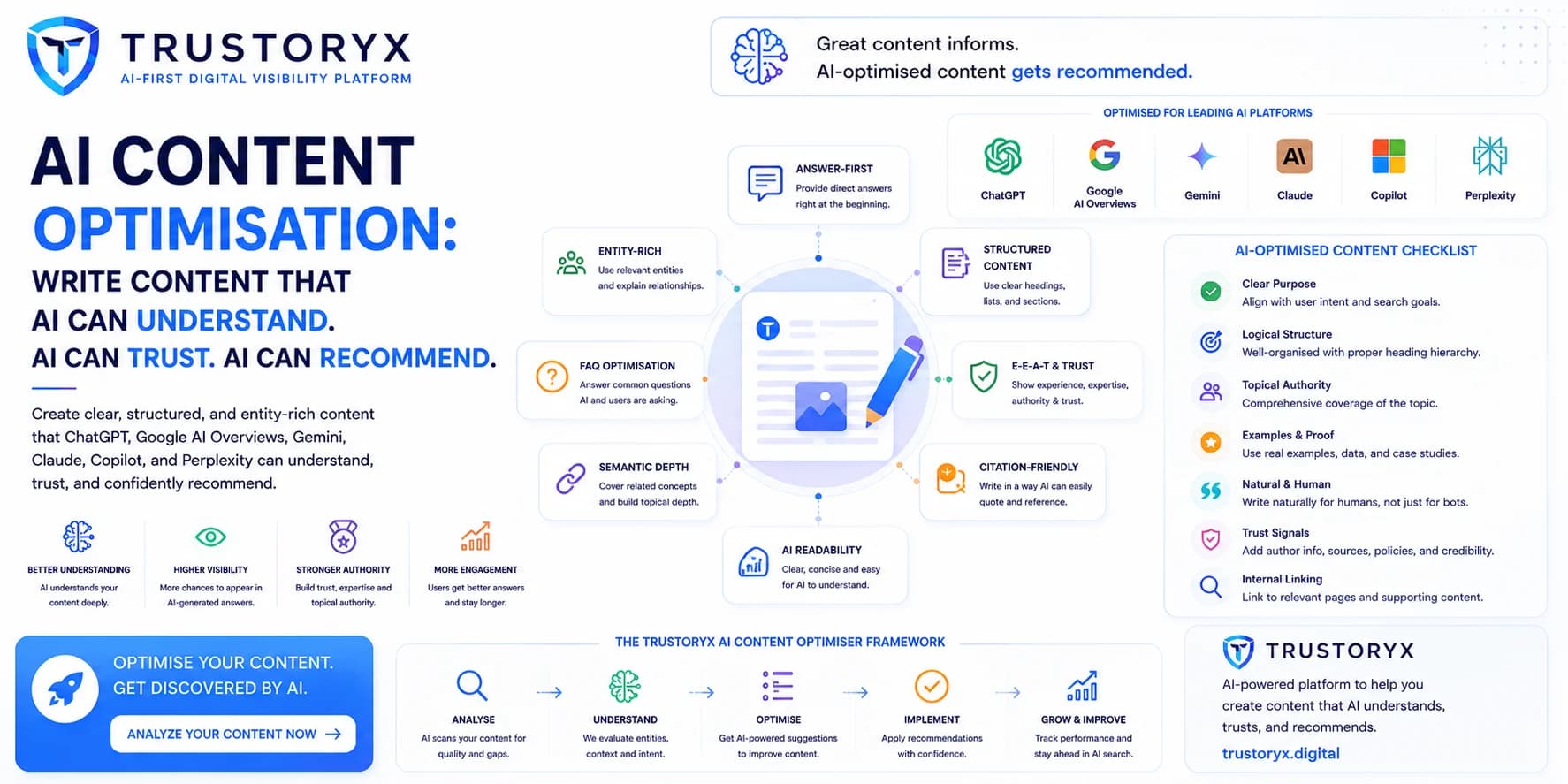
AI Content Optimisation: How to Write Content That ChatGPT, Google AI Overviews, Gemini, Claude, Copilot, and Perplexity Can Understand and Recommend
Introduction The internet is entering a new era. For decades, businesses created content primarily for search engines. Success depended on keywords, backli...
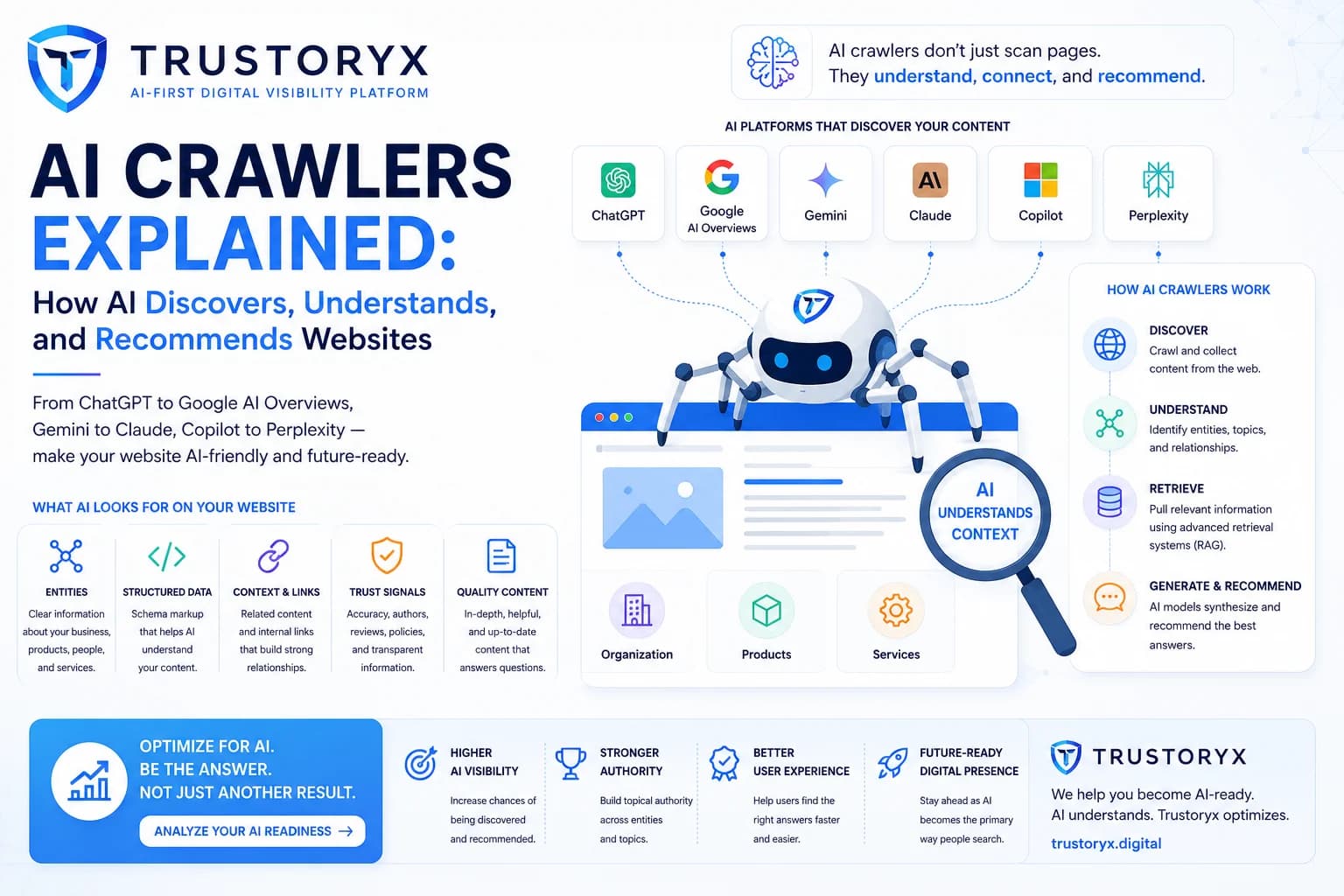
AI Crawlers Explained: How ChatGPT, Google AI Overviews, Gemini, Claude, Copilot, and Perplexity Discover and Understand Websites
Introduction For more than two decades, website owners optimised for one primary crawler: Googlebot. The objective was simple. Make your website easy to cr...
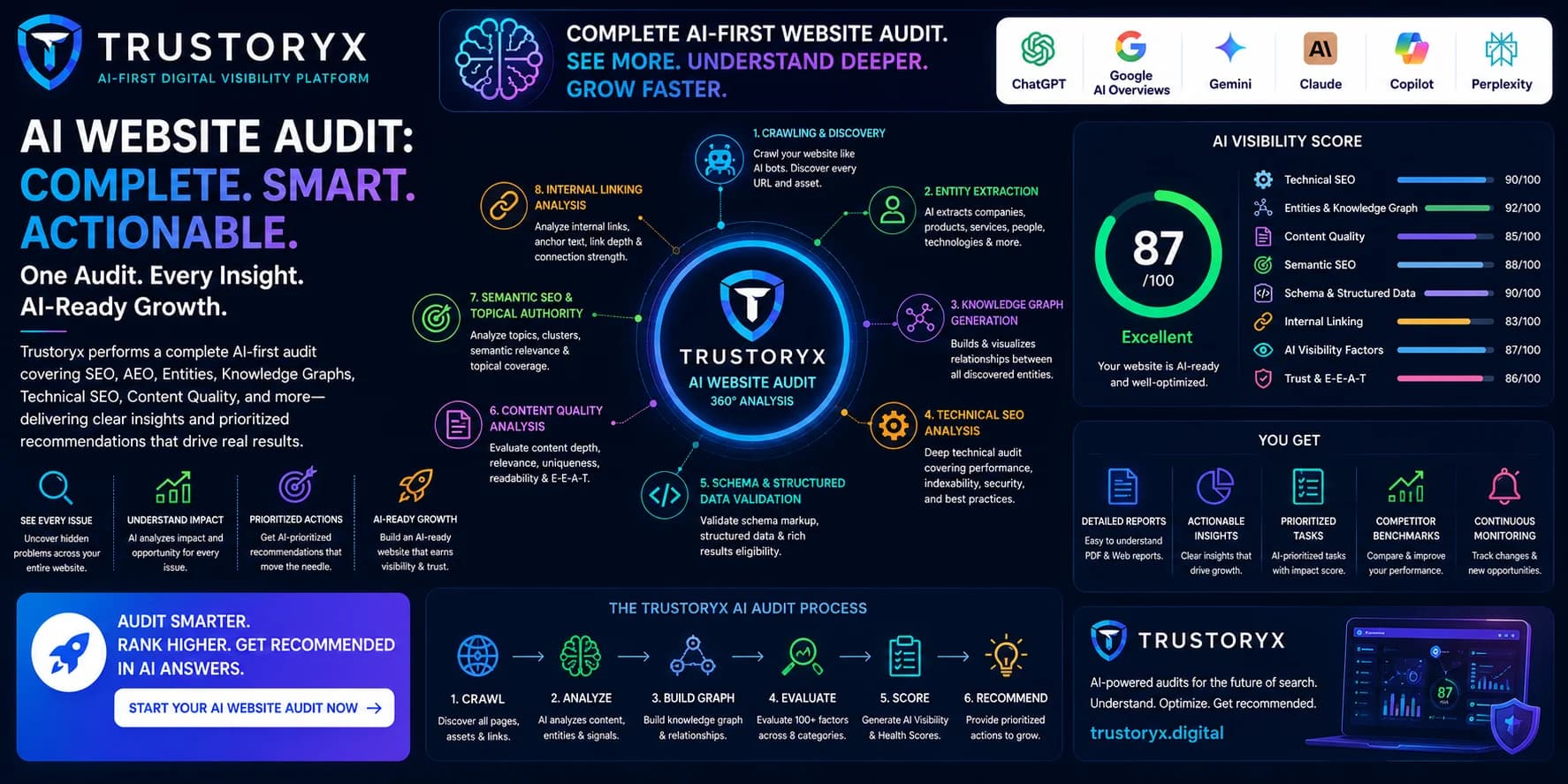
AI Website Audit: How Trustoryx Performs a Complete AI-First SEO, AEO, Entity, Knowledge Graph, and Technical Website Analysis
Introduction For years, website audits focused on a limited set of SEO metrics such as page speed, metadata, backlinks, and keyword rankings. Learn how Trustoryx conducts full AI-first audits.
Ready to Scale Your Search & Revenue?
Attract, Convert & Dominate Globally.
Get a complimentary 30-point SEO and Growth Audit. We identify competitor gaps, technical bottlenecks, and actionable quick wins in 48 hours.