How AI Understands Your Website: The Complete Guide to Entities, Knowledge Graphs, and Answer Engine Optimisation
Introduction When people think about search engine optimisation, they often imagine keywords, backlinks, and Google rankings. Those factors are still impor...
[!IMPORTANT]
Executive Summary: This document provides an in-depth technical analysis and strategic roadmap for How AI Understands Your Website: The Complete Guide to Entities, Knowledge Graphs, and Answer Engine Optimisation. Designed for technology leaders, engineering teams, and growth strategists aiming for maximum search authority and AI readiness.
System Architecture & Process Workflow
Introduction
When people think about search engine optimisation, they often imagine keywords, backlinks, and Google rankings. Those factors are still important, but modern AI systems evaluate websites in a fundamentally different way.
Large Language Models (LLMs) such as ChatGPT, Gemini, Claude, Microsoft Copilot, and Perplexity are designed to understand meaning rather than simply match keywords. They attempt to identify the entities on a website, determine how those entities relate to one another, assess whether the information is trustworthy, and use that understanding to generate answers for users.
This shift marks the beginning of Answer Engine Optimisation (AEO), where the objective is not just to rank in search results but to become a trusted source that AI systems can confidently reference.
For businesses, this means that simply publishing content is no longer enough. Your website must function as a structured knowledge base. Every service, product, person, technology, and topic should be clearly defined, connected, and supported by accurate information.
Trustoryx was built to help organisations make this transition.
Search Engines Read Pages. AI Builds Knowledge.
Traditional search engines primarily index web pages.
An AI model tries to build an internal understanding of your business.
For example, consider a software company.
A traditional search engine may recognise keywords such as:
- Software Development
- Mobile Apps
- Flutter
- React
- AI Development
An AI assistant attempts to answer questions such as:
- What does this company specialise in?
- Which industries does it serve?
- What products does it sell?
- Which technologies does it use?
- Is it trustworthy?
- What problems does it solve?
Those are very different objectives.
What Is an Entity?
An entity is a uniquely identifiable thing.
Examples include:
People
- Elon Musk
- Sundar Pichai
- Ada Lovelace
Companies
- Trustoryx
- OpenAI
- Microsoft
Technologies
- Flutter
- Kubernetes
- PostgreSQL
Services
- Technical SEO
- AI Consulting
- Mobile App Development
Products
- Trustoryx SEO Analyzer
- ChatGPT
- Docker Desktop
Locations
- Delhi
- London
- Bengaluru
Concepts
- Answer Engine Optimisation
- Machine Learning
- Cybersecurity
Entities are the building blocks of AI understanding.
Without entities, a website is simply text.
With entities, it becomes structured knowledge.
Why Entities Matter
Imagine this sentence:
We build modern software for startups.
This sentence is understandable to humans but vague for AI.
Now compare it with:
Trustoryx provides Flutter app development, AI consulting, technical SEO, Answer Engine Optimisation (AEO), and cloud infrastructure services for startups and enterprises.
The second sentence contains identifiable entities.
AI can extract:
Company
→ Trustoryx
Services
→ Flutter Development
→ AI Consulting
→ Technical SEO
→ AEO
Audience
→ Startups
→ Enterprises
Every additional entity increases AI confidence.
The Knowledge Graph
Entities become significantly more valuable when connected.
Example:
Trustoryx
↓
Provides
↓
Answer Engine Optimisation
↓
Uses
↓
Schema Markup
↓
Improves
↓
AI Visibility
↓
Benefits
↓
Businesses
↓
Appears In
↓
AI Search
This interconnected network is called a knowledge graph.
Instead of isolated pages, AI sees relationships.
Knowledge graphs help answer complex questions like:
"What companies specialise in AI SEO?"
"Which tools improve Answer Engine Optimisation?"
"What services help businesses appear in AI search?"
How Trustoryx Builds a Knowledge Graph
Trustoryx begins by scanning every page of a website.
It identifies:
- organisations
- products
- services
- technologies
- locations
- industries
- authors
- certifications
- documentation
- frequently asked questions
Each becomes a node.
Relationships become connections.
Example:
Organisation
Trustoryx
Offers
Technical SEO
Uses
JSON-LD
Creates
Knowledge Graphs
Supports
Google AI Overviews
Optimises
ChatGPT Discovery
Every relationship increases semantic understanding.
AI Does Not Think Like a Search Engine
Keyword optimisation alone is no longer enough.
Suppose a website repeats:
"Best SEO Company"
fifty times.
An AI system quickly recognises that repetition adds little value.
Instead, AI looks for evidence.
For example:
- Detailed service explanations
- Real implementation guides
- Customer case studies
- Technical documentation
- Structured data
- Frequently asked questions
Depth is more valuable than repetition.
Building Semantic Context
Context tells AI how ideas connect.
Suppose your article discusses Flutter.
If it also mentions:
- Dart
- Android
- iOS
- Firebase
- Material Design
- State Management
AI understands the article is genuinely about Flutter development.
Trustoryx measures semantic coverage rather than keyword frequency.
The Importance of Structured Data
Structured data acts as metadata for machines.
Instead of forcing AI to guess, you explicitly describe information.
Examples include:
Organisation Schema
Service Schema
Product Schema
FAQ Schema
Article Schema
How-To Schema
SoftwareApplication Schema
Review Schema
Breadcrumb Schema
LocalBusiness Schema
Trustoryx automatically identifies missing schema opportunities and prioritises those that provide the greatest benefit.
AI-Friendly Website Structure
A modern website should resemble a library rather than a collection of unrelated pages.
Example:
Homepage
↓
Services
↓
Technical SEO
↓
Answer Engine Optimisation
↓
Knowledge Graphs
↓
Schema Markup
↓
AI Search
↓
Case Studies
↓
Documentation
↓
FAQs
↓
Blog
Every page supports another.
This strengthens topical authority.
Why FAQs Matter
AI assistants frequently answer questions.
Well-written FAQs increase the likelihood that your content aligns with those user queries.
Instead of writing only promotional copy, include practical questions such as:
What is AEO?
Why is schema markup important?
How does AI understand websites?
How long does AI optimisation take?
What is the difference between SEO and AEO?
Trustoryx automatically recommends FAQ opportunities based on the content already present on a website.
Detecting Content Gaps
Many businesses unintentionally leave major gaps.
For example, a cybersecurity company may discuss:
- Firewalls
- Antivirus
- VPNs
But omit:
- Zero Trust
- Identity Management
- Threat Intelligence
- SIEM
- Endpoint Detection
AI interprets these omissions as incomplete expertise.
Trustoryx identifies missing topics that strengthen topical authority.
Trust Signals
AI systems evaluate credibility.
Important trust signals include:
- Clear author information
- Company details
- Contact information
- Privacy Policy
- Terms of Service
- Customer testimonials
- Certifications
- Awards
- Case studies
- Accurate citations
Trustoryx audits these elements to improve confidence in the information presented.
Measuring AI Readiness
Traditional SEO scores focus on ranking factors.
Trustoryx evaluates broader dimensions, including:
- Entity coverage
- Semantic relationships
- Knowledge graph completeness
- Structured data
- AI readability
- Content depth
- Internal linking
- Technical performance
- Authority signals
- Question coverage
Together, these metrics provide a practical assessment of a website's readiness for AI-powered discovery.
The Future of Digital Visibility
Search behaviour is changing rapidly.
People increasingly expect conversational answers rather than lists of links.
Businesses that organise their knowledge effectively will be better positioned to appear in AI-generated responses.
Those that rely solely on traditional optimisation techniques may find it more difficult to remain visible as answer engines become a primary way people discover information.
Preparing for this future requires more than adding keywords. It requires designing websites that communicate meaning clearly to both humans and machines.
Conclusion
Artificial intelligence is transforming how information is discovered, interpreted, and recommended. The websites that succeed in this environment will be those that present structured, trustworthy, and interconnected knowledge rather than isolated pages of content.
Trustoryx helps organisations make that transition by identifying entities, building knowledge graphs, improving semantic structure, strengthening technical implementation, and uncovering opportunities to increase AI visibility.
As Answer Engine Optimisation continues to evolve, businesses that invest in structured knowledge today will be better prepared for the next generation of AI-powered search and digital discovery.
Frequently Asked Questions (FAQ)
What makes how ai understands your website: the complete guide to entities, knowledge graphs, and answer engine optimisation critical for digital success in 2026?
With search evolving towards direct answer generation by AI assistants (ChatGPT, Claude, Gemini, Perplexity) and Google AI Overviews, optimizing for how ai understands your website: the complete guide to entities, knowledge graphs, and answer engine optimisation ensures your brand is understood, trusted, and recommended directly as the primary answer rather than lost in traditional link results.
How does Trustoryx implement solutions for how ai understands your website: the complete guide to entities, knowledge graphs, and answer engine optimisation?
Trustoryx applies an engineering-first methodology combining structured data schema, entity extraction, knowledge graph modeling, performance tuning, and AI readability optimization to ensure full machine comprehension and authority.
How long does it take to see measurable results from how ai understands your website: the complete guide to entities, knowledge graphs, and answer engine optimisation optimization?
Most websites experience noticeable improvements in AI discovery, crawl efficiency, and citation frequency within 30 to 90 days following technical implementation and knowledge graph alignment.
Technical Schema & Structured Data
{
  "@context": "https://schema.org",
  "@type": "TechArticle",
  "headline": "How AI Understands Your Website: The Complete Guide to Entities, Knowledge Graphs, and Answer Engine Optimisation",
  "description": "How AI Understands Your Website: The Complete Guide to Entities, Knowledge Graphs, and Answer Engine Optimisation",
  "author": {
    "@type": "Person",
    "name": "Nikhil Kumar",
    "jobTitle": "Principal Architect & Founder",
    "worksFor": {
      "@type": "Organization",
      "name": "Trustoryx",
      "url": "https://www.trustoryx.digital"
    }
  },
  "publisher": {
    "@type": "Organization",
    "name": "Trustoryx",
    "url": "https://www.trustoryx.digital",
    "logo": "https://www.trustoryx.digital/logo.png"
  },
  "mainEntityOfPage": "https://www.trustoryx.digital/blog/understinaging",
  "inLanguage": "en-US"
}Frequently Asked Questions
Need Expert Help with how ai understands your website: the complete guide to entities, knowledge graphs, and answer engine optimisation?
Get a free 30-point audit from our engineering team.
Get Free AuditRelated Articles
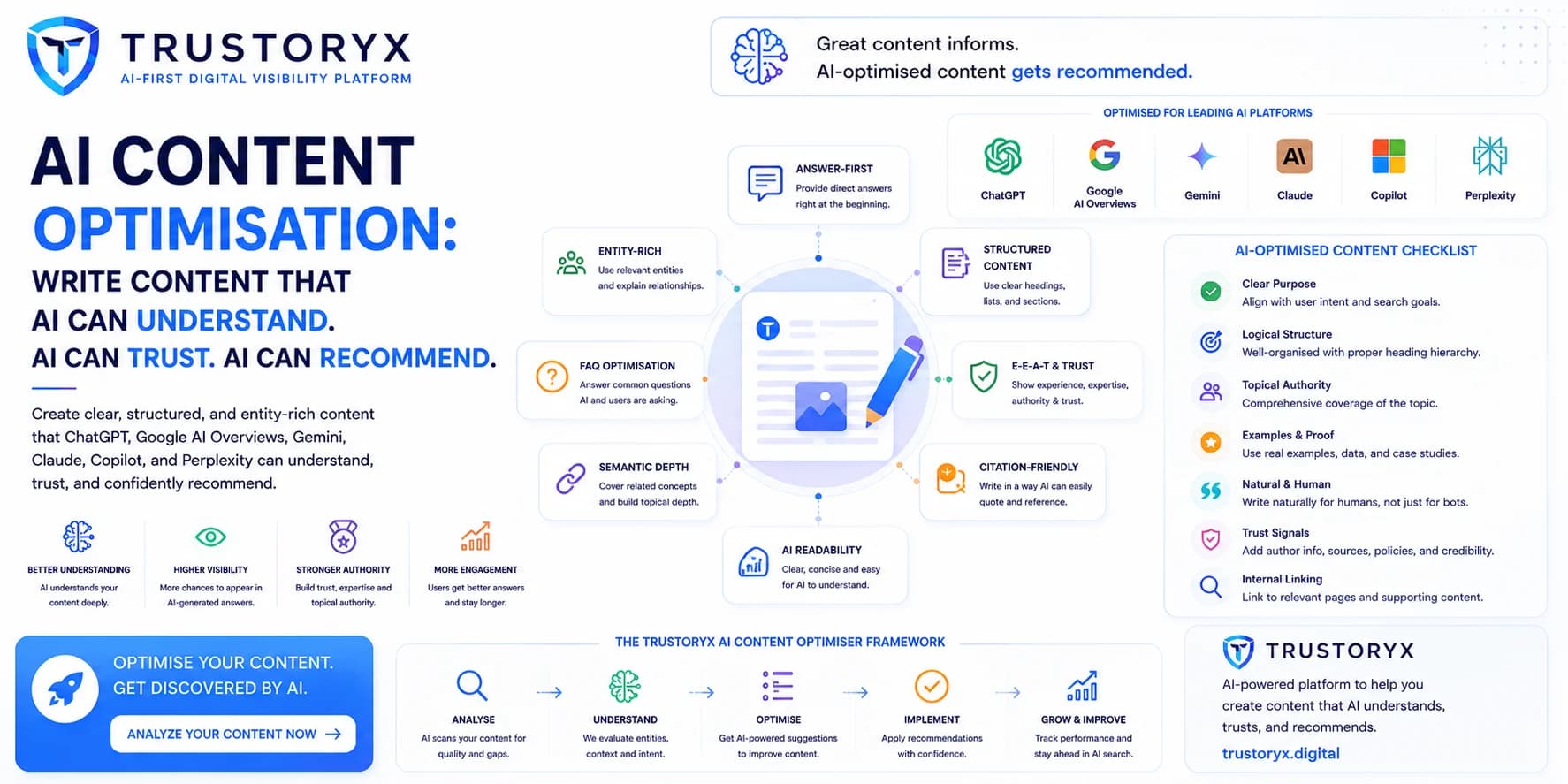
AI Content Optimisation: How to Write Content That ChatGPT, Google AI Overviews, Gemini, Claude, Copilot, and Perplexity Can Understand and Recommend
Introduction The internet is entering a new era. For decades, businesses created content primarily for search engines. Success depended on keywords, backli...
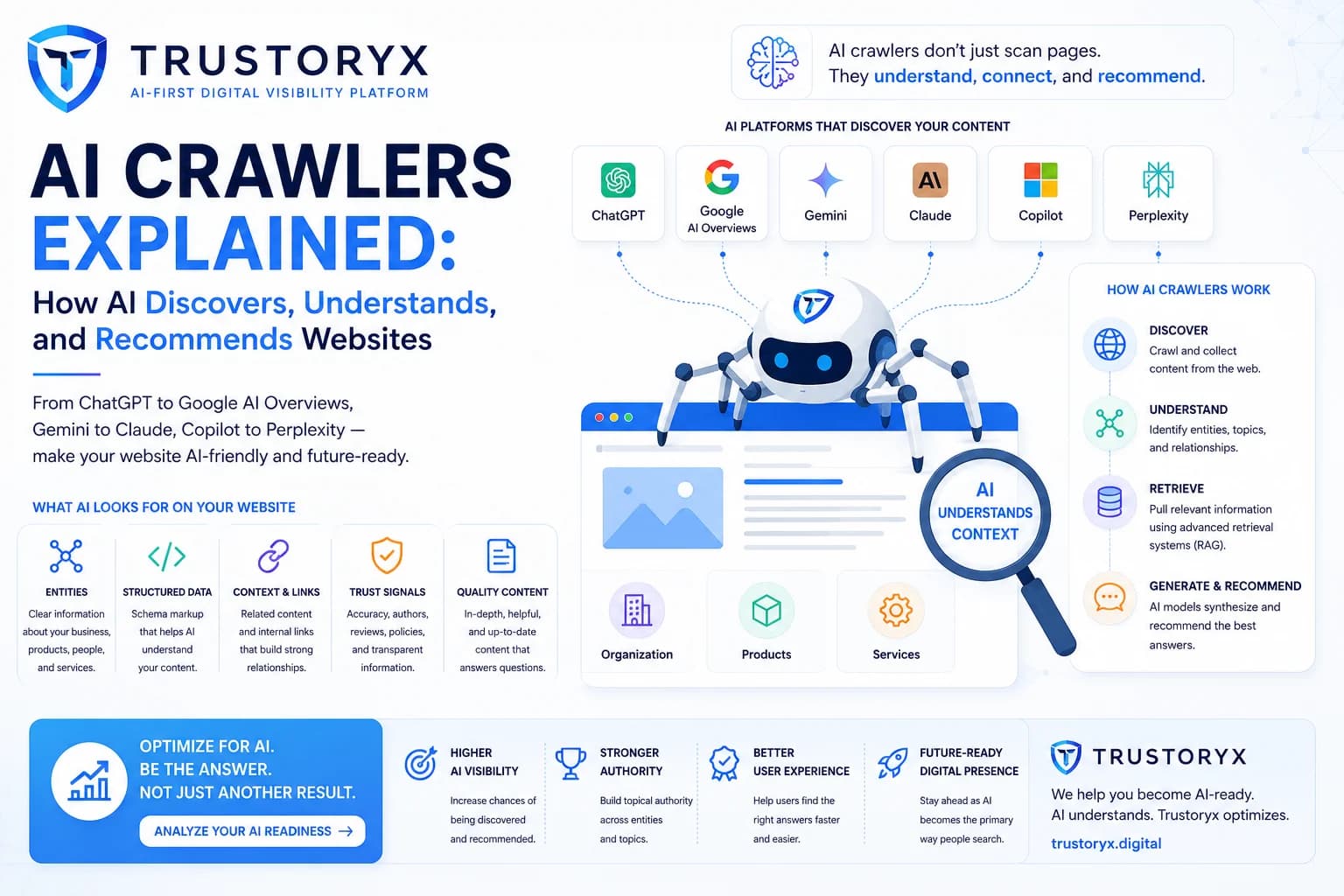
AI Crawlers Explained: How ChatGPT, Google AI Overviews, Gemini, Claude, Copilot, and Perplexity Discover and Understand Websites
Introduction For more than two decades, website owners optimised for one primary crawler: Googlebot. The objective was simple. Make your website easy to cr...
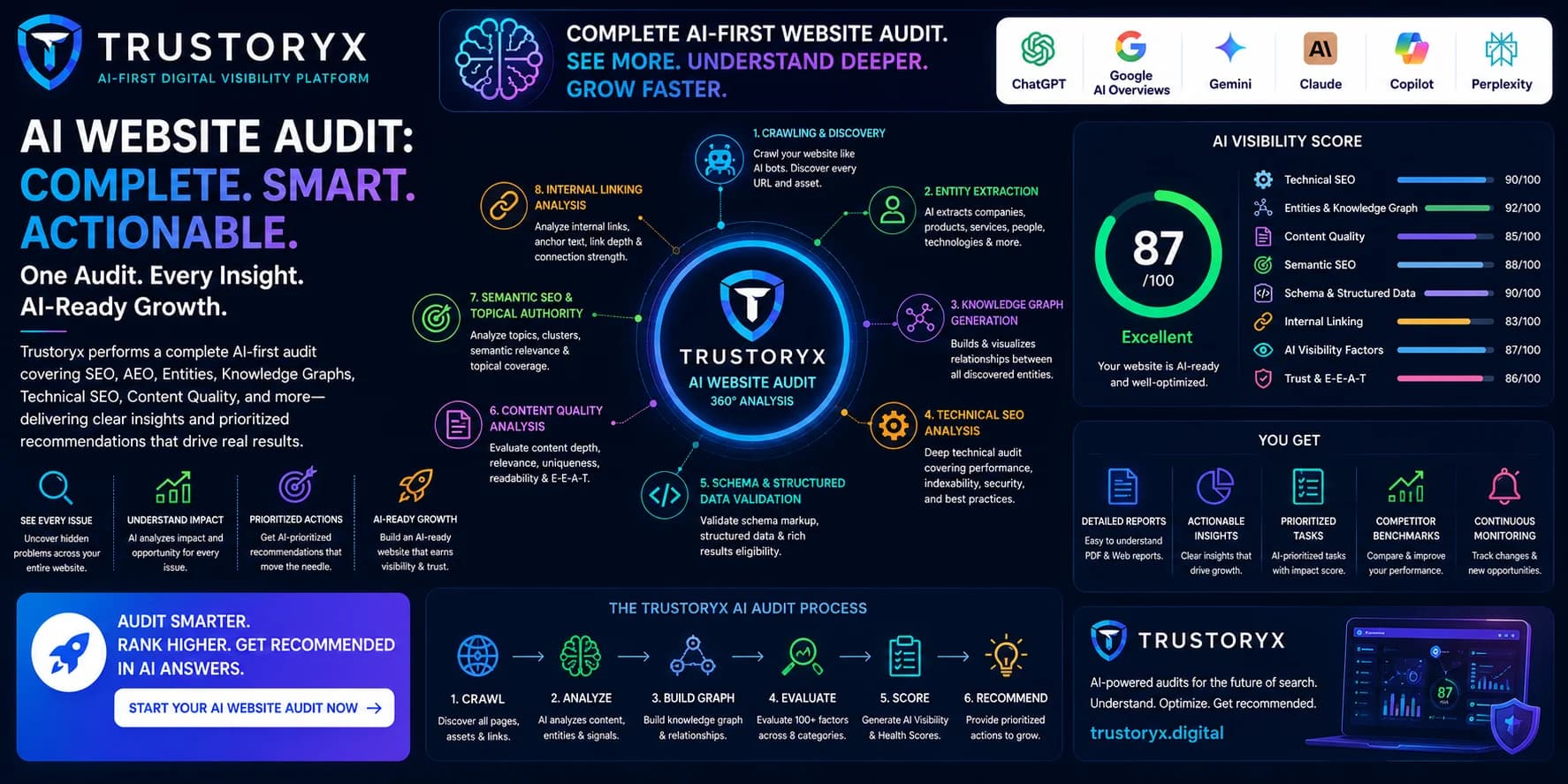
AI Website Audit: How Trustoryx Performs a Complete AI-First SEO, AEO, Entity, Knowledge Graph, and Technical Website Analysis
Introduction For years, website audits focused on a limited set of SEO metrics such as page speed, metadata, backlinks, and keyword rankings. Learn how Trustoryx conducts full AI-first audits.
Ready to Scale Your Search & Revenue?
Attract, Convert & Dominate Globally.
Get a complimentary 30-point SEO and Growth Audit. We identify competitor gaps, technical bottlenecks, and actionable quick wins in 48 hours.