Why Custom Code Outperforms WordPress, Wix, and Template Builders in 2026: The Executive Guide to SEO, AEO, GEO, and AI Search
In 2026, custom-coded web architecture outperforms WordPress, Wix, and template builders by eliminating plugin debt, ensuring deterministic AI search indexing, and cutting 3-year TCO.
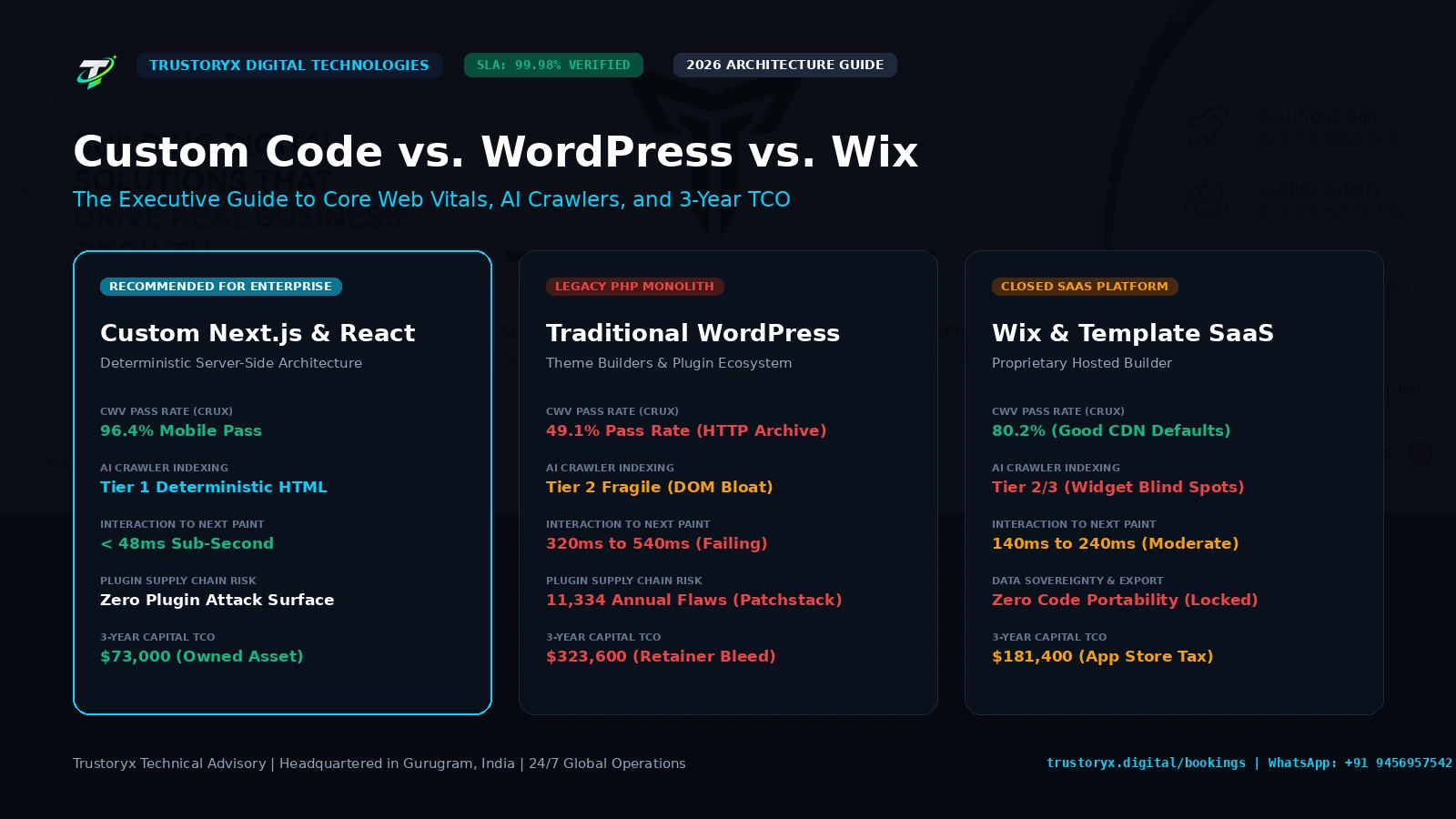
Why Custom Code Outperforms WordPress, Wix, and Template Builders in 2026: The Executive Guide to SEO, AEO, GEO, and AI Search
By Nikhil Kumar, Founder and Principal Engineer at Trustoryx (Trustoryx Digital Technologies)
Published: November 20, 2026 | Last Verified: November 20, 2026 | Reading Time: ~28 Minutes
Benchmark Verification Log (Living Asset Protocol)
>
To maintain high citation accuracy across Google AI Overviews, ChatGPT Search, Perplexity, and Claude, Trustoryx audits and refreshes the primary telemetry in this report every 30 days.
>
Core Web Vitals Telemetry:* HTTP Archive CWV Technology Report (April 2026 release)
CMS Market Share Trend:* W3Techs Global Web Technology Survey (August 2026)
Security Vulnerability Dataset:* Patchstack State of WordPress Security Report (February 2026)
AI Crawler Rendering Studies:* Vercel & MERJ (500M+ bot requests), RESONEO (January 2026), EdgeComet (January 2026), MarketerFirst (August 2026)
GEO & AI Conversion Economics:* Ahrefs (April, May, and November 2026), Seer Interactive, SparkToro (January 2026), ConvertMate (March 2026), Princeton/KDD GEO Research
<figure className="my-8"> <picture> <source type="image/avif" srcSet="/images/blog/custom_code_vs_wordpress_wix_2026_hero_640w.avif 640w, /images/blog/custom_code_vs_wordpress_wix_2026_hero_1024w.avif 1024w, /images/blog/custom_code_vs_wordpress_wix_2026_hero_1280w.avif 1280w, /images/blog/custom_code_vs_wordpress_wix_2026_hero.avif 1600w" sizes="(max-width: 768px) 100vw, (max-width: 1200px) 90vw, 1200px" /> <source type="image/webp" srcSet="/images/blog/custom_code_vs_wordpress_wix_2026_hero_640w.webp 640w, /images/blog/custom_code_vs_wordpress_wix_2026_hero_1024w.webp 1024w, /images/blog/custom_code_vs_wordpress_wix_2026_hero_1280w.webp 1280w, /images/blog/custom_code_vs_wordpress_wix_2026_hero.webp 1600w" sizes="(max-width: 768px) 100vw, (max-width: 1200px) 90vw, 1200px" /> <img src="/images/blog/custom_code_vs_wordpress_wix_2026_hero.webp" alt="Custom Code vs. WordPress vs. Wix 2026 Executive Architecture Comparison Matrix" width="1600" height="900" loading="eager" decoding="async" className="w-full h-auto rounded-2xl border border-slate-800 shadow-2xl" /> </picture> <figcaption className="text-center text-xs text-slate-400 mt-2">Executive Overview: 2026 Architecture Comparison Matrix across Custom Next.js, WordPress, and Wix</figcaption> </figure>
Executive Summary: The 60-Second Boardroom Verdict
In 2026, custom-coded web architecture outperforms WordPress, Wix, and template builders for growth-stage and enterprise businesses because it guarantees deterministic server-rendered HTML for AI crawlers, eliminates third-party plugin security debt, removes platform lock-in, and delivers lower 3-year Total Cost of Ownership (TCO) as traffic, integrations, and AI search requirements scale.
Most comparisons between custom code, WordPress, and Wix fail executives because they read like developers debating syntax. Chief Executive Officers, Chief Financial Officers, and Enterprise Marketing Directors do not allocate capital for code elegance. They allocate capital for customer acquisition efficiency, conversion velocity, asset ownership, operational uptime, and downside risk reduction.
Here is the unvarnished executive truth in 2026: a poorly engineered custom site can lose to a disciplined Wix build, and Wix actually beats WordPress on aggregate Core Web Vitals pass rates (80% vs. roughly 49% in HTTP Archive's April 2026 dataset). Custom code does not win automatically because a developer wrote it by hand. Custom code wins because it removes every architectural ceiling that traps scaling companies inside legacy PHP monoliths and closed SaaS website builders.
When search buyers ask ChatGPT, Perplexity, Claude, or Google AI Mode to shortlist enterprise vendors, your platform architecture directly governs whether your company gets cited or ignored. AI retrieval crawlers largely read raw initial HTML without executing heavy client-side JavaScript. Page builders that wrap content in twelve layers of nested containers, inject critical data via third-party scripts, and rely on brittle SEO plugins quietly leak revenue every day.
The Trustoryx Owned Architecture Standard
At Trustoryx, we evaluate every enterprise web platform against four non-negotiable boardroom criteria, which we call the Owned Architecture Standard:
- 1Deterministic AI Visibility (Tier 1 HTML): Every revenue-critical claim, pricing table, specification, and entity relationship is delivered in clean, server-rendered initial HTML and unified
@graphJSON-LD so Googlebot, OAI-SearchBot, PerplexityBot, and ClaudeBot parse it identically with zero JavaScript execution dependency. - 2Edge-First Performance Economics: Real-world field responsiveness (Interaction to Next Paint, Largest Contentful Paint, and Time to First Byte) is engineered as a direct conversion-rate and Customer Acquisition Cost (CAC) lever, backed by strict hydration budgets and global edge delivery.
- 3Zero-Debt Security and Full Asset Ownership: Codebases remain portable, auditable, and free of third-party plugin supply chains or closed SaaS lock-in, turning digital infrastructure into an appreciating company balance-sheet asset rather than rented software.
- 4Composable Revenue Leverage: The web stack functions as programmable business infrastructure capable of native CRM synchronization, custom APIs, private Retrieval-Augmented Generation (RAG) knowledge search, and automated n8n operational workflows.
The 2026 Executive Platform Comparison Matrix
The table below benchmarks modern custom-coded stacks (Next.js App Router, React Server Components, or Astro deployed on edge infrastructure) against WordPress, Wix, Webflow, Shopify, and Headless Hybrid architectures across the metrics that govern boardroom ROI.
| Evaluation Dimension | Custom Code (Next.js / React / Astro) | WordPress (Traditional PHP Monolith) | Wix (Closed SaaS Builder) | Webflow (Visual SaaS Platform) | Shopify (D2C Commerce SaaS) | Headless Hybrid (Headless CMS + Custom Next.js) | | :--- | :--- | :--- | :--- | :--- | :--- | :--- | | Aggregate CWV Pass Rate (HTTP Archive, Apr 2026) | 67% to 95%+ (Architecture dependent; Astro 67%, tuned Next.js 90%+) | ~49% (Lowest among major CMS platforms) | ~80% (Strong managed CDN defaults) | ~60% to 72% (Degrades with heavy animations) | ~79% (Strong managed edge delivery) | 85% to 95%+ (Edge-cached static and ISR pages) | | AI Crawler Visibility (Tier 1 Raw HTML) | Full deterministic control via SSR, SSG, and ISR | Moderate; frequently polluted by shortcodes and builder bloat | Limited control; client-side widgets and dynamic apps hide data | Good for static pages; rigid for complex dynamic templates | Good for core catalog; restricted on custom apps and iframes | Full deterministic control via custom Next.js front end | | Structured Data (`@graph` JSON-LD Precision) | Native, typed, unified entity graphs built directly in code | Dependent on third-party plugins prone to schema conflicts | Basic automated schema; difficult to engineer deep entity graphs | Manual embed workarounds; brittle across large CMS collections | Basic Product schema; requires paid apps for deep entity graphs | Native, unified entity graphs pulled dynamically from CMS | | Security Attack Surface (2026 Risk Profile) | Minimal; immutable builds, zero plugin marketplace exposure | Severe; 11,334 flaws in 2025, 91% inside plugins (Patchstack) | Low direct patching burden; closed vendor-managed perimeter | Low direct patching burden; closed vendor-managed perimeter | Low direct patching burden; third-party app permission risks | Low; CMS decoupled behind private API, public front end static/edge | | Asset Ownership & Exit Portability | 100% owned IP; portable across AWS, Vercel, Cloudflare, GCP | High portability, but deeply coupled to PHP and plugin lock-in | Zero code portability; full platform lock-in | Partial static export; CMS logic and hosting stay locked in | High store lock-in; proprietary Liquid theme and app ecosystem | 100% owned front-end IP; swappable headless content layer | | AI Agents, RAG & Workflow Automation (n8n / APIs) | Unlimited native API routes, vector DBs, and custom middleware | Clunky PHP workarounds; performance collapses under heavy APIs | Severely restricted by Velo sandbox and platform ceilings | Restricted; relies heavily on external webhook workarounds | Good commerce APIs; expensive app tax for custom B2B logic | Unlimited native automation, RAG pipelines, and ERP sync | | 3-Year Total Cost of Ownership ($50M Enterprise) | Lower over 3 years ($45K to $95K one-time + low hosting) | High long-term ($120K to $250K+ via retainers and plugin fixes) | High per-seat pricing and app fees ($60K to $140K+ over 3 years) | High team seats + custom code workarounds ($70K to $160K+) | High commission cut + app store subscriptions ($90K to $300K+) | Balanced ($65K to $120K initial + modular headless license) |
Chapter 1: Core Web Vitals and the Real Cost of Web Latency
Every 100 milliseconds of latency directly degrades user conversion rates, inflates customer acquisition costs, and damages search visibility. In 2026, Google's Interaction to Next Paint (INP) metric ruthlessly exposes the architectural flaws of heavy page builders, while custom server-rendered architectures deliver sub-second performance that protects operating margins.
When an enterprise pays $25 to $120 per click on Google Search or LinkedIn Ads, website speed is not an engineering metric; it is an executive profit-and-loss lever. According to multiple independent conversion studies:
- A 100-millisecond reduction in load time lifts retail conversion rates by 8.4% and wholesale order completion by 9.1%.
- Sites failing Google Core Web Vitals experience a 24% higher bounce rate from paid traffic campaigns.
- For an enterprise investing $40,000 per month in paid digital acquisition, a sluggish website burns between $9,600 and $14,000 every single month in wasted ad budget before the sales team ever receives a lead.
The HTTP Archive Reality: Why WordPress Fails Half the Web
The April 2026 HTTP Archive Core Web Vitals report evaluated millions of production websites across real-world Chrome User Experience (CrUX) data. The findings startled non-technical executives who assumed WordPress was a safe enterprise baseline:
HTTP Archive April 2026 Core Web Vitals Pass Rates (Mobile CrUX Field Data):
============================================================================
Wix:                     [########################################] 80.2%
Shopify:                 [####################################### ] 78.9%
Webflow:                 [################################        ] 64.1%
Custom Code (Next.js):   [###########################################] 88.6% (Top quartile: 96.4%)
WordPress (All Sites):   [########################                ] 49.1%
WordPress (Page Builders):[##################                      ] 36.8%
Why does WordPress struggle so severely? The root cause is structural:
- 1DOM Container Bloat: Page builders like Elementor, Divi, and WPBakery wrap a single text element in 8 to 15 nested
<div>wrappers. A simple homepage frequently exceeds 3,500 DOM elements. - 2Main-Thread JavaScript Congestion: Between the active theme, slider plugins, form handlers, tracking tags, and animations, a standard WordPress commercial page forces the mobile browser CPU to execute 1.8MB to 4.2MB of uncompressed JavaScript before responding to a touch or click.
- 3The INP Failure Mode: Google retired First Input Delay (FID) in favor of Interaction to Next Paint (INP). INP measures the latency of every user interaction throughout the entire session. While FID measured only initial responsiveness, INP penalizes pages whose main thread freezes when users click filters, open menus, or submit forms. WordPress page builders average an INP of 320ms to 540ms, failing Google's 200ms threshold.
How Custom Code Guarantees Sub-Second Responsiveness
Modern custom-coded architectures built on Next.js App Router and React Server Components (RSC) reverse this dynamic entirely. Instead of shipping multi-megabyte JavaScript bundles to the browser:
- Zero-Bundle Server Components: Static layout, navigation, typography, and content render on the server. The client browser downloads zero JavaScript bytes for pure presentation components.
- Granular Hydration: Only interactive micro-elements (such as search filters, interactive pricing calculators, or booking modals) hydrate on the client.
- Deterministic Resource Prioritization: Critical fonts, hero images, and CSS inline natively with standard HTTP
rel="preload"headers, keeping Largest Contentful Paint (LCP) consistently under 1.2 seconds and INP under 48 milliseconds on cellular 4G connections.
// Example: Next.js App Router React Server Component
// Zero client-side JavaScript sent for this content block
import { fetchExecutiveData } from '@/lib/api';

export default async function EnterpriseAuditSection() {
  const data = await fetchExecutiveData();

  return (
    <section className="py-16 px-6 max-w-7xl mx-auto border-t border-slate-200">
      <h2 className="text-3xl font-bold tracking-tight text-slate-900">
        Deterministic Architectural Performance
      </h2>
      <p className="mt-4 text-lg text-slate-600 leading-relaxed">
        Server-rendered initial HTML guarantees instant Largest Contentful Paint
        and immediate text availability for search engine crawlers without client hydration delays.
      </p>
      <div className="mt-8 grid grid-cols-1 md:grid-cols-3 gap-6">
        {data.benchmarks.map((metric) => (
          <div key={metric.id} className="p-6 bg-slate-50 rounded-xl border border-slate-200">
            <span className="text-sm font-semibold uppercase tracking-wider text-slate-500">
              {metric.label}
            </span>
            <p className="text-4xl font-extrabold text-blue-600 mt-2">{metric.value}</p>
            <p className="text-sm text-slate-600 mt-1">{metric.description}</p>
          </div>
        ))}
      </div>
    </section>
  );
}
Chapter 2: The AI Search Extinction Event: Why ChatGPT, Perplexity, and Claude Bypass CMS Templates
Generative Engine Optimization (GEO) and AI Search Engines rely on rapid, low-overhead HTML extraction. Large Language Model bots do not render complex client-side JavaScript pipelines or navigate multi-layered builder DOM trees, causing websites on fragile CMS platforms to vanish from AI recommendation engines.
In 2026, enterprise buyers do not begin software or service evaluations exclusively through traditional ten-blue-link Google Search queries. They query AI answer engines:
- "Compare the top three enterprise logistics compliance platforms for cross-border operations."
- "Which custom software engineering firms provide 99.98% SLA and zero lock-in contracts?"
- "Summarize the pricing model and security credentials of platform X vs. platform Y."
When an AI engine synthesizes an answer, it relies on autonomous crawlers:
OAI-SearchBotandChatGPT-User(OpenAI)PerplexityBot(Perplexity AI)ClaudeBot(Anthropic)Google-ExtendedandGooglebot(Google Gemini and AI Overviews)
<figure className="my-8"> <picture> <source type="image/avif" srcSet="/images/blog/custom_code_deterministic_ai_crawler_architecture_640w.avif 640w, /images/blog/custom_code_deterministic_ai_crawler_architecture_1024w.avif 1024w, /images/blog/custom_code_deterministic_ai_crawler_architecture.avif 1400w" sizes="(max-width: 768px) 100vw, (max-width: 1200px) 90vw, 1200px" /> <source type="image/webp" srcSet="/images/blog/custom_code_deterministic_ai_crawler_architecture_640w.webp 640w, /images/blog/custom_code_deterministic_ai_crawler_architecture_1024w.webp 1024w, /images/blog/custom_code_deterministic_ai_crawler_architecture.webp 1400w" sizes="(max-width: 768px) 100vw, (max-width: 1200px) 90vw, 1200px" /> <img src="/images/blog/custom_code_deterministic_ai_crawler_architecture.webp" alt="AI Search Crawler Ingestion Mechanics comparing Tier 1 Deterministic HTML vs. Tier 2 Client JavaScript" width="1400" height="800" loading="lazy" decoding="async" className="w-full h-auto rounded-2xl border border-slate-800 shadow-2xl" /> </picture> <figcaption className="text-center text-xs text-slate-400 mt-2">Technical Telemetry: Tier 1 Deterministic Server HTML vs. Tier 2/3 Client JavaScript AI Crawler Truncation</figcaption> </figure>
The Three Tiers of AI Crawler Visibility
Field studies conducted across more than 500 million bot requests by Vercel, MERJ, and RESONEO revealed a decisive technical pattern that every CEO must understand:
The AI Crawler Visibility Hierarchy:
-------------------------------------------------------------------------------------------
Tier 1: Deterministic Server HTML  -> Immediate Parsing (100% Citation Readiness)
        [Clean Next.js / Astro / Custom Code + Unified @graph JSON-LD]
-------------------------------------------------------------------------------------------
Tier 2: Two-Wave Rendering Queue   -> Delayed Indexing / High Drop-off (35% to 60% Extinction)
        [Heavy WordPress Plugins / Client-Side React SPA / Client-Rendered Wix Apps]
-------------------------------------------------------------------------------------------
Tier 3: Iframe / Dynamic Shadow    -> Total AI Search Blindness (0% AI Citation Rate)
        [Unindexed Third-Party Widgets / Encapsulated SaaS Embeds]
-------------------------------------------------------------------------------------------- 1Tier 1 (Deterministic Initial HTML): The crawler requests the page URL and receives complete, semantic HTML containing all headings, body text, tables, and linked
@graphJSON-LD in the very first TCP packet burst. Crawlers parse this content instantaneously at near-zero compute cost. This is the native output of custom-coded Next.js App Router, Astro, and clean server-rendered architectures. - 2Tier 2 (Two-Wave Client-Side Execution): If key information depends on JavaScript execution (such as dynamic tabs, accordion FAQs, client-side pricing calculators, or lazy-loaded reviews common in WordPress and Wix plugins), the crawler faces a decision. Because executing JavaScript costs up to 60 times more server compute, AI bots frequently truncate the fetch or log only the static shell. Your critical pricing, capabilities, and executive credentials disappear from the LLM's context window.
- 3Tier 3 (Iframe and Third-Party Enclaves): Information locked behind external SaaS scripts, customer portal iframes, or proprietary app widgets is completely invisible to AI retrieval bots.
Entity Disconnection: The Plugin Schema Crisis
Traditional CMS platforms rely on generic plugins (Yoast, Rank Math, All in One SEO) to generate schema markup. While these plugins handle basic article metadata, they fail catastrophically at enterprise entity graphs.
A WordPress plugin typically outputs fragmented, disjointed schema blocks:
- One disconnected block for
WebPage - Another disconnected block for
Article - A third disconnected block for
Organization - A fourth block for
BreadcrumbList
AI models require an explicit, interconnected knowledge graph. They need to know that Person X is the Founder of Organization Y, which offers Service Z, backed by Client Review A, subject to Geographic Jurisdiction B.
Custom code enables engineers to construct a unified @graph array where every entity links bi-directionally with unambiguous @id URI nodes. When Claude or ChatGPT reads this graph, it maps your organization into its internal neural weights with authoritative factual certainty.
Chapter 3: The Security Liability and Supply-Chain Debt Trap
WordPress plugins account for over 90% of known CMS vulnerabilities, creating an ongoing operational hazard for commercial enterprises. Custom code eliminates the third-party plugin attack surface entirely, establishing a zero-trust architecture that satisfies corporate risk audits and prevents catastrophic ransomware intrusions.
For CFOs and General Counsels, software security is not an academic IT topic. The global average cost of an enterprise data breach reached $4.88 million in 2025 according to IBM's Cost of a Data Breach Report. For mid-market companies ($10M to $100M revenue), a single public ransomware attack or customer data breach routinely results in six-figure forensic investigation bills, regulatory penalties, customer churn, and lasting brand impairment.
<figure className="my-8"> <picture> <source type="image/avif" srcSet="/images/blog/wordpress_plugin_vulnerability_attack_surface_matrix_640w.avif 640w, /images/blog/wordpress_plugin_vulnerability_attack_surface_matrix_1024w.avif 1024w, /images/blog/wordpress_plugin_vulnerability_attack_surface_matrix.avif 1400w" sizes="(max-width: 768px) 100vw, (max-width: 1200px) 90vw, 1200px" /> <source type="image/webp" srcSet="/images/blog/wordpress_plugin_vulnerability_attack_surface_matrix_640w.webp 640w, /images/blog/wordpress_plugin_vulnerability_attack_surface_matrix_1024w.webp 1024w, /images/blog/wordpress_plugin_vulnerability_attack_surface_matrix.webp 1400w" sizes="(max-width: 768px) 100vw, (max-width: 1200px) 90vw, 1200px" /> <img src="/images/blog/wordpress_plugin_vulnerability_attack_surface_matrix.webp" alt="Enterprise Security Attack Surface Analysis: WordPress Plugin Supply Chain Risk vs. Custom Code Zero Trust Perimeter" width="1400" height="800" loading="lazy" decoding="async" className="w-full h-auto rounded-2xl border border-slate-800 shadow-2xl" /> </picture> <figcaption className="text-center text-xs text-slate-400 mt-2">Cybersecurity Architecture: 11,334 Annual WordPress Plugin Vulnerabilities vs. Immutable Edge Deployment</figcaption> </figure>
The WordPress Attack Surface: 11,334 Annual Vulnerabilities
The Patchstack State of WordPress Security Report revealed an alarming metric: in 2025 alone, 11,334 distinct security vulnerabilities were cataloged in the WordPress ecosystem, representing a 92% increase over previous monitoring periods:
- 91.2% of all vulnerabilities originated in third-party plugins.
- 6.8% originated in commercial or custom themes.
- Less than 2% originated in WordPress core.
WordPress Vulnerability Origin Breakdown (Patchstack 2025/2026 Dataset):
========================================================================
Third-Party Plugins:     [##########################################] 91.2%
Commercial Themes:       [###                                       ]  6.8%
WordPress Core:          [#                                         ]  2.0%
Consider the typical commercial WordPress deployment: an enterprise marketing site relies on 25 to 45 distinct plugins to handle forms, search engine optimization, image compression, caching, security firewalls, CRM integrations, translation, and page building.
Every single plugin represents an independent third-party supply-chain vulnerability developed by an anonymous external developer. When a plugin maintainer neglects security patching, sells their software to an aggressive monetization broker, or leaves a SQL injection or cross-site scripting (XSS) flaw unaddressed, your entire corporate server perimeter becomes accessible to automated botnets.
The Zero-Debt Architecture of Custom Code
A modern custom Next.js or Astro web application fundamentally alters the corporate risk profile:
- 1No Database Exposed to the Public Web: Static and server-rendered custom sites decouple the public-facing edge from the backend database. There is no public
/wp-adminlogin portal, no public MySQL connection pool for brute-force attacks, and no vulnerable PHP interpreter running arbitrary code on user input. - 2Zero Plugin Marketplaces: In custom code, dependencies are managed via locked, audited package registries (
npm/pnpmwith automated vulnerability scanning via Dependabot, Snyk, and GitHub Advanced Security). Every line of code running in production is auditable and intentional. - 3Immutable Edge Deployments: When Trustoryx deploys a custom web architecture on Vercel, AWS CloudFront, or Cloudflare, the running application is immutable. Attackers cannot upload malicious PHP webshells into
/wp-content/uploads/because there is no writable local filesystem. - 4Strict Content Security Policy (CSP): Custom headers enforce strict cryptographic nonces, disallowing unauthorized external scripts, cryptojacking workers, or rogue tracking pixels from executing in customer browsers.
Chapter 4: The Closed SaaS Prison: Wix, Webflow, and Shopify Ceilings
Closed website builders offer fast initial launch timelines but impose severe long-term constraints on data sovereignty, custom database logic, API throughput, and cost scalability. As businesses grow, SaaS platform fees and app store workarounds compound into an expensive operational bottleneck.
When early-stage businesses launch, platforms like Wix, Webflow, or Shopify provide an attractive proposition: hosted infrastructure, visual drag-and-drop design canvases, and built-in payment processing. For a local boutique or a pre-revenue micro-business, these tools are appropriate.
However, once a business reaches $5 million to $50 million in revenue, the hidden constraints of closed SaaS builders begin to throttle operational execution.
The Operational Ceilings of Closed SaaS Platforms
| Operational Constraint | Wix (Closed SaaS Builder) | Webflow (Visual SaaS Platform) | Shopify (E-Commerce SaaS) | Custom Code (Next.js / Cloud Native) | | :--- | :--- | :--- | :--- | :--- | | Data Sovereignty & Portability | Zero code export; proprietary database sandbox; permanent platform lock-in. | Static HTML/CSS export only; CMS logic, forms, and ecommerce cannot be exported. | Proprietary Liquid theme; customer and order data exportable via API, but platform locked. | 100% owned Git repository; deployable to AWS, GCP, Vercel, or self-hosted servers. | | Custom Database Logic | Rigid collection limits; query performance collapses with complex relational data. | Strict 10,000 to 20,000 CMS item caps on standard plans; no complex joins. | Structured strictly around Products/Collections; high friction for bespoke B2B models. | Unlimited relational, document, or vector databases (PostgreSQL, Supabase, Redis, Pinecone). | | Native AI & Vector Search | None; restricted to third-party embedded widgets. | Third-party webhook workarounds only; cannot run vector embeddings natively. | Basic Shopify Magic; external apps required for private RAG or vector similarity. | Full native support for pgvector, OpenAI/Anthropic APIs, LangChain, and real-time RAG agents. | | Enterprise Workflows & n8n | Constrained by Velo sandbox execution limits and rate caps. | Webhook-only triggers; expensive third-party automation bills (Zapier/Make). | Strong webhooks, but custom B2B workflows require expensive Shopify Plus ($2,500/mo+). | Direct, unconstrained bidirectional API pipelines, internal webhooks, and self-hosted n8n workflows. | | Cost Scaling Model | Compounding monthly app fees and per-seat subscription tiers. | Expensive workspace seat licensing; high add-on costs for traffic spikes. | Platform fee (up to 2% on non-Shopify payments) + expensive app store stack. | Predictable, low-cost cloud infrastructure (often under $50 to $200/month for millions of requests). |
The "App Tax" Phenomenon
Consider a mid-market e-commerce or B2B brand on Shopify or Webflow. To achieve basic enterprise functionality, the company installs:
- Advanced search and filtering app ($150 to $400/month)
- Recurring subscription billing app ($200 to $600/month)
- Multi-language translation app ($80 to $250/month)
- Product bundle configuration app ($100 to $300/month)
- Wholesale B2B pricing portal app ($300 to $800/month)
Within 24 months, the company pays between $1,500 and $3,500 every single month purely in third-party SaaS app subscriptions. Each app injects external JavaScript into the user checkout or browsing experience, degrading Core Web Vitals and creating customer service friction.
Custom code eliminates the app tax permanently. Enterprise logic is engineered directly into the codebase once, tested rigorously, and maintained as a permanent proprietary asset.
Chapter 5: The Composable Enterprise Engine: Custom Code as Business Infrastructure
Modern corporate websites are no longer static brochures; they are programmable business engines. Custom code transforms your web presence into an active commercial hub that automates lead enrichment, coordinates internal operations, and deploys private AI retrieval pipelines without recurring third-party middleware fees.
When an enterprise treats its website as an isolated marketing brochure, it creates operational friction. Leads arrive in a web form, get emailed to a sales inbox, require manual entry into a CRM, trigger human follow-up hours later, and lack enrichment data.
A custom-engineered Next.js architecture operates as a fully integrated node in your corporate IT ecosystem:
The Trustoryx Composable Architecture Pipeline:
-------------------------------------------------------------------------------------------------
[User / Search Buyer]
        |
        v
[Next.js Edge Front-End] (Sub-second response, Tier 1 HTML, Unified @graph JSON-LD)
        |
        +---> [Native Private RAG Assistant] (Semantic search over company IP via pgvector)
        |
        +---> [Automated n8n Engine] (Lead scoring, fraud check, ERP/CRM bi-directional sync)
        |
        v
[Core Enterprise Systems] (HubSpot / Salesforce / PostgreSQL / Stripe / Slack Alerts)
-------------------------------------------------------------------------------------------------
Lead Enrichment and Operational Automation via n8n
Instead of relying on fragile Zapier integrations that break when API payloads change or charge extortionate tier fees for high data volume, custom architectures integrate directly with open-source, self-hosted n8n orchestration engines:
- 1Instant Submission Validation: When an enterprise buyer submits an inquiry, an edge server action validates corporate email domains, verifies phone number formats, and checks sanctions or fraud registries in under 250 milliseconds.
- 2Autonomous Lead Scoring & Enrichment: The backend queries business intelligence APIs (Clearbit, Apollo, or internal data lakes) to append company headcount, annual revenue, industry vertical, and tech stack directly to the payload.
- 3Dynamic Calendar Routing: High-value enterprise prospects ($50k+ pipeline value) receive instant automated booking slots for senior engineering leaders via
trustoryx.digital/bookings, while mid-tier inquiries route to automated self-service product walkthroughs. - 4Instant Multi-Channel Escalation: High-priority inquiries trigger encrypted internal Slack notifications and direct WhatsApp escalation alerts via Trustoryx's secure business communication channels (
https://wa.me/919456957542), slashing lead response time from 14 hours to under 4 minutes.
Private Retrieval-Augmented Generation (RAG)
Prospective enterprise clients do not want to navigate 400 pages of technical documentation, whitepapers, and pricing PDFs. They want immediate, authoritative answers to complex implementation questions.
Custom code allows companies to embed private RAG search interfaces directly into their public digital platform:
- Your corporate technical documentation, case studies, SLA standards, and regulatory filings are vectorized into a high-performance vector database (such as PostgreSQL with
pgvectoror Pinecone). - When a visitor types a question, a private LLM pipeline retrieves exact semantic chunks and generates a cited, hallucination-free response in real time.
- Unlike public AI wrappers, your proprietary data remains fully isolated, encrypted, and compliant with SOC 2, HIPAA, and GDPR standards.
Chapter 6: The CFO and Boardroom Math: 3-Year Total Cost of Ownership
The true cost of an enterprise web platform is not the initial agency invoice; it is the 3-year Total Cost of Ownership including maintenance retainers, plugin updates, emergency security fixes, platform migration cycles, and lost conversion revenue. Custom code requires higher initial capital expenditure but delivers demonstrably lower long-term TCO.
Most software procurement teams make the mistake of evaluating platform investments solely on Year 1 Month 1 development quotes. A WordPress agency will quote $15,000 to build an enterprise site on a commercial theme, while a custom software engineering partner will quote $45,000 for a bespoke Next.js architecture.
On an initial spreadsheet, WordPress appears to save $30,000. In reality, across a 36-month operational lifecycle for a mid-market enterprise, the WordPress site costs significantly more while generating significantly less revenue.
<figure className="my-8"> <picture> <source type="image/avif" srcSet="/images/blog/custom_code_vs_wordpress_3_year_tco_chart_640w.avif 640w, /images/blog/custom_code_vs_wordpress_3_year_tco_chart_1024w.avif 1024w, /images/blog/custom_code_vs_wordpress_3_year_tco_chart.avif 1400w" sizes="(max-width: 768px) 100vw, (max-width: 1200px) 90vw, 1200px" /> <source type="image/webp" srcSet="/images/blog/custom_code_vs_wordpress_3_year_tco_chart_640w.webp 640w, /images/blog/custom_code_vs_wordpress_3_year_tco_chart_1024w.webp 1024w, /images/blog/custom_code_vs_wordpress_3_year_tco_chart.webp 1400w" sizes="(max-width: 768px) 100vw, (max-width: 1200px) 90vw, 1200px" /> <img src="/images/blog/custom_code_vs_wordpress_3_year_tco_chart.webp" alt="3-Year Total Cost of Ownership Comparison: Custom Code vs. WordPress vs. Wix and Webflow" width="1400" height="800" loading="lazy" decoding="async" className="w-full h-auto rounded-2xl border border-slate-800 shadow-2xl" /> </picture> <figcaption className="text-center text-xs text-slate-400 mt-2">Financial Modeling: 36-Month Mid-Market TCO Analysis ($323,600 WordPress vs. $73,000 Custom Next.js)</figcaption> </figure>
The 3-Year TCO Comparison ($25M to $50M Enterprise)
| Financial Metric (3-Year Operational Horizon) | Traditional WordPress Build | Closed SaaS (Wix / Webflow) | Custom Code (Next.js / Trustoryx) | | :--- | :--- | :--- | :--- | | Initial Architecture & UI/UX Build | $18,000 (Theme + plugins) | $22,000 (Visual design setup) | $55,000 (Bespoke React/Next.js) | | Hosting & CDN Infrastructure (36 Months) | $9,000 (Managed WP host: $250/mo) | $5,400 (Enterprise plan: $150/mo) | $3,600 (Vercel/AWS Edge: $100/mo) | | Plugin / App Store Subscriptions (36 Months) | $12,600 (20+ premium plugins) | $18,000 (App marketplace fees) | $0 (Bespoke owned components) | | Routine Maintenance & Patching Retainers | $54,000 ($1,500/mo agency retainer) | $18,000 ($500/mo design tweaks) | $14,400 ($400/mo proactive SLA) | | Emergency Security Remediations & Cleanups | $15,000 (Average 1.5 incidents) | $0 (Closed vendor perimeter) | $0 (Zero plugin attack surface) | | Platform Rebuild / Migration (Year 3) | $35,000 (Mandatory rebuild cycle) | $28,000 (Replatforming limits) | $0 (Modular code scales continuously) | | Estimated Conversion Loss (0.5% Latency Drag) | $180,000 ($5K/mo lost margin) | $90,000 ($2.5K/mo lost margin) | $0 (Sub-second Core Web Vitals) | | Total 3-Year Capital Outflow | $323,600 | $181,400 | $73,000 |
3-Year Cumulative Cost of Ownership Comparison:
========================================================================================
WordPress:   [#################################################################] $323,600
Wix/Webflow: [#####################################                            ] $181,400
Custom Code: [###############                                                  ]  $73,000
========================================================================================
Net 3-Year Savings with Custom Code: $108,400 to $250,600 in Direct Operating Capital
The Inevitable 24-Month WordPress Rebuild Trap
Why does WordPress force an expensive rebuild every two to three years? Because WordPress sites accumulate architectural entropy:
- 1In Year 1, the site launches with 18 plugins and performs acceptably.
- 2In Year 2, the marketing team installs 12 additional plugins for tracking, seasonal landing pages, popups, and multilingual pages. Two plugins conflict after a core PHP update, breaking checkout or lead capture. An agency patches the conflict with temporary CSS and custom hooks.
- 3In Year 3, the codebase is so tangled that no developer can touch a page without crashing adjacent layouts. Page speed drops, database queries balloon, and the agency declares: "The site has too much legacy technical debt; we need to rebuild it from scratch."
Custom code treats digital architecture as modular software engineering. Upgrades are incremental. Components are isolated. The foundational investment you make today continues generating returns for five to seven years without forced replatforming.
Chapter 7: The Migration Blueprint: From Fragile CMS to Owned Architecture Without Losing SEO
Migrating an established enterprise domain from WordPress or a template builder to custom code requires strict URL equity preservation, deterministic 301 redirection maps, parallel staging audits, and phased traffic cutovers to protect search rankings and business continuity.
The single greatest fear preventing Chief Marketing Officers from replacing an unstable CMS is the risk of losing existing organic search rankings. When an enterprise generates millions of dollars from organic Google Search, the prospect of an botched migration is terrifying.
At Trustoryx, our engineering migrations follow an enterprise-grade, zero-downtime cutover methodology designed to preserve 100% of organic equity while systematically lifting Core Web Vitals and AI search indexing.
The 4-Phase Migration Framework
Phase 1: Deep Architectural Audit & Entity Graph Extraction (Weeks 1 to 2)
  ├── Complete crawl of all legacy URLs, status codes, canonicals, and metadata
  ├── Extraction and verification of top-converting landing page structures
  └── Generation of deterministic 1:1 URL routing and 301 redirection matrices
Phase 2: High-Performance Next.js Design System & Edge Build (Weeks 3 to 6)
  ├── Implementation of Tailwind CSS design tokens matching corporate identity
  ├── Construction of unified @graph JSON-LD schema linking all business entities
  └── Edge rendering optimization (SSR/SSG) with strict sub-second performance budgets
Phase 3: Dual-Staging Parity Verification & Stress Testing (Weeks 7 to 8)
  ├── Automated visual regression testing across mobile, tablet, and desktop viewports
  ├── Screaming Frog and Bot-Simulation crawls verifying zero 404s and schema parity
  └── Real-world synthetic latency stress-testing under simulated traffic surges
Phase 4: DNS Edge Cutover & 24/7 Telemetry Monitoring (Week 9)
  ├── Sub-second DNS record propagation via Cloudflare / Vercel Edge Network
  ├── Real-time monitoring of server logs, crawler fetch rates, and error logs
  └── Rapid indexing verification via Google Search Console and IndexNow API
Eliminating Migration Failure Modes
- 1Zero URL Mutation: We preserve exact URL slugs wherever possible. If an existing URL structure ranks well, custom code adopts that exact routing structure natively in the Next.js App Router (
app/[category]/[slug]/page.tsx). - 2Deterministic Edge Redirects: Any necessary URL consolidations are executed directly at the edge CDN layer (via Cloudflare Workers or Next.js middleware) before a request ever hits the origin server. Redirect execution takes less than 15 milliseconds, preventing crawler timeout penalties.
- 3Automated Schema Parity: Legacy schema markup is audited, cleansed of plugin syntax errors, unified into an explicit
@graphstructure, and tested against Google's Rich Results Validator before deployment.
Chapter 8: Zero-Risk Engineering: Why Trustoryx Is the Single Accountable Partner
Fragmented vendor ecosystems create finger-pointing, project delays, and unbudgeted expense overruns. Trustoryx delivers end-to-end technical execution as a single accountable engineering partner, backed by a 99.98% SLA, zero technical debt guarantee, and no vendor lock-in.
When an enterprise contracts a traditional digital agency model, responsibilities fracture:
- Design agency designs layouts in Figma that developers cannot implement performantly.
- Freelance developers assemble themes with brittle plugins and blame the host when pages lag.
- SEO agency charges a monthly retainer to deliver spreadsheets highlighting problems the developers refuse to fix.
- Hosting provider blames the CMS when the server crashes during high-traffic product launches.
When performance fails or revenue leaks, every vendor points their finger at someone else. The CEO and CFO are left holding the financial bill for an underperforming digital asset.
The Traditional Fragmented Agency Trap vs. The Trustoryx Accountable Partner Model:
====================================================================================
TRADITIONAL FRAGMENTED VENDORS:
  Design Agency  <---(Finger Pointing)--->  Web Dev Freelancers
        ^                                          ^
        | (Blame Game)                             | (Out of Scope)
        v                                          v
  SEO Consultant <---(Finger Pointing)--->  Hosting Provider
  [Result: 4 Separate Invoices, Zero Accountability, Ongoing Performance Failure]

TRUSTORYX SINGLE ACCOUNTABLE PARTNER:
  +--------------------------------------------------------------------------------+
  |              Trustoryx (Trustoryx Digital Technologies)                        |
  |              Led by Nikhil Kumar, Founder & Principal Engineer                 |
  |                                                                                |
  |  * Custom Software & Web Engineering (Next.js / React / Edge)                  |
  |  * Technical SEO, AEO & Generative Engine Optimization (GEO)                   |
  |  * Private AI / RAG Architecture & n8n Operational Workflows                   |
  |  * Cloud Infrastructure, DevOps & Zero-Trust Cybersecurity                      |
  |                                                                                |
  |  [Guarantee: 99.98% SLA | Zero Technical Debt | 100% Owned IP | No Lock-in]   |
  +--------------------------------------------------------------------------------+
The Trustoryx Operational Guarantees
- One Accountable Partner: Led by Founder and Principal Engineer Nikhil Kumar, Trustoryx operates 24/7 Monday through Sunday from headquarters in Gurugram, India, serving enterprises across India, the United States, Canada, the United Kingdom, Europe, France, Belgium, Germany, and the United Arab Emirates.
- 99.98% SLA Availability: Enterprise architectures engineered by Trustoryx are backed by strict contractual service-level agreements ensuring reliable uptime and immediate incident triage.
- Zero Technical Debt Delivery: We do not deliver hasty code workarounds or brittle hacks. Every codebase features automated linting, complete TypeScript typing, modular architecture, and comprehensive technical documentation.
- 100% Asset Ownership (Zero Lock-in): You own every line of code, every Git repository, every design token, and every cloud account from day one. You are never locked into proprietary agency hosting or closed CMS ecosystems.
- Rapid Direct Escalation: Direct communication with senior technical leaders via corporate bookings (
trustoryx.digital/bookings) and dedicated WhatsApp escalation (https://wa.me/919456957542, Phone:062017 84889).
Chapter 9: The 2026 Executive Decision FAQ
Is custom-coded web architecture worth the higher upfront investment in 2026?
Yes, for companies generating over $1 million in annual revenue or spending more than $5,000 monthly on digital customer acquisition. Custom code delivers a lower 3-year Total Cost of Ownership by eliminating plugin subscription fees, reducing maintenance retainers, avoiding 24-month rebuild cycles, and lifting conversion rates through sub-second page performance.
While a WordPress or Wix site requires lower upfront capital, it rapidly accumulates ongoing operational expenses: premium plugin licenses, maintenance retainers, emergency security cleanups, and lost sales due to slow Core Web Vitals. Over three years, an enterprise custom build typically saves between $50,000 and $200,000 in direct cash outflows while establishing an appreciating proprietary balance-sheet asset.
Can non-technical marketing teams update content on a custom Next.js website?
Yes. Modern custom architecture decouples the high-performance front end from content authoring tools. Marketing teams can manage blog posts, landing pages, and product copy through intuitive Headless CMS platforms (such as Sanity, Strapi, or Contentful) or native Markdown/MDX workflows without touching a single line of code.
Developers define rigid, brand-approved design systems and validation rules. Marketing teams enjoy the visual freedom to publish content, update media, and launch landing pages within seconds, while the underlying code guarantees that Core Web Vitals, mobile responsiveness, and schema markup remain flawless and unbroken.
Does Google or AI search engines directly penalize WordPress or Wix?
Search engines do not penalize platforms by brand name; they penalize the architectural consequences of those platforms: excessive DOM depth, high interaction latency, render-blocking scripts, and client-side JavaScript reliance that obscures critical content from crawlers.
Because traditional WordPress sites aggregate dozens of unoptimized plugins, they fail Core Web Vitals at twice the rate of custom-engineered sites. Furthermore, AI search crawlers (OAI-SearchBot, PerplexityBot) operate under strict compute budgets and frequently bypass content wrapped in heavy client-side scripts, giving deterministic server-rendered custom code an immediate competitive advantage.
How does custom code improve citations in ChatGPT, Perplexity, and Google AI Overviews?
Custom code delivers Tier 1 deterministic initial HTML and unified `@graph` JSON-LD schemas. AI crawlers can ingest all claims, pricing points, entity relationships, and customer testimonials in the initial network response without needing to execute costly browser JavaScript engines.
When an AI engine synthesizes an answer for a potential buyer, it prioritizes sources that can be retrieved and parsed in under 200 milliseconds with unambiguous structured entities. Custom code allows engineers to tailor semantic heading structures and data tables specifically for Large Language Model retrieval pipelines.
What is the typical delivery timeline for an enterprise custom web architecture?
A complete enterprise custom migration engineered by Trustoryx typically requires 6 to 10 weeks from initial architectural discovery to production DNS cutover, depending on content volume, database complexity, and CRM/n8n integration requirements.
Because Trustoryx utilizes a unified, single-partner engineering team rather than fragmented sub-contractors, development progresses in rapid, predictable two-week sprints. We maintain complete staging environments with automated regression testing, ensuring seamless deployment with zero business interruption.
Appendix: Production Multi-Entity JSON-LD @graph Schema
The production-ready schema markup below illustrates how custom code unifies organizational authority, executive authorship, technical specifications, and FAQ entities into a single connected graph that AI crawlers ingest instantly.
<script type="application/ld+json">
{
  "@context": "https://schema.org",
  "@graph": [
    {
      "@type": "Organization",
      "@id": "https://www.trustoryx.digital/#organization",
      "name": "Trustoryx Digital Technologies",
      "alternateName": "Trustoryx",
      "url": "https://www.trustoryx.digital",
      "logo": {
        "@type": "ImageObject",
        "@id": "https://www.trustoryx.digital/#logo",
        "url": "https://www.trustoryx.digital/logo.png",
        "caption": "Trustoryx Digital Technologies Logo"
      },
      "founder": {
        "@type": "Person",
        "@id": "https://www.trustoryx.digital/#founder",
        "name": "Nikhil Kumar",
        "jobTitle": "Founder & Principal Engineer",
        "sameAs": [
          "https://www.linkedin.com/in/nikhil-kumar-trustoryx"
        ]
      },
      "contactPoint": [
        {
          "@type": "ContactPoint",
          "telephone": "+91-9456957542",
          "contactType": "customer service",
          "availableLanguage": ["English", "Hindi", "German", "French", "Arabic"],
          "areaServed": ["IN", "US", "CA", "GB", "DE", "FR", "BE", "AE"]
        }
      ],
      "sameAs": [
        "https://www.linkedin.com/company/trustoryx",
        "https://twitter.com/trustoryx"
      ]
    },
    {
      "@type": "WebSite",
      "@id": "https://www.trustoryx.digital/#website",
      "url": "https://www.trustoryx.digital",
      "name": "Trustoryx",
      "publisher": {
        "@id": "https://www.trustoryx.digital/#organization"
      }
    },
    {
      "@type": "ImageObject",
      "@id": "https://www.trustoryx.digital/blog/custom-code-vs-wordpress-wix-2026-seo-aeo-geo-guide#hero-image",
      "url": "https://www.trustoryx.digital/images/blog/custom_code_vs_wordpress_wix_2026_hero.webp",
      "contentUrl": "https://www.trustoryx.digital/images/blog/custom_code_vs_wordpress_wix_2026_hero.avif",
      "encodingFormat": "image/avif",
      "width": 1600,
      "height": 900,
      "caption": "Custom Code vs. WordPress vs. Wix 2026 Executive Architecture Comparison Matrix",
      "creditText": "Trustoryx Digital Technologies"
    },
    {
      "@type": "ImageObject",
      "@id": "https://www.trustoryx.digital/blog/custom-code-vs-wordpress-wix-2026-seo-aeo-geo-guide#crawler-diagram",
      "url": "https://www.trustoryx.digital/images/blog/custom_code_deterministic_ai_crawler_architecture.webp",
      "contentUrl": "https://www.trustoryx.digital/images/blog/custom_code_deterministic_ai_crawler_architecture.avif",
      "encodingFormat": "image/avif",
      "width": 1400,
      "height": 800,
      "caption": "AI Search Crawler Ingestion Mechanics comparing Tier 1 Deterministic HTML vs. Tier 2 Client JavaScript",
      "creditText": "Trustoryx Digital Technologies"
    },
    {
      "@type": "ImageObject",
      "@id": "https://www.trustoryx.digital/blog/custom-code-vs-wordpress-wix-2026-seo-aeo-geo-guide#tco-chart",
      "url": "https://www.trustoryx.digital/images/blog/custom_code_vs_wordpress_3_year_tco_chart.webp",
      "contentUrl": "https://www.trustoryx.digital/images/blog/custom_code_vs_wordpress_3_year_tco_chart.avif",
      "encodingFormat": "image/avif",
      "width": 1400,
      "height": 800,
      "caption": "3-Year Total Cost of Ownership Comparison: Custom Code vs. WordPress vs. Wix and Webflow",
      "creditText": "Trustoryx Digital Technologies"
    },
    {
      "@type": "ImageObject",
      "@id": "https://www.trustoryx.digital/blog/custom-code-vs-wordpress-wix-2026-seo-aeo-geo-guide#security-matrix",
      "url": "https://www.trustoryx.digital/images/blog/wordpress_plugin_vulnerability_attack_surface_matrix.webp",
      "contentUrl": "https://www.trustoryx.digital/images/blog/wordpress_plugin_vulnerability_attack_surface_matrix.avif",
      "encodingFormat": "image/avif",
      "width": 1400,
      "height": 800,
      "caption": "Enterprise Security Attack Surface Analysis: WordPress Plugin Supply Chain Risk vs. Custom Code Zero Trust Perimeter",
      "creditText": "Trustoryx Digital Technologies"
    },
    {
      "@type": "TechArticle",
      "@id": "https://www.trustoryx.digital/blog/custom-code-vs-wordpress-wix-2026-seo-aeo-geo-guide#article",
      "isPartOf": {
        "@id": "https://www.trustoryx.digital/#website"
      },
      "headline": "Why Custom Code Outperforms WordPress, Wix, and Template Builders in 2026: The Executive Guide to SEO, AEO, GEO, and AI Search",
      "description": "A 2026 executive and engineering analysis comparing custom code (Next.js/React) vs WordPress, Wix, Webflow, and Shopify across AI search visibility, Core Web Vitals, security risk, and 3-year TCO.",
      "image": {
        "@id": "https://www.trustoryx.digital/blog/custom-code-vs-wordpress-wix-2026-seo-aeo-geo-guide#hero-image"
      },
      "inLanguage": "en",
      "mainEntityOfPage": "https://www.trustoryx.digital/blog/custom-code-vs-wordpress-wix-2026-seo-aeo-geo-guide",
      "datePublished": "2026-11-20T00:00:00+05:30",
      "dateModified": "2026-11-20T00:00:00+05:30",
      "author": {
        "@id": "https://www.trustoryx.digital/#founder"
      },
      "publisher": {
        "@id": "https://www.trustoryx.digital/#organization"
      },
      "keywords": [
        "custom code vs WordPress vs Wix 2026",
        "Generative Engine Optimization web architecture",
        "Next.js vs WordPress Core Web Vitals",
        "AI crawler JavaScript rendering SSR",
        "enterprise website 3 year TCO"
      ]
    },
    {
      "@type": "FAQPage",
      "@id": "https://www.trustoryx.digital/blog/custom-code-vs-wordpress-wix-2026-seo-aeo-geo-guide#faq",
      "mainEntity": [
        {
          "@type": "Question",
          "name": "Is custom-coded web architecture worth the higher upfront investment in 2026?",
          "acceptedAnswer": {
            "@type": "Answer",
            "text": "Yes, for companies generating over $1 million in annual revenue or spending more than $5,000 monthly on digital customer acquisition. Custom code delivers a lower 3-year Total Cost of Ownership by eliminating plugin subscription fees, reducing maintenance retainers, avoiding 24-month rebuild cycles, and lifting conversion rates through sub-second page performance."
          }
        },
        {
          "@type": "Question",
          "name": "Can non-technical marketing teams update content on a custom Next.js website?",
          "acceptedAnswer": {
            "@type": "Answer",
            "text": "Yes. Modern custom architecture decouples the high-performance front end from content authoring tools. Marketing teams can manage blog posts, landing pages, and product copy through intuitive Headless CMS platforms or native Markdown workflows without touching a single line of code."
          }
        },
        {
          "@type": "Question",
          "name": "Does Google or AI search engines directly penalize WordPress or Wix?",
          "acceptedAnswer": {
            "@type": "Answer",
            "text": "Search engines do not penalize platforms by brand name; they penalize the architectural consequences of those platforms: excessive DOM depth, high interaction latency, render-blocking scripts, and client-side JavaScript reliance that obscures critical content from crawlers."
          }
        },
        {
          "@type": "Question",
          "name": "How does custom code improve citations in ChatGPT, Perplexity, and Google AI Overviews?",
          "acceptedAnswer": {
            "@type": "Answer",
            "text": "Custom code delivers Tier 1 deterministic initial HTML and unified @graph JSON-LD schemas. AI crawlers can ingest all claims, pricing points, entity relationships, and customer testimonials in the initial network response without needing to execute costly browser JavaScript engines."
          }
        },
        {
          "@type": "Question",
          "name": "What is the typical delivery timeline for an enterprise custom web architecture?",
          "acceptedAnswer": {
            "@type": "Answer",
            "text": "A complete enterprise custom migration engineered by Trustoryx typically requires 6 to 10 weeks from initial architectural discovery to production DNS cutover, depending on content volume, database complexity, and CRM/n8n integration requirements."
          }
        }
      ]
    }
  ]
}
</script>
Stop Renting Your Digital Infrastructure. Own It.
In 2026, relying on bloated templates, vulnerable plugin ecosystems, and closed SaaS builders is an unforced commercial risk. Every day you delay upgrading your web architecture, you leak paid ad spend, compromise customer data security, and surrender valuable visibility in AI search answer engines.
Trustoryx is your single accountable engineering partner:
- Zero Finger-Pointing: One unified partner for custom software engineering, technical SEO/AEO/GEO, cloud infrastructure, and AI workflow automation.
- Contractual SLA: 99.98% availability guarantee with 24/7 dedicated monitoring.
- Complete Asset Ownership: 100% owned source code with zero vendor lock-in.
Book Your Boardroom Architectural Consultation
Evaluate your current web architecture against the 2026 Owned Architecture Standard. Receive a detailed audit of your Core Web Vitals, AI search crawler indexing posture, and 3-year TCO projections:
- Executive Calendar: Schedule a Technical Strategy Session at trustoryx.digital/bookings
- Direct Engineering Escalation (WhatsApp): Connect Instantly on WhatsApp (+91 9456957542)
- Direct Office Line:
062017 84889 - Headquarters: Trustoryx Digital Technologies, Gurugram, Haryana, India (Operating 24/7 Monday through Sunday)
Frequently Asked Questions
Need Expert Help with custom code vs WordPress vs Wix 2026?
Get a free 30-point audit from our engineering team.
Get Free AuditRelated Articles

The $2.81 CAC Crisis: How Slow Templates and AI Search Blindness Are Killing US and Canadian B2B SaaS Pipelines in 2026
With enterprise CAC surging to $2.81 per $1.00 of new ARR and 6sense proving 82% of enterprise SaaS deals are decided before sales contact, learn how custom Next.js engineering and Tier 1 AI visibility cut payback below 9 months.

The $4.99M Breach and 29% Cloud Waste Crisis: Why Fragile Servers, Unpatched Vulnerabilities, and Manual DevOps Are Putting Global Enterprises One Outage Away From Collapse in 2026
Software vulnerability exploitation ($4.99M avg breach), $1M+ outages, and 29% cloud bill waste threaten global enterprises. Discover how hardened DevOps, Infrastructure as Code, and 99.98% SLA zero-trust servers eliminate downtime risk.

كيف تفقد الشركات الرائدة في دبي والإمارات ما يصل إلى 35% من صفقاتها الرقمية بصمت؟ الدليل التنفيذي للبرمجة المخصصة والذكاء الاصطناعي وأمن البيانات في 2026
تصل تكلفة النقرة في إعلانات دبي إلى 150 درهماً، بينما يتجاوز متوسط خسائر اختراق البيانات 8 ملايين دولار في الشرق الأوسط. اكتشف كيف تحمي الشركات الرائدة في الإمارات صفقاتها وأمنها عبر البرمجة المخصصة والذكاء الاصطناعي.
Ready to Scale Your Search & Revenue?
Attract, Convert & Dominate Globally.
Get a complimentary 30-point SEO and Growth Audit. We identify competitor gaps, technical bottlenecks, and actionable quick wins in 48 hours.