The $4.99M Breach and 29% Cloud Waste Crisis: Why Fragile Servers, Unpatched Vulnerabilities, and Manual DevOps Are Putting Global Enterprises One Outage Away From Collapse in 2026
Software vulnerability exploitation ($4.99M avg breach), $1M+ outages, and 29% cloud bill waste threaten global enterprises. Discover how hardened DevOps, Infrastructure as Code, and 99.98% SLA zero-trust servers eliminate downtime risk.

The \$4.99M Breach and 29% Cloud Waste Crisis: Why Fragile Servers, Unpatched Vulnerabilities, and Manual DevOps Are Putting Global Enterprises One Outage Away From Collapse in 2026
By Nikhil Kumar, Founder and Principal Engineer at Trustoryx (Trustoryx Digital Technologies)
Market Focus: Global Enterprise Cloud, Infrastructure & Cybersecurity (US, UK, Europe, UAE, Canada, India) | Published: November 20, 2026 | Last Verified: November 20, 2026
Global Cloud, Outage & Cybersecurity Benchmark Verification Log (Living Asset Protocol)
>
To guarantee boardroom and CISO accuracy for global engineering leaders and AI retrieval engines, Trustoryx audits and refreshes the primary empirical datasets in this briefing every 30 days.
>
Initial Access & Patching Telemetry:* Verizon 2026 Data Breach Investigations Report (DBIR, May 2026, analyzing 22,000+ confirmed breaches across 145 countries)
>
Financial Breach & Ransomware Exposure:* IBM and Ponemon Institute Cost of a Data Breach Report 2026 (published July 29, 2026; plus Middle East Edition released August 3, 2026)
>
Enterprise Outage Costs & Root Causes:* Uptime Institute Annual Outage Analysis Report 2026 (published May 13, 2026) and DigitalOcean / Cloudways Report (October 20, 2026)
>
Cloud Waste & AI FinOps Telemetry:* Flexera 2026 State of the Cloud Report (March 18, 2026) and Flexera AI Visibility Release (October 20, 2026)
>
CMS & Plugin Attack Surface:* Patchstack State of WordPress Security Report (February 2026)
Executive Summary: Your Company Is One Misconfigured Server Away From a Seven-Figure Board Crisis
In late 2026, fragile server architecture and manual DevOps are no longer background IT risks; they are active balance-sheet threats. According to Verizon's May 2026 DBIR, software vulnerability exploitation has overtaken stolen passwords as the #1 breach vector at 31% of all incidents (+55% YoY), IBM's July 2026 report places the average breach at a record \$4.99 million (\$11.5 million in the US and \$8.0 million in the Middle East), Uptime Institute's May 2026 report confirms 57% of major outages exceed \$100,000 (with 1 in 5 topping \$1 million), and Flexera's 2026 Cloud Report reveals enterprises are burning 29% of their entire cloud bill on unoptimized waste.
Every CEO and CTO sleeps well until the Tuesday at 2:14 AM when production goes dark, customer databases are exfiltrated, or an enterprise procurement officer freezes a \$500,000 annual contract because your server infrastructure failed a basic security questionnaire.
Here is the brutal 2026 operational truth that traditional hosting vendors and part-time DevOps contractors never explain to executives: cybersecurity and uptime are no longer problems you can solve by patching faster manually.
Look at the math exposed by Verizon's 2026 DBIR across 22,000 confirmed breaches:
- Organizations now take a median of 43 days to remediate a known-exploited vulnerability (worse than 32 days the year prior), and only 26% of known-exploited vulnerabilities ever get fully remediated.
- Meanwhile, autonomous AI attacker pipelines move from vulnerability disclosure to live exploitation in under four hours.
- Simultaneously, Uptime Institute's May 2026 Annual Outage Analysis confirmed that human error contributes to 9 out of 10 major outages, driven overwhelmingly by manual server clicks, skipped deployment checklists, and unautomated configuration drift.
Running revenue-critical applications, SaaS backends, e-commerce checkouts, or AI workloads on manually configured virtual machines, shared hosting tiers, or plugin-bloated CMS servers guarantees two outcomes simultaneously: you overpay 29% to 40% every month for sloppy cloud compute while sitting exposed to catastrophic downtime and reputation-destroying ransomware.
The 2026 Enterprise Infrastructure Risk & Cloud Bleed Ledger
| Silent Infrastructure Liability | Verified 2026 Global Benchmark | Direct Boardroom Exposure (Scaling Enterprise / SaaS) | Architectural Root Cause | | ----- | ----- | ----- | ----- | | 1. Unpatched Perimeter & Server Exploitation | 31% of all breaches start via vulnerability exploitation (#1 vector, +55% YoY); 43-day median remediation lag vs. 4-hour exploit speed (Verizon DBIR, May 2026). | \$4.99M global avg breach (\$11.5M US; \$8.0M Middle East; IBM, Jul/Aug 2026). | Mutable live servers, public admin panels, third-party plugin stacks, manual OS patching. | | 2. Reputation-Extortion Ransomware | 39% of enterprises hit by ransomware (4th straight annual rise); 41% specifically weaponize public brand shaming and media leaks (IBM, Jul 2026). | Permanent customer churn, stalled Series B/M&A exits, regulatory investigations. | Flat internal networks with zero micro-segmentation, missing RBAC/MFA, unencrypted backups. | | 3. Human-Error Outages & SLA Failures | 57% of major outages cost >\$100,000; 20% exceed \$1 million; 9 in 10 involve human error; only 9% run continuous automated monitoring (Uptime May 2026; DigitalOcean Oct 2026). | \$40,000 to \$300,000+ per hour of halted transactions and enterprise SLA penalty credits. | Manual SSH edits ("ClickOps"), single-region deployments, zero automated rollback pipelines. | | 4. Runaway Cloud & AI Compute Waste (FinOps) | 29% of all IaaS/PaaS cloud spend is wasted (first surge in 5 years); only 31% have visibility into AI cloud spend; AWS hiked GPU pricing 20% twice in 2026 (Flexera, 2026). | \$35,000 to \$350,000+/year directly incinerated on idle instances, egress fees, and oversized GPUs. | Untracked dev environments running 24/7, uncached origin queries, zero automated FinOps tagging. |
Boardroom Reality Check for CEOs, CTOs, and CISOs
>
Most executive teams wait for a crisis before funding hardened cloud architecture because "nothing has broken yet." That is survivorship bias disguised as fiscal restraint. In 2026, IBM verified that organizations operating mature automated security and DevSecOps architectures save \$1.93 million per breach (\$4.00M vs. \$5.93M) and contain incidents 65 days faster. Hardened infrastructure is not a cost center; it is the highest-leverage insurance policy and enterprise sales accelerator on your balance sheet.
Chapter 1: The 43-Day Patching Trap: Why Vulnerability Exploitation Became the #1 Breach Vector in 2026
For the first time in the history of the Verizon Data Breach Investigations Report (May 2026), exploiting unpatched software and perimeter vulnerabilities overtook stolen passwords and phishing to become the #1 way attackers breach enterprises, driving 31% of all confirmed intrusions (+55% year-over-year).
Traditional corporate security assumed a simple defense loop: run a server, subscribe to security advisories, schedule a monthly maintenance window, and patch critical vulnerabilities before hackers find them.
In 2026, AI-driven offensive automation permanently broke that defense loop.
Look at the exact structural mismatch documented across Verizon's 2026 DBIR (22,000+ breaches), IBM's July 2026 Breach Report, and Patchstack's February 2026 CMS Security Report:
- 1Disclosure to Weaponization Takes Hours: Threat actors deploy automated reconnaissance agents that parse newly published CVE disclosures, reverse-engineer the patch diff, and scan the entire public IPv4 space for exposed edge appliances, APIs, and CMS plugins inside four hours.
- 1Enterprise Patching Takes Weeks (Or Never Happens): Verizon's 2026 dataset showed vulnerability volume exploded from 68.7 million instances in 2022 to 527 million instances, pushing median corporate remediation time backward to 43 days while 74% of known-exploited vulnerabilities remain unpatched. In the WordPress ecosystem specifically, Patchstack confirmed 11,334 new flaws in a single year (+42% YoY, 91% inside plugins) where 33% never receive an official patch at all.
- 1AI-Driven Attacks Surged 56% Year-Over-Year: IBM's July 2026 report confirmed that more than 1 in 4 enterprises faced AI-weaponized attacks in the past twelve months, adding \$1 million in incremental cost per incident.
Why You Cannot Patch Your Way Out of Fragile Architecture
If your production revenue stack sits on mutable virtual servers running public CMS admin panels, dozens of third-party plugins, exposed SSH ports, and outdated runtime libraries, hiring more engineers to chase CVE alerts is a losing war of attrition.
The Principal Engineering cure is architectural attack-surface collapse:
- Eliminate Mutable Live Servers: Replace manually patched pet servers with immutable, containerized builds and edge-rendered front ends (Next.js / React / Edge CDNs). There is no writable web root for attackers to drop webshells and no public
/wp-adminportal to brute-force.
- Zero Public Database Exposure: Production databases (PostgreSQL, Redis, vector stores) live strictly inside private VPC subnets with zero public IP addresses, accessible exclusively over encrypted mTLS/service-mesh tunnels.
- Automated Dependency & Container Gatekeeping: Every commit runs automated Software Composition Analysis (SCA), secret scanning, and container CVE checks inside CI/CD. Vulnerable packages are blocked automatically before they ever touch production.
Chapter 2: The Reputation-Extortion Era: How 41% of Ransomware Attacks Now Target Your Brand Equity
Ransomware has evolved beyond encrypting hard drives into public corporate extortion: IBM's July 2026 Breach Report revealed that 39% of enterprises were hit by ransomware (the fourth consecutive annual rise), and 41% of those attacks explicitly targeted brand reputation through public shaming, customer blackmail, and media leaks.
Many mid-market founders comfort themselves with a dangerous outdated myth: "We have nightly database backups, so ransomware cannot hurt us."
Backups no longer stop extortion. In 2026, attackers silently dwell inside misconfigured cloud environments, exfiltrate your customer databases, signed contracts, internal Slack/CRM exports, and proprietary source code first, and then threaten to email your top 50 enterprise clients, your board of directors, and regional trade press unless you pay.
How a Weak Infrastructure Posture Silently Kills Enterprise Sales Deals
Even before an attacker ever strikes, fragile server security directly kills top-line revenue inside your sales funnel.
If you sell B2B software, digital commerce, FinTech, healthcare, or enterprise services to mid-market and Fortune 1000 clients across the United States, UK, Europe, or UAE, you already know the procurement bottleneck: the 250-question Enterprise Security & Vendor Risk Assessment (SIG / CAIQ / SOC 2 / ISO 27001 / GDPR / PDPL questionnaire).
When your infrastructure lacks documented zero-trust network segmentation, automated WAF/DDoS mitigation, strict Role-Based Access Control (RBAC), encrypted secrets management, immutable audit logs, and verified 99.98% SLA uptime architecture, the prospect's CISO vetoes your contract during Month 5 of the sales cycle, handing the deal directly to a better-engineered competitor.
Hardening your cloud infrastructure with Trustoryx simultaneously neutralizes extortion risk and turns your security architecture into an enterprise sales weapon that accelerates procurement sign-off by weeks.
Chapter 3: The \$1 Million Outage Reality: Why 9 Out of 10 Outages Trace Back to Manual "ClickOps"
According to Uptime Institute's Annual Outage Analysis Report (published May 13, 2026), 57% of operators reported their most recent major outage cost over \$100,000, 1 in 5 (20%) suffered losses exceeding \$1 million, and human error contributed to 9 out of 10 outages because teams relied on manual procedures rather than automated, codified infrastructure.
Combine Uptime Institute's global data center findings with DigitalOcean's October 2026 digital business survey (£376,000 average annual downtime loss in the UK, or £47,000 per hour, with only 9% of firms running continuous automated monitoring and 20% discovering outages from angry customer complaints), and the root cause of modern enterprise outages becomes crystal clear.
Most severe production outages are not caused by lightning strikes or exotic zero-day hackers. They are caused by ClickOps:
- A developer logs directly into the AWS Console or SSHes into a live production server at 4:45 PM on a Friday to tweak an Nginx config, change an environment variable, or run a manual database migration.
- One typo drops an SSL certificate, breaks a CORS header, exhausts database connection pools, or opens an S3 bucket to the public internet.
- Because nobody codified the environment, nobody can reproduce what changed, rollback fails, and your checkout or SaaS dashboard stays offline for four hours while leadership scrambles in Slack.
What True 99.98% Uptime SLA Architecture Looks Like Under the Hood
Understanding uptime math matters to a CEO:
| Uptime Tier | Maximum Permitted Downtime Per Year | Maximum Permitted Downtime Per Month | Architectural Reality | | ----- | ----- | ----- | ----- | | 99.0% (Shared Hosting / Unmanaged VPS) | 3.65 Days (87.6 Hours) | 7.3 Hours | Catastrophic for revenue; routine plugin crashes and manual maintenance windows. | | 99.9% ("Three Nines" Standard Cloud) | 8.76 Hours | 43.8 Minutes | Acceptable for internal blogs; still exposes £40K to £300K+ peak trading losses. | | 99.98% (Trustoryx Enterprise SLA Standard) | 1.75 Hours Total/Year | 8.7 Minutes | Multi-AZ redundancy, edge caching, blue/green zero-downtime CI/CD, 24/7 automated observability. |
At Trustoryx, our 99.98% uptime SLA is never a marketing promise slapped onto a contract; it is enforced through five deterministic DevOps engineering controls:
- 1100% Infrastructure as Code (Terraform / OpenTofu): Every VPC, firewall rule, IAM permission, load balancer, Kubernetes/container cluster, and CDN route is declared in Git-versioned code. Manual console edits ("ClickOps") in production are locked out completely.
- 1Blue/Green & Canary Zero-Downtime Deployments: Every software release deploys to an isolated parallel slot, runs automated synthetic health and API verification checks, and shifts live traffic smoothly at the load balancer. If latency or error rates spike by even 0.5%, traffic rolls back automatically in under 15 seconds.
- 1Multi-Availability-Zone & Edge Failover: Static and ISR application layers serve globally from edge CDN nodes across North America, Europe, the Middle East, and Asia, while stateful APIs and primary databases run active-standby failover across isolated cloud availability zones (shielding you from the external third-party connectivity outages Uptime Institute flagged as rising in 2026).
- 124/7 Automated Telemetry & Predictive Alerting: Continuous synthetic transaction checks, APM tracing, log aggregation, and anomaly alerting detect memory leaks, certificate expiry, or database saturation before a single customer ever sees an error screen.
- 1Tested Disaster Recovery (RPO / RTO Drills): Encrypted cross-region automated backups paired with verified restoration drills ensure your business recovers cleanly inside strict Recovery Point and Recovery Time Objectives.
Chapter 4: The 29% Cloud Waste Crisis: Reclaiming Six Figures From AWS, Azure, and GPU Bill Bloat
Flexera's 2026 State of the Cloud Report (March 2026) revealed a major CFO alarm: estimated wasted IaaS and PaaS cloud spend surged back up to 29% for the first time in five years, driven by runaway AI workloads, over-provisioned compute, hidden egress fees, and the fact that only 31% of organizations have clear visibility into their AI software and cloud consumption (Flexera, October 2026).
This is where Trustoryx's Cloud DevOps & FinOps engineering literally pays for itself before Month 3.
In 2026, cloud hyperscalers raised pricing aggressively (AWS hiked EC2 GPU instance rates by 20% twice in 2026 alone). Meanwhile, fast-growing SaaS and enterprise engineering teams spun up duplicate staging clusters, left oversized GPU inference nodes running idle at 3:00 AM, forgot unattached storage volumes, and served uncached database queries directly over expensive cloud internet egress pipelines.
On a \$25,000/month (\$300,000/year) AWS, Azure, or GCP bill, 29% waste equals \$87,000 per year directly incinerated. On a \$100,000/month (\$1.2M/year) enterprise cloud bill, \$348,000 per year vanishes into thin air.
The Trustoryx 6-Point Cloud FinOps Compression Protocol
Whenever our Principal DevOps pod audits an enterprise cloud account, we systematically compress monthly infrastructure burn by 25% to 45% while simultaneously increasing performance and resilience:
- 1Edge Caching Offload: Moving read-heavy web pages, API catalogs, images, and static assets from origin EC2/containers onto edge CDNs (Cloudflare / CloudFront / Vercel Edge) slashes origin compute CPU load and eliminates punitive hyperscaler data-egress fees.
- 1Right-Sizing & Autoscaling Compute: Replacing permanently over-provisioned virtual machines with metric-driven horizontal autoscaling and ARM-based Graviton compute cuts baseline compute bills by 20% to 40% immediately.
- 1Non-Production Schedule Governance: Automatically spinning down dev, QA, and staging clusters nights and weekends (running 50 hours/week instead of 168 hours/week) cuts non-production cloud spend by up to 70% with zero developer friction.
- 1AI & GPU Workload Tiering: Routing lightweight classification, summarization, and RAG retrieval tasks to cost-efficient distilled models or CPU embeddings instead of keeping expensive dedicated GPU instances idling 24/7.
- 1Unit-Economics Cost Tagging: Enforcing strict IaC tagging (
owner,environment,service,customer_tier) so CFOs and CTOs see exact cloud cost per active user, per API call, and per AI workflow rather than one opaque monthly hyperscaler invoice.
- 1Automated Storage Lifecycle Policies: Transitioning stale logs, database snapshots, and archived compliance files automatically to cold glacier storage tiers and purging orphaned volumes monthly.
Chapter 5: The 60-Second CTO & CEO Perimeter Self-Audit (Run This Right Now)
Before assuming your current hosting provider or web agency has secured your perimeter, run these two non-intrusive diagnostic commands against your primary production domain to uncover exposed server versions, missing zero-trust security headers, and slow origin response times.
Open your terminal (or forward this snippet directly to your Head of Engineering):
# 1. Inspect exposed server banners and missing zero-trust HTTP security headers
curl -sI https://yourdomain.com | grep -iE "server:|x-powered-by:|strict-transport-security:|content-security-policy:|x-frame-options:|x-content-type-options:"

# 2. Check global TLS handshake speed, origin TTFB, and HTTP protocol version
curl -o /dev/null -s -w "HTTP Version: %{http_version}\nStatus: %{http_code}\nTLS Connect: %{time_appconnect}s\nTTFB: %{time_starttransfer}s\nTotal: %{time_total}s\n" https://yourdomain.com/
Immediate Executive Red Flags to Look For:
- 1You see `X-Powered-By: PHP/...`, `Express`, or exact `Server: Apache/2.4.x` version numbers: Your server is advertising its exact software stack to automated AI reconnaissance bots scanning for known CVEs.
- 1You are missing `Strict-Transport-Security` (HSTS), `Content-Security-Policy` (CSP), or `X-Content-Type-Options: nosniff`: Your application lacks foundational browser-level protection against XSS data theft, clickjacking, and protocol downgrade attacks.
- 1Your `TTFB` exceeds `0.400s` or your site still negotiates HTTP/1.1 instead of HTTP/2 or HTTP/3: Your users and AI search crawlers are hitting an uncached origin server bottleneck rather than a hardened global edge layer.
### Urgent Infrastructure & Security Diagnostic for CTOs, CISOs & Enterprise Founders
>
Do not wait for a 2:00 AM outage, a failed enterprise security audit, or a surprise cloud invoice spike to expose weaknesses in your server architecture.
>
Trustoryx conducts a confidential 5-Point Zero-Trust Cloud, Security, Uptime & FinOps Audit, pinpointing unpatched perimeter risks, single points of failure, ClickOps bottlenecks, and the exact 25% to 45% cloud waste you can eliminate immediately.
>
**Book Your 30-Minute Executive Cloud & Security Teardown at trustoryx.digital/bookings** | **Message Our 24-Hour Executive WhatsApp Desk Directly**
Chapter 6: Why Your Cloud Security Architecture Directly Governs SEO, AEO, and AI Search Visibility
In 2026, cloud DevOps and search visibility are inseparable: sluggish origin TTFB causes real-time AI search bots (`OAI-SearchBot`, `PerplexityBot`, `ClaudeBot`) to time out, misconfigured Web Application Firewalls (WAFs) accidentally return `403 Forbidden` blocks to ChatGPT and Perplexity, and unpatched server compromises trigger Google Safe Browsing blacklists that annihilate years of organic equity overnight.
Most cybersecurity vendors ignore SEO and GEO completely, while almost all SEO agencies lack the DevOps authority to touch Cloudflare rules, AWS WAF configurations, or edge caching headers. That silo creates silent revenue destruction:
- The Over-Aggressive WAF Trap: A well-meaning IT admin switches on generic "Bot Fight Mode" or blanket cloud firewall rules to stop scraping. Overnight, legitimate real-time AI retrieval crawlers (
OAI-SearchBot,ChatGPT-User,PerplexityBot) start receiving403challenges. Your human visitors see nothing wrong, Google Search Console looks normal, yet your brand silently vanishes from ChatGPT and Perplexity buying recommendations for months.
- The Slow Origin Crawl Penalty: Uncached server databases with 1.5-second TTFB starve Googlebot's crawl budget and cause live LLM search pipelines operating on strict latency budgets to skip your commercial pages.
- The Compromised Domain Death Spiral: A single unpatched CMS plugin hack injects spam redirects; Google flags your domain with a crimson malware warning; organic traffic drops 95% within 48 hours and takes months of manual reconsideration requests to recover.
Because Trustoryx unifies Cloud DevOps, Cybersecurity, Custom Next.js Web Engineering, and Technical SEO/GEO inside one accountable engineering pod, your edge WAF blocks malicious DDoS floods and CVE exploit scanners with surgical precision while explicitly white-listing verified search and AI citation bots over sub-80ms global edge nodes.
Chapter 7: The CFO & CTO Math: In-House SRE Team vs. Legacy MSP vs. Trustoryx Hardened Cloud Pod
Building a 24/7 in-house Site Reliability Engineering (SRE), Cloud DevOps, and AppSec team in North America or Western Europe requires a minimum of three to four senior specialists to maintain true on-call rotation, costing \$580,000 to \$860,000+ per year before tooling. Legacy Managed Service Providers (MSPs) charge steep retainers for reactive ticket-closing without modern IaC, Next.js edge engineering, or AI/FinOps mastery. Trustoryx consolidates 24/7 hardened DevOps, zero-trust security, FinOps compression, and full-stack software engineering into one accountable global pod at 60% to 75% lower annual burn.
Compare the 12-month executive balance-sheet math across all three infrastructure models:
| 12-Month Infrastructure & Security Dimension (USD) | Option A: In-House 24/7 DevOps / SRE + AppSec Team (US / UK / EU) | Option B: Traditional Legacy MSP / Hosting Vendor | Option C: Trustoryx Unified Cloud DevOps, Security & Engineering Pod | | ----- | ----- | ----- | ----- | | Annual Specialist Payroll / Retainer Burn | \$580,000 to \$860,000+ (3 to 4 senior SRE/Cloud/SecOps salaries + 25% tax/benefits) | \$72,000 to \$180,000/yr (Reactive ticket support + surprise hourly incident fees) | Custom Enterprise Pods (Tiers starting from \$1,000/mo up to dedicated full-stack agile pods) | | 24/7/365 Live Global On-Call Coverage | High burnout risk below 4 dedicated engineers | Tier-1 call-center script readers; slow escalation to senior engineers | True 24-Hour Global Engineering Desk (Monday to Sunday; 99.98% Uptime SLA) | | Infrastructure as Code (IaC) & Zero-Downtime CI/CD | Strong (Requires 4 to 6 months recruiting + ramp time) | Weak (Heavy reliance on manual patches and legacy server scripts) | 100% Terraform/IaC, Immutable Builds & Automated Blue/Green Rollbacks | | Cloud FinOps Savings (Recapturing 29% Waste) | Often deprioritized during product crunches | Zero financial incentive to lower your hosting tier | 25% to 45% Cloud Bill Compression Engineered In (Frequently Self-Funding) | | Unified App, AI/RAG & SEO/GEO Alignment | Siloed from marketing and front-end growth teams | Zero capability in Next.js, RAG security, or AI crawler WAF tuning | Single Unified Partner Owning Cloud, Security, Web Apps, SEO/GEO & AI/n8n | | IP Ownership & Vendor Lock-In | Permanent fixed payroll and severance overhead | Proprietary MSP monitoring lock-ins; rigid annual contracts | No-Lock-In Contracts; 100% Owned IaC, Repos & Cloud Accounts in Your Name |
The Self-Funding Infrastructure Equation
Run the numbers on a scaling enterprise spending \$30,000/month (\$360,000/year) across AWS/Azure cloud compute, bloated staging environments, and unoptimized AI workloads:
- Compressing Flexera's 29% average cloud waste down to under 5% recaptures \$86,400 per year in direct cash flow.
- Avoiding just one mid-sized major outage (which costs over \$100,000 for 57% of enterprises per Uptime Institute May 2026) protects \$100,000 to \$1,000,000+ in revenue and SLA credits.
- Closing one stalled enterprise B2B contract faster because your zero-trust security posture passes CISO vendor due diligence cleanly adds six to seven figures in top-line ARR.
Hardened cloud architecture is one of the rare investments on a CFO's desk that simultaneously lowers monthly cloud burn, slashes catastrophic downside risk, and accelerates top-line enterprise sales.
### Lock In 99.98% Uptime, Zero-Trust Security, and 25% to 45% Lower Cloud Burn
>
Stop gambling your company's valuation on manual ClickOps, unpatched server stacks, and reactive hosting support that discovers outages from angry customers.
>
Trustoryx delivers hardened cloud DevOps, Terraform IaC, zero-trust cybersecurity, FinOps cost compression, and full-stack Next.js + AI/n8n engineering under one accountable 24-hour global partner, backed by a 99.98% uptime SLA, zero technical debt, and no-lock-in contracts.
>
**Schedule Your Confidential Cloud, Security & FinOps Review at trustoryx.digital/bookings**
Chapter 8: The 30 / 60 / 90-Day Zero-Downtime Hardening & Cloud Modernization Roadmap
CTOs and VPs of Engineering reject disruptive cloud overhauls because halting live customer traffic or stalling core product sprints is unacceptable. Trustoryx hardens your security perimeter, compresses cloud waste, and migrates legacy servers onto immutable IaC in parallel with zero customer downtime.
Days 1 to 30: Threat Triage, FinOps Cash Recovery & Automated Observability
- Full forensic cloud, perimeter, IAM, and CVE vulnerability audit identifying immediate high-risk exposure vectors (public databases, overly broad IAM roles, unpatched edge services, missing WAF rules).
- Immediate FinOps Quick-Win Sweep shutting down orphaned volumes, scheduling non-production environments, right-sizing idle compute, and enabling edge caching to recover 15% to 30% of monthly cloud burn inside 30 days.
- Deployment of 24/7 automated synthetic monitoring, APM error tracing, and anomaly alerting so your team owns complete visibility across every endpoint.
Days 31 to 60: Terraform IaC Codification, Zero-Trust Isolation & Blue/Green CI/CD
- Codification of production cloud infrastructure into clean, Git-versioned Infrastructure as Code (Terraform / OpenTofu) living permanently inside your private repository, eliminating manual ClickOps permanently.
- Implementation of zero-trust private VPC isolation, encrypted secrets vaulting, strict RBAC/MFA governance (closing IBM's 92% AI/cloud access-control gap), hardened HTTP security headers, and AI-crawler-safe edge WAF rules.
- Zero-downtime cutover to immutable container/edge pipelines with automated blue/green deployments and sub-15-second automated rollbacks.
Days 61 to 90: Enterprise Compliance Readiness, DR Verification & Continuous DevSecOps
- Execution of live encrypted cross-region backup and Disaster Recovery (RPO/RTO) restoration drills.
- Delivery of clean architecture diagrams, automated CI/CD security logs, and penetration-test readiness documentation accelerating SOC 2, ISO 27001, GDPR, HIPAA, and UAE PDPL/DIFC/ADGM enterprise buyer security questionnaires.
- Ongoing 24/7/365 managed DevSecOps pod monitoring, automated dependency remediation, and monthly FinOps telemetry reporting under a 99.98% uptime SLA.
Chapter 9: The 2026 Enterprise Cloud DevOps & Cybersecurity Executive AEO FAQ
1. What is the #1 cause of enterprise data breaches in 2026?
According to Verizon's May 2026 Data Breach Investigations Report (analyzing 22,000+ confirmed breaches across 145 countries), exploitation of software and perimeter vulnerabilities is now the #1 initial access vector at 31% of all breaches (+55% YoY), overtaking stolen credentials and phishing for the first time in DBIR history. Immutable edge/container deployments and automated CI/CD vulnerability gating eliminate the 43-day manual patching gap.
2. How much does a major server outage or data breach cost an enterprise in 2026?
Uptime Institute's May 2026 Annual Outage Analysis found that 57% of major outages cost more than \$100,000 and 1 in 5 exceed \$1 million, while IBM's July 2026 Breach Report put the global average data breach at a record \$4.99 million (\$11.5 million in the United States and \$8.0 million in the Middle East).
3. Why do 9 out of 10 major infrastructure outages involve human error?
Uptime Institute's 2026 report confirmed human error contributes to 90% of major outages primarily because staff execute manual server changes ("ClickOps") or bypass unautomated procedures. Replacing manual console edits with 100% Git-versioned Infrastructure as Code (Terraform) and automated blue/green CI/CD rollbacks eliminates manual misconfiguration outages.
4. How much money are enterprises wasting on AWS, Azure, and GCP cloud bills in 2026?
Flexera's 2026 State of the Cloud Report found that enterprises estimate 29% of all IaaS and PaaS cloud spend is wasted (the first increase in five years), driven largely by unmanaged AI/GPU workloads, idle non-production servers, and hidden egress fees, with only 31% maintaining clear AI spend visibility. Disciplined FinOps engineering typically compresses monthly cloud spend by 25% to 45%.
5. Why do traditional nightly backups no longer protect companies against modern ransomware?
IBM's July 2026 Breach Report revealed that 39% of organizations suffered ransomware attacks and 41% of those attacks specifically targeted brand reputation through stolen-data publication and media extortion. Even with clean backups, exfiltrated customer PII or contracts cause catastrophic legal and reputational damage unless zero-trust network segmentation, encryption, and strict RBAC prevent lateral data theft first.
6. Can hardening our Web Application Firewall (WAF) accidentally hurt our SEO or ChatGPT/Perplexity citations?
Yes; generic firewall rules and blunt "Bot Fight" toggles frequently return `403 Forbidden` blocks to legitimate real-time AI search crawlers (`OAI-SearchBot`, `ChatGPT-User`, `PerplexityBot`), making your brand invisible in AI buying recommendations. Trustoryx configures surgical edge WAF rules that stop CVE scanners and DDoS floods while explicitly permitting verified search and AI citation bots over sub-80ms edge routes.
7. How does Trustoryx guarantee a 99.98% uptime SLA without locking us into proprietary hosting?
Trustoryx architects 99.98% uptime (less than 8.7 minutes of downtime per month) directly inside your own AWS, Azure, GCP, Cloudflare, or Vercel cloud accounts using multi-AZ redundancy, global edge caching, automated failover, and 24/7 synthetic observability. You retain 100% account ownership, 100% Terraform IaC IP, and no-lock-in contract freedom.
8. Can Trustoryx help our SaaS or enterprise team pass SOC 2, ISO 27001, GDPR, or UAE PDPL security questionnaires?
Yes; by enforcing zero-trust VPC isolation, encrypted data at rest and in transit, immutable audit logging, automated CI/CD vulnerability scanning, strict RBAC/MFA controls, and regional cloud data residency (US, UK, EU, UAE, India), Trustoryx establishes the exact technical controls enterprise CISOs and compliance auditors require.
9. How fast can Trustoryx reduce our existing AWS or Azure cloud spend without slowing down our product?
Most enterprises recover 15% to 30% of wasted cloud spend inside the first 30 days through non-production scheduling, orphaned resource cleanup, edge caching offload, and instance right-sizing, expanding to 25% to 45% cumulative savings by Day 90 while improving real-world application speed.
10. Does Trustoryx provide true 24-hour global DevOps and incident coverage across all time zones?
Yes; Trustoryx operates 24 hours a day, Monday through Sunday, supporting clients across the United States, Canada, the United Kingdom, France, Germany, Belgium, Europe, the UAE, and India. Engineering teams get continuous automated monitoring, proactive anomaly response, and immediate escalation via direct booking or our 24-hour executive WhatsApp desk.
Appendix A: Production Security & Cloud Hardening Assets (Copy-Paste Ready)
1. Hardened Zero-Trust HTTP Security Headers (next.config.js / Edge Middleware)
Eliminate exposed server banners and enforce browser-level zero-trust protection across every route without breaking performance:
// next.config.js - Trustoryx Baseline Zero-Trust Security Headers
const securityHeaders = [
  {
    key: 'Strict-Transport-Security',
    value: 'max-age=63072000; includeSubDomains; preload',
  },
  {
    key: 'X-Frame-Options',
    value: 'DENY',
  },
  {
    key: 'X-Content-Type-Options',
    value: 'nosniff',
  },
  {
    key: 'Referrer-Policy',
    value: 'strict-origin-when-cross-origin',
  },
  {
    key: 'Permissions-Policy',
    value: 'camera=(), microphone=(), geolocation=(), browsing-topics=()',
  },
  {
    key: 'Content-Security-Policy',
    value: "default-src 'self'; img-src 'self' https: data:; script-src 'self' 'unsafe-inline'; style-src 'self' 'unsafe-inline'; font-src 'self' data:; frame-ancestors 'none'; base-uri 'self'; form-action 'self'; upgrade-insecure-requests;",
  },
];

module.exports = {
  poweredByHeader: false, // Strips X-Powered-By: Next.js fingerprinting
  async headers() {
    return [
      {
        source: '/(.*)',
        headers: securityHeaders,
      },
    ];
  },
};
2. Unified Global Cloud DevOps & Cybersecurity JSON-LD @graph Schema
Embed this unified server-rendered JSON-LD payload in your <head> so Google, ChatGPT Search, Perplexity, and Claude verify Trustoryx's Principal Engineering authority, infrastructure security capabilities, and structured AEO FAQs cleanly:
{
  "@context": "https://schema.org",
  "@graph": [
    {
      "@type": "Organization",
      "@id": "https://www.trustoryx.digital/#organization",
      "name": "Trustoryx",
      "legalName": "Trustoryx Digital Technologies",
      "url": "https://www.trustoryx.digital/",
      "logo": {
        "@type": "ImageObject",
        "url": "https://www.trustoryx.digital/logo.png"
      },
      "description": "Enterprise-grade full-stack digital engineering partner delivering hardened cloud DevOps, Terraform IaC, zero-trust cybersecurity, FinOps cost optimization, custom Next.js/React platforms, technical SEO/GEO, and Private RAG/n8n automation under a 99.98% uptime SLA.",
      "founder": {
        "@id": "https://www.trustoryx.digital/#nikhil-kumar"
      },
      "areaServed": [
        "United States",
        "Canada",
        "United Kingdom",
        "France",
        "Germany",
        "Belgium",
        "Europe",
        "United Arab Emirates",
        "India"
      ],
      "contactPoint": {
        "@type": "ContactPoint",
        "telephone": "+91-62017-84889",
        "contactType": "sales",
        "availableLanguage": ["English"]
      },
      "sameAs": [
        "https://wa.me/919456957542"
      ]
    },
    {
      "@type": "Person",
      "@id": "https://www.trustoryx.digital/#nikhil-kumar",
      "name": "Nikhil Kumar",
      "jobTitle": "Founder and Principal Engineer",
      "worksFor": {
        "@id": "https://www.trustoryx.digital/#organization"
      }
    },
    {
      "@type": "TechArticle",
      "@id": "https://www.trustoryx.digital/insights/global-cloud-devops-zero-trust-security-uptime-sla-2026-guide#article",
      "headline": "The $4.99M Breach and 29% Cloud Waste Crisis: Why Fragile Servers, Unpatched Vulnerabilities, and Manual DevOps Are Putting Global Enterprises One Outage Away From Collapse in 2026",
      "description": "An executive and engineering briefing for global CTOs, CISOs, and CEOs on eliminating vulnerability-driven breaches, preventing $100K to $1M+ outages with 99.98% SLA Infrastructure as Code, and cutting 29% cloud compute waste.",
      "author": {
        "@id": "https://www.trustoryx.digital/#nikhil-kumar"
      },
      "publisher": {
        "@id": "https://www.trustoryx.digital/#organization"
      },
      "datePublished": "2026-11-20",
      "dateModified": "2026-11-20",
      "inLanguage": "en-US",
      "audience": {
        "@type": "BusinessAudience",
        "audienceType": "CTOs, VPs of Engineering, CISOs, CEOs, and CFOs of scaling global enterprises"
      }
    },
    {
      "@type": "FAQPage",
      "@id": "https://www.trustoryx.digital/insights/global-cloud-devops-zero-trust-security-uptime-sla-2026-guide#faq",
      "mainEntity": [
        {
          "@type": "Question",
          "name": "What is the #1 cause of enterprise data breaches in 2026?",
          "acceptedAnswer": {
            "@type": "Answer",
            "text": "According to Verizon's May 2026 Data Breach Investigations Report, exploitation of software and perimeter vulnerabilities is now the #1 initial access vector at 31% of all breaches (+55% YoY), overtaking stolen credentials and phishing."
          }
        },
        {
          "@type": "Question",
          "name": "How much does a major server outage or data breach cost an enterprise in 2026?",
          "acceptedAnswer": {
            "@type": "Answer",
            "text": "Uptime Institute's May 2026 Annual Outage Analysis found 57% of major outages cost over $100,000 and 1 in 5 exceed $1 million, while IBM's July 2026 Breach Report put the global average data breach at a record $4.99 million ($11.5 million in the US and $8.0 million in the Middle East)."
          }
        },
        {
          "@type": "Question",
          "name": "How much money are enterprises wasting on AWS, Azure, and GCP cloud bills in 2026?",
          "acceptedAnswer": {
            "@type": "Answer",
            "text": "Flexera's 2026 State of the Cloud Report found enterprises estimate 29% of all IaaS and PaaS cloud spend is wasted, driven heavily by unoptimized AI/GPU workloads, idle non-production servers, and uncached origin egress fees."
          }
        }
      ]
    }
  ]
}
Engineer Outages, Breaches, and Cloud Waste Out of Your Business Permanently.
Everything digital. One accountable partner.
No fragile ClickOps servers, no 43-day patching backlogs, no runaway cloud invoices, and no finger-pointing between hosting hosts, security consultants, and web developers: just hardened zero-trust cloud DevOps, immutable Infrastructure as Code, and 99.98% SLA-backed global execution.
Put Trustoryx's 24-hour Principal Engineering pod to work securing and optimizing your cloud infrastructure today, with zero technical debt, 100% owned IP, and no-lock-in contracts.
- Book Your Confidential Cloud, Security & FinOps Strategy Call: trustoryx.digital/bookings
- Message Our 24-Hour Executive WhatsApp Desk Directly: wa.me/919456957542
- Direct Phone Line (Open 24 Hours): +91 62017 84889
Frequently Asked Questions
Need Expert Help with enterprise cloud DevOps and zero-trust cybersecurity architecture 2026?
Get a free 30-point audit from our engineering team.
Get Free AuditRelated Articles

The $2.81 CAC Crisis: How Slow Templates and AI Search Blindness Are Killing US and Canadian B2B SaaS Pipelines in 2026
With enterprise CAC surging to $2.81 per $1.00 of new ARR and 6sense proving 82% of enterprise SaaS deals are decided before sales contact, learn how custom Next.js engineering and Tier 1 AI visibility cut payback below 9 months.
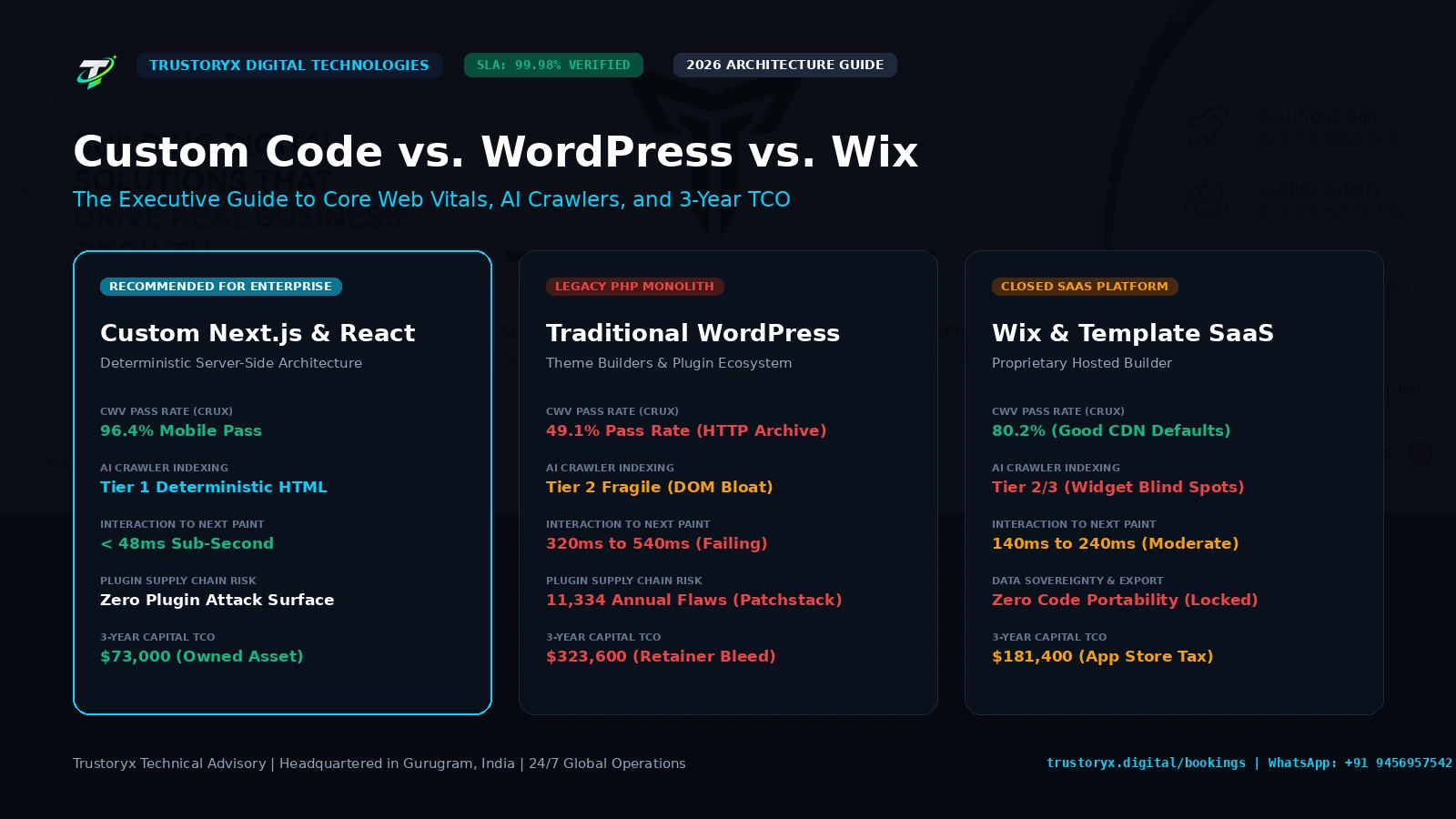
Why Custom Code Outperforms WordPress, Wix, and Template Builders in 2026: The Executive Guide to SEO, AEO, GEO, and AI Search
In 2026, custom-coded web architecture outperforms WordPress, Wix, and template builders by eliminating plugin debt, ensuring deterministic AI search indexing, and cutting 3-year TCO.

كيف تفقد الشركات الرائدة في دبي والإمارات ما يصل إلى 35% من صفقاتها الرقمية بصمت؟ الدليل التنفيذي للبرمجة المخصصة والذكاء الاصطناعي وأمن البيانات في 2026
تصل تكلفة النقرة في إعلانات دبي إلى 150 درهماً، بينما يتجاوز متوسط خسائر اختراق البيانات 8 ملايين دولار في الشرق الأوسط. اكتشف كيف تحمي الشركات الرائدة في الإمارات صفقاتها وأمنها عبر البرمجة المخصصة والذكاء الاصطناعي.
Ready to Scale Your Search & Revenue?
Attract, Convert & Dominate Globally.
Get a complimentary 30-point SEO and Growth Audit. We identify competitor gaps, technical bottlenecks, and actionable quick wins in 48 hours.