The $2.81 CAC Crisis: How Slow Templates and AI Search Blindness Are Killing US and Canadian B2B SaaS Pipelines in 2026
With enterprise CAC surging to $2.81 per $1.00 of new ARR and 6sense proving 82% of enterprise SaaS deals are decided before sales contact, learn how custom Next.js engineering and Tier 1 AI visibility cut payback below 9 months.

The $2.81 CAC Crisis: How Slow Templates and AI Search Blindness Are Killing US and Canadian B2B SaaS Pipelines in 2026
By Nikhil Kumar, Founder and Principal Engineer at Trustoryx (Trustoryx Digital Technologies)
Market Focus: United States and Canada B2B SaaS | Published: November 20, 2026 | Last Verified: November 20, 2026
North American B2B SaaS Benchmark Verification Log (Living Asset Protocol)
>
To guarantee boardroom-grade accuracy for US and Canadian SaaS founders, investors, and AI retrieval engines, Trustoryx refreshes the primary empirical datasets in this briefing every 30 days.
>
B2B Buying Committee Telemetry:* 6sense 2026 Global B2B Buyer Experience Report (November 2026)
SaaS CAC and Payback Ratios:* Benchmarkit 2026 B2B SaaS Performance Report (198 reporting companies, verified October 2026)
North American Paid Search & Conversion Data:* GrowthSpree 2026 SaaS Google Ads Benchmarks ($60M+ spend, 300+ accounts, April 2026) and Pipe Rocket Digital 24-Month B2B SaaS Dataset (August 2026)
Platform Performance & Security Risk:* HTTP Archive CWV Technology Report (April 2026) and Patchstack State of WordPress Security Report (February 2026)
AI Crawler & Conversion Telemetry:* Vercel & MERJ (500M+ bot requests), RESONEO (January 2026), Ahrefs (May & November 2026), Seer Interactive
Executive Summary: You Are Losing 82% of Enterprise Deals Before Your Sales Team Joins the Call
In late 2026, scaling B2B SaaS companies in the United States and Canada are silently bleeding six to seven figures in annual runway because their marketing websites, pricing architectures, and fragmented vendor stacks fail during anonymous buyer evaluation. According to 6sense's November 2026 B2B Buyer Experience Report, 91.4% of enterprise buying committees rank their vendor shortlist before ever speaking to a sales rep, and the pre-contact favorite wins 82% of the time.
Read that number twice as a CEO. If your product is superior, your engineers are brilliant, and your sales reps are aggressive, yet pipeline feels harder and more expensive to close every quarter, the bottleneck is almost certainly not your sales deck. The bottleneck is that your company is losing the anonymous vetting phase before your sales team even knows a deal exists.
In 2026, North American SaaS capital markets no longer subsidize inefficient growth. Benchmarkit's 2026 SaaS Performance Report puts the median New Name CAC ratio at $1.63 spent for every $1.00 of new ARR, surging to an alarming $2.81 per $1.00 of new ARR for enterprise SaaS contracts between $50,000 and $100,000 ACV. Median CAC payback has stretched to 16 months across the market and 22 to 24+ months in the enterprise and bottom quartiles.
Yet thousands of Series A through Series C SaaS founders in San Francisco, New York, Austin, Boston, and Toronto continue running $10M to $50M businesses on top of sluggish WordPress themes, rigid Webflow templates, client-side JavaScript pricing calculators that ChatGPT and Claude cannot parse, and three disconnected agencies pointing fingers at each other while ad costs climb.
The North American B2B SaaS Silent Revenue Bleed Ledger (2026)
Every month a scaling SaaS company postpones upgrading from fragmented templates to unified, custom-engineered web and AI infrastructure, four compounding leaks silently drain valuation and runway:
| Silent Pipeline Leak | Verified 2026 Market Reality | Monthly Financial Impact ($25K/mo Ad Spend / $35K ACV SaaS) | Architectural Root Cause | | :--- | :--- | :--- | :--- | | 1. Paid Search Conversion Bleed | Bottom-quartile SaaS landing pages convert at 0.8% to 2.0% vs. 5.0% to 8.0% for top-quartile custom pages (GrowthSpree, Apr 2026). | $10,000 to $15,000/month in directly wasted Google and LinkedIn ad spend (40% to 60% waste rate). | Heavy template scripts, poor Interaction to Next Paint (INP > 300ms), generic un-personalized landing pages. | | 2. AI Shortlist Extinction | 81% of B2B buyers use LLMs (ChatGPT, Claude, Perplexity) during evaluations to compare shortlisted vendors (6sense, Nov 2026). | 3 to 8 lost enterprise evaluations per quarter ($105K to $280K+ in invisible lost pipeline). | Tier 2 client-side JS pricing/specs, iframes, and fragmented schema plugins invisible to AI crawlers. | | 3. The "Fragmented Vendor" Drag | Managing separate web devs, UI/UX freelancers, SEO retainers, and CRM ops burns founder hours and stalls sprint velocity. | $12,000 to $25,000/month in overlapping retainers plus delayed feature/campaign launches. | Siloed agency incentives with zero single-point accountability for revenue outcomes. | | 4. Missing Embedded-AI Proof | 80% of B2B evaluations include AI requirements, and 58% strongly encourage or mandate embedded AI capabilities (6sense, Nov 2026). | Immediate disqualification during technical validation by enterprise IT and procurement committees. | Static brochure website with zero interactive product proof, custom RAG solutions assistant, or automated onboarding. |
Boardroom Reality Check for US and Canadian Founders
>
Seventy percent of B2B leaders delay infrastructure upgrades because sticking with the status quo feels safe. In 2026, the status quo is not standing still; it is actively depreciating your valuation multiple. When your CAC payback creeps past 20 months and your competitor ships a sub-second Next.js platform with Tier 1 AI search visibility and automated CRM/n8n routing, doing nothing is the highest-risk decision on your board agenda.
Chapter 1: The $2.81 CAC Crisis: Why North American SaaS Acquisition Economics Broke in 2026
North American B2B SaaS acquisition economics have shifted permanently from cheap top-of-funnel click arbitrage to ruthless post-click conversion engineering. With non-brand Google Search clicks costing $8.50 to $25.00+ and enterprise SQL costs reaching $2,500 to $8,000, a slow or generic template website acts as a direct tax on every investor dollar you deploy.
For years, US and Canadian SaaS marketing playbooks relied on one simple lever: raise venture capital, pour money into Google Ads and LinkedIn Sponsored Content, publish 40 SEO blog posts per month on WordPress or Webflow, and let SDRs work the inbound queue.
Look at the verified 2026 North American paid acquisition numbers from GrowthSpree's $60M+ B2B SaaS dataset (April 2026) and Benchmarkit's 2026 SaaS Report:
| SaaS Vertical (US & Canada) | Average Non-Brand Search CPC | Average Landing Page CVR | Average Cost Per Lead (CPL) | Average Cost Per SQL | | :--- | :--- | :--- | :--- | :--- | | Cybersecurity SaaS | $18.00 | 1.8% | $550 | $3,500 | | FinTech & Payments SaaS | $16.00 | 2.2% | $420 | $2,800 | | Healthcare / HealthTech | $14.50 | 2.4% | $380 | $2,200 | | MarTech & Sales Tech | $13.00 | 3.0% | $310 | $1,800 | | ERP & Operations SaaS | $12.00 | 2.8% | $290 | $1,600 | | HR Tech / HRIS | $11.50 | 3.5% | $280 | $1,400 | | DevTools & Developer Platforms | $7.50 | 4.8% | $130 | $650 |
Why Cheaper Clicks Are Not Coming Back
Pipe Rocket Digital's 24-month benchmark study of active B2B SaaS accounts (updated August 2026) proved a decisive rule for CEOs: click costs are flat and permanently elevated, meaning the companies that cut their Cost Per Lead by 44% did so entirely by engineering a 48% lift in landing page conversion rates.
Read that again. Your paid media agency cannot bid-strategy their way out of an $18.00 Cybersecurity CPC or a $16.00 FinTech CPC. Auction density in North America is saturated by AI-automated bidding from well-funded incumbents.
The only lever left that your team fully owns and controls is what happens in the 3,000 milliseconds after a VP of Engineering or CFO clicks your ad or finds your brand in ChatGPT.
Consider two competing B2B SaaS platforms bidding on the exact same $14.00 non-brand keyword in the United States, each spending $30,000 per month (2,142 high-intent clicks/month) selling a $40,000 ACV platform:
- Competitor A (Legacy WordPress/Webflow Template, 1.6% CVR, 15% Lead-to-Close):
- Generates 34 leads/month ($882 CPL).
- Closes 5.1 deals/month = $204,000 in new monthly ARR.
- Pays back paid media + SDR/AE overhead in 21+ months, forcing painful down-round or bridge conversations.
- Competitor B (Custom Next.js Edge Architecture + Interactive Product UX + Automated Routing, 4.8% CVR, 18% Lead-to-Close):
- Generates 103 leads/month ($291 CPL) from the exact same $30,000 ad spend.
- Closes 18.5 deals/month = $740,000 in new monthly ARR.
- Cuts blended CAC payback below 9 months, unlocking top-quartile SaaS valuation multiples.
The difference between burning investor cash and compounding category leadership is rarely the product roadmap alone. More often than founders admit, it is the revenue infrastructure standing between your market and your product.
Chapter 2: The Silent Death of Your Pipeline: How 91.4% of Buyers Eliminate You Before Calling Sales
B2B SaaS buying is no longer a discovery process led by sales reps; it is an anonymous self-education marathon. 6sense's November 2026 study reveals that buying groups spend nearly six months researching independently before contacting any vendor, that the eventual winner was on the Day 1 shortlist 92% of the time, and that once buyers fill out a form, only 35.2% even submit their own real contact details initially.
If you run a US or Canadian SaaS company and your website still hides pricing behind a "Book a Demo" wall, forces buyers through slow page loads, offers generic corporate buzzwords instead of concrete architectural proof, and drops anonymous evaluators into broken PDFs, your website is actively disqualifying you during the six months that actually decide the deal.
The Mechanics of the Modern 10.3-Month Enterprise Buying Cycle
Look at what happens inside a North American B2B buying committee (typically 6 to 11 stakeholders spanning IT, Security, Finance, and Operations) while your CRM still shows zero activity:
- 1Months 1 to 5 (The Dark Research Window): The buying group defines the problem, inspects vendor websites anonymously, tests documentation, checks security compliance posture, runs vendor comparisons through ChatGPT and Claude, and debates ROI internally.
- 2Month 6 (The Shortlist Lock): Roughly 59% of the way through a 10.3-month cycle, 91.4% of buying groups have already ranked their vendor shortlist. They have already chosen their #1 favorite.
- 3Months 6 to 10 (The Validation Stress Test): Now they finally click "Book a Demo." Your Account Executive thinks the race just started. In reality, if your brand is not already the #1 pre-contact favorite, your sales rep is acting as unpaid "column fodder" so procurement can satisfy a three-quote compliance rule while the #1 favorite wins 82% of the time.
Why Finance and Technical Evaluators Kill Weak Websites Instantly
6sense's 2026 data also exposes why deals stall out into "no decision": 56% of buying groups struggle just to align internally on whether the investment is worth making, and 74% of finance stakeholders in failed deals reported that justifying the business case was harder than selecting a vendor.
When a CFO or VP of Engineering lands on a sluggish, template-built SaaS website that feels indistinguishable from ten lookalike competitors (remember: 86% of B2B buyers report seeing no real difference between competing vendors), their threat-detection brain triggers immediate skepticism:
- "If their own public web application lags, shifts layout, and looks like a generic $99 theme, how much technical debt is buried inside their core SaaS product?"
- "Where is their security architecture proof, API transparency, and ROI math I can forward to my board?"
A sub-second, custom-engineered dark-mode or precision enterprise web platform built on a cohesive Figma-to-Next.js design system communicates engineering authority subconsciously in 50 milliseconds. Before a single prospect ever meets your founder, your architecture proves you operate at enterprise grade.
Chapter 3: AI Shortlist Extinction: Why ChatGPT, Claude, and Perplexity Cite Your Competitors Instead of You
In 2026, 81% of B2B software buyers use Large Language Models during vendor evaluations to compare specifications, summarize trade-offs, and stress-test shortlisted contenders. Because AI search crawlers (`OAI-SearchBot`, `ChatGPT-User`, `ClaudeBot`, and `PerplexityBot`) parse raw initial HTML without executing client-side JavaScript, SaaS companies relying on JS-rendered pricing calculators, bloated builders, or iframe widgets are being quietly erased from buyer comparison tables.
Notice the crucial nuance in the November 2026 buyer telemetry: buyers do not only use AI for initial discovery; 81% use ChatGPT, Claude, and Perplexity mid-evaluation to compare you head-to-head against your top two competitors.
Picture a VP of Operations in Chicago or Vancouver typing this exact prompt into ChatGPT or Perplexity at 8:30 AM before a leadership meeting:
"Compare [Your SaaS] vs. [Competitor X] on enterprise security compliance, SOC 2 posture, API rate limits, pricing model for 250 seats, and CRM workflow integrations. Output a decision table for our CFO."
Here is what happens behind the scenes in the next two seconds:
- 1
OAI-SearchBotorPerplexityBotfetches your/pricing,/security, and/integrationsURLs in real time. - 2If your SaaS site runs on a client-side React SPA, a JavaScript-injected Webflow/Wix pricing toggle, or a bloated WordPress builder where seat tiers, integration matrices, and compliance facts render only after browser JavaScript executes (Tier 2 visibility) or sit inside third-party iframes (Tier 3 blind spots): the AI crawler retrieves empty HTML shells.
- 3Meanwhile, Competitor X runs a custom Next.js App Router (React Server Components) architecture that serves crisp, edge-cached Tier 1 server-rendered HTML and unified
@graphJSON-LD in 60 milliseconds. - 4ChatGPT builds the CFO's comparison table with rich, verified specs for Competitor X and writes "Pricing and API compliance details not publicly confirmed" under your company's column.
You just lost a $75,000 ARR enterprise deal without ever receiving a single email, form fill, or alert in HubSpot.
The Empirical Proof: 500 Million Bot Requests Do Not Lie
Independent 2026 engineering telemetry leaves zero room for wishful thinking:
- Vercel & MERJ (500M+ Bot Requests): Confirmed that
GPTBotandClaudeBotdo not execute client-side JavaScript to build the DOM. - RESONEO & EdgeComet (January 2026): Proved that
OAI-SearchBot,ChatGPT-User,PerplexityBot, andClaudeBotextract strictly from initial raw HTTP 200 HTML payloads. - Ahrefs & Seer Interactive (2026): Demonstrated that when buyers do click through from AI citations, they convert at 5x to 9x the rate of Google organic traffic (10.5% to 15.9% vs. 1.76%), with Ahrefs recording 12.1% of total product signups from just 0.5% of traffic arriving via AI search.
Run the 60-Second Founder AI-Blindness Test Right Now
Open your terminal (or Slack this command to your CTO right now) to see what ChatGPT and Perplexity actually see when an enterprise buyer asks about your SaaS pricing and capabilities:
# Test whether OpenAI's real-time search crawler can read your pricing tiers in raw Tier 1 HTML
curl -s -A "OAI-SearchBot/1.0" https://yoursaas.com/pricing | grep -iE "enterprise|annual|soc 2|api"

# Check if your firewall is blocking Perplexity or timing out above 500ms TTFB
curl -o /dev/null -s -w "HTTP: %{http_code} | TTFB: %{time_starttransfer}s | Bytes: %{size_download}\n" \
  -A "PerplexityBot/1.0" https://yoursaas.com/
If the first command returns blank output, or the second returns 403, 429, or a TTFB above 0.500s, your SaaS brand is suffering from AI Shortlist Extinction.
### Urgent Diagnostic for US & Canadian SaaS Founders: Plug Your CAC & AI-Visibility Leak
>
Stop letting bloated templates and JavaScript blind spots hand six-figure enterprise deals to inferior competitors.
>
Trustoryx delivers a rapid, engineering-grade B2B SaaS CAC, Speed & AI-Shortlist Teardown, auditing your Tier 1 HTML crawler visibility, Core Web Vitals (INP/LCP), landing page conversion friction, and unified
@graphJSON-LD architecture.
>
**Book Your Free 30-Minute Executive Teardown at trustoryx.digital/bookings** | **Direct 24-Hour Executive WhatsApp Desk**
Chapter 4: The Fragmented Vendor Tax: Why Multi-Agency Chaos Destroys SaaS Velocity and Runway
The hidden enemy draining Series A through Series C SaaS companies is not a lack of marketing budget; it is multi-vendor fragmentation. Splitting your revenue engine across a separate design studio, a WordPress or Webflow agency, an SEO retainer, a paid ads shop, and overloaded internal product engineers guarantees finger-pointing, missed release windows, and compounding technical debt.
Every scaling SaaS CEO recognizes this exact Thursday morning headache:
- Your VP of Marketing wants to launch five high-intent competitor comparison landing pages with an interactive ROI calculator and live HubSpot attribution before a major conference.
- The design freelancer delivers pretty Figma frames that ignore responsive performance and WCAG compliance.
- The Webflow or WordPress agency says the interactive calculator requires third-party iframe embeds and three weeks of billable hours.
- The SEO agency sends a 40-page automated PDF audit complaining about Core Web Vitals, broken schema, and duplicate URLs, then blames the web agency for not fixing them.
- Your internal core product engineers are pulled off shipping paid customer features to untangle broken Zapier webhooks and auth redirects.
- Meanwhile, nobody owns the bottom-line number: pipeline conversion and CAC payback.
How Siloed Vendors Manufacture Technical Debt
Separate vendors are structurally incentivized to protect their narrow scope, not your ARR:
| Siloed Vendor | What They Optimize For | What Breaks as a Direct Result | | :--- | :--- | :--- | | Traditional Branding / Design Agency | Visual portfolio awards, heavy animations, oversized custom video backgrounds | Largest Contentful Paint (LCP) hits 4.5s+; mobile conversion rates collapse by 35%+ | | Template Web Agency (WP / Webflow) | Fast billable handoff using pre-built themes, visual builders, and marketplace plugins | Severe DOM bloat, 11,334+ annual WordPress plugin vulnerability ecosystem (Patchstack 2026), INP failure | | Standalone SEO Retainer | Monthly keyword rank reports and high-volume generic AI blog posts | Zero engineering authority to fix SSR rendering, edge caching, or @graph JSON-LD conflicts | | Disconnected RevOps / Zapier Freelancer | Quick duct-tape automations linking forms to CRMs | Silent webhook failures, dropped enterprise leads, broken multi-touch AI referral attribution |
The Unified Alternative: One Accountable Full-Stack Engineering Partner
High-velocity North American SaaS winners have abandoned the fragmented four-agency model in favor of single-partner embedded agile pods.
At Trustoryx, founded by Principal Engineer Nikhil Kumar, we architected our entire company specifically to kill multi-vendor chaos: Next.js/React web engineering, Figma design systems, full-stack technical SEO and GEO, hardened cloud DevOps, and custom AI/RAG plus n8n workflow automation operating inside one unified delivery framework. When one accountable engineering partner owns the code, the design system, the schema, the speed telemetry, and the CRM automation, finger-pointing vanishes overnight.
Chapter 5: The 58% Mandate: Why Brochure Websites Fail Modern US and Canadian SaaS Evaluations
According to 6sense's November 2026 buyer research, AI capabilities now feature in 80% of B2B software purchases, and embedded AI is strongly encouraged or strictly mandated in 58% of evaluations. A static brochure website telling prospects to "fill out a form and wait 24 hours for an SDR" signals legacy stagnation to modern North American enterprise buyers.
Think about buyer psychology during anonymous evaluation. When an enterprise CTO or VP of Operations evaluates a modern SaaS vendor in late 2026, they do not want to read three paragraphs claiming your platform is "AI-powered and scalable." They want to experience engineering competence immediately on your domain.
Turning Your Website Into Your Highest-Closing Solutions Engineer
Custom-coded Next.js/React architecture unlocks four interactive revenue weapons that closed template builders (Wix, Squarespace, Webflow) and bloated PHP monoliths (WordPress) simply cannot execute cleanly at sub-second speed:
- 1Private Enterprise RAG Solutions Assistants (Zero Hallucinations):
Instead of slapping a sluggish third-party chat bubble onto your site that annoys buyers with scripted bots, custom code lets you deploy a lightweight, native UI assistant powered by Retrieval-Augmented Generation (RAG) connected exclusively to your verified API docs, SOC 2 security questionnaires, integration specs, and pricing tiers. When a technical evaluator asks at 11:00 PM EST whether your platform supports Okta SCIM provisioning and HIPAA BAA workflows, your site answers instantly with exact documentation citations and offers a one-click calendar slot.
- 1Interactive Self-Serve ROI and Pricing Configurators (With Tier 1 HTML Transparency):
Remember 6sense's finding that 74% of finance stakeholders kill deals because justifying ROI is too difficult. A custom React Server Component pricing page exposes clear, AI-crawlable Tier 1 HTML baseline pricing while giving CFOs an interactive seat-and-savings calculator that generates a shareable boardroom PDF business case in seconds, capturing high-intent pipeline without intrusive friction.
- 1Automated n8n Lead Enrichment, Scoring, and Instant Routing:
When a high-value prospect from a Fortune 1000 domain interacts with your site or books a slot, custom edge APIs paired with n8n workflow automation instantly enrich the account, verify firmographics, push clean multi-touch attribution (including ChatGPT/Perplexity referral tags) straight into Salesforce or HubSpot, alert the assigned AE in Slack within 1,500 milliseconds, and fire a personalized technical prep brief.
- 1Live Product Sandboxes and Programmatic Integration Hubs:
Instead of publishing 50 thin, duplicate integration pages that get ignored by Google and LLMs, custom code generates edge-cached, data-rich programmatic integration architectures complete with live API payload previews, unified SoftwareApplication JSON-LD schemas, and native WCAG accessibility.
Chapter 6: Sub-Second Speed as a Valuation Multiplier: Engineering 5% to 8% Landing Page Conversion
In 2026, top-quartile B2B SaaS landing pages convert paid search traffic at 5.0% to 8.0%, while bottom-quartile template pages languish at 0.8% to 2.0%. Bridging that gap requires engineering discipline across real-world Core Web Vitals (LCP, INP, CLS), zero-bloat React Server Components, reusable Figma-to-Code design systems, and WCAG 2.2 AA accessibility.
Let's strip away developer jargon and view front-end engineering purely through a CEO's financial lens.
Why Real-World Speed (CrUX Field Telemetry) Governs Both Google Rankings and Paid ROAS
Google's ranking algorithms and ad Quality Scores evaluate your site using real-user Chrome User Experience (CrUX) telemetry, not synthetic laptop tests. In HTTP Archive's April 2026 global dataset, WordPress finished dead last among major platforms with roughly 51% of sites failing Core Web Vitals.
Why does that destroy US and Canadian SaaS paid campaigns?
- Lower Google Ads Quality Score = Higher CPC Penalty: Slow, layout-shifting landing pages degrade Google's Landing Page Experience rating, forcing your SaaS company to pay 15% to 35% higher CPCs than faster competitors for the exact same ad slot.
- Main-Thread INP Lag Kills High-Intent Form Submissions: When a busy Director clicks your "Start Free Trial" or "Request Demo" CTA on mobile and heavy tracking plugins freeze the browser main thread for 450 milliseconds (failing Google's 200ms Interaction to Next Paint threshold), abandonment spikes silently.
The Trustoryx Sub-Second SaaS Engineering Standard
When Trustoryx engineers a custom Next.js/React marketing platform and web app ecosystem for a North American SaaS company, every sprint enforces five non-negotiable technical standards:
- 1Edge-First React Server Components (RSC): Static marketing copy, customer case studies, comparison matrices, and documentation ship zero unnecessary client-side JavaScript, cutting Time to First Byte (TTFB) below 80ms across US East, US West, and Canadian edge nodes.
- 2Modular Figma-to-Code Design Systems: Rather than rebuilding pages from scratch for every product launch, we engineer a tokenized component library (precision dark-mode or brand-aligned bento grids, reusable pricing modules, interactive telemetry cards) so your marketing team launches campaign pages in hours while maintaining 100% visual consistency.
- 3Deterministic Unified `@graph` JSON-LD: Strongly typed TypeScript schema generators link your
Organization,SoftwareApplication,Person(founder/executive authors),TechArticle, andFAQPageentities cleanly across every route, eliminating plugin schema conflicts permanently. - 4Native WCAG 2.2 AA Compliance: Protects US and Canadian SaaS vendors against escalating ADA Title III and AODA (Accessibility for Ontarians with Disabilities Act) legal demands, while also satisfying enterprise government and healthcare procurement checklists.
- 5Headless Editorial Autonomy: Pairing your custom Next.js front end with a modern headless CMS (such as Sanity or Strapi) gives your VP of Marketing 100% freedom to edit copy, publish thought leadership, and spin up ABM landing pages in minutes without ever waiting on an engineer or risking broken DOM layouts.
Chapter 7: The CFO and Boardroom Math: In-House US/Canada Hiring vs. Fragmented Agencies vs. One Accountable Agile Pod
Building an equivalent full-stack digital growth, web engineering, SEO/GEO, and AI automation team in-house in the United States or Canada costs $460,000 to $640,000+ per year in base salaries, benefits, and recruiting fees. Hiring fragmented North American specialty agencies runs $180,000 to $280,000 per year with chronic coordination drag. Consolidating into a single enterprise-grade global agile pod cuts annual capital burn by 60% to 75% while accelerating shipping velocity.
Every Series A, Series B, and bootstrapped SaaS CFO asks the exact same capital-allocation question: "Should we hire internally in the US/Canada, retain local niche agencies, or partner with a unified global engineering pod?"
Compare the actual 2026 fully loaded 12-month numbers side by side:
| Resource & Capability Line Item (12-Month Run Rate, USD) | Option A: In-House US / Canada Team | Option B: Fragmented North American Agencies | Option C: Trustoryx Unified Global Agile Pod | | :--- | :--- | :--- | :--- | | Senior Next.js / Full-Stack Engineer | $165,000 to $210,000 (Salary + 25% benefits/tax) | $84,000 to $130,000 (Web dev agency retainer) | Included in Unified Pod | | Senior UI/UX & Design Systems Lead | $140,000 to $175,000 (Salary + benefits) | $48,000 to $72,000 (Design studio retainer) | Included in Unified Pod | | Technical SEO, GEO & AI Search Architect | $125,000 to $160,000 (Salary + benefits) | $42,000 to $78,000 (SEO/GEO agency retainer) | Included in Unified Pod | | AI/RAG, n8n Automation & Cloud DevOps | $180,000+ (Or pulled off core SaaS product devs) | $36,000 to $60,000 (RevOps/AI consultants) | Included in Unified Pod | | Recruiting Fees, Onboarding & Management Drag | $45,000 to $80,000 + 3 to 6 months hiring delay | 10+ founder/VP hours weekly coordinating vendors | Zero recruiting lag; live sprint kickoff in days | | Total 12-Month Capital Burn (USD) | $655,000 to $805,000+ | $210,000 to $340,000+ | Custom Enterprise Pods (Tiers starting from $1,000/mo up to dedicated full-stack agile pods) | | Contract Lock-In & IP Ownership | Permanent payroll overhead & severance risk | Rigid 6 to 12 month agency lock-in contracts | No-lock-in contracts; 100% owned IP in your GitHub | | Accountability & Uptime Guarantee | Internal silo friction | Chronic multi-vendor finger-pointing | One accountable global partner; 99.98% uptime SLA |
M&A Due Diligence and Series B Valuation Protection
When private equity firms or Tier 1 venture funds conduct technical due diligence prior to a Series B, Series C, or acquisition exit, they inspect your digital acquisition infrastructure closely.
- A clean, version-controlled Next.js/React repository with automated CI/CD performance budgets, documented cloud security, clean HubSpot/Salesforce n8n pipelines, and verified AI search authority increases enterprise value.
- A tangled WordPress installation running 38 plugins (exposed to Patchstack's 11,334 annual vulnerability ecosystem) or a locked-in Wix/Webflow build with broken attribution gets flagged directly in the technical audit report as post-close remediation debt.
### Boardroom Runway Recovery: Replace Four Siloed Vendors With One Accountable Pod
>
Stop letting internal product engineers get dragged into marketing website fixes, and stop funding disconnected agencies that report vanity impressions while your CAC payback climbs past 20 months.
>
Trustoryx gives US and Canadian B2B SaaS founders a single 99.98% SLA-backed full-stack partner spanning custom Next.js/React engineering, Figma design systems, technical SEO/GEO, hardened cloud DevOps, and custom AI/RAG + n8n automation, operating 24 hours a day across North American time zones with zero technical debt and no-lock-in contracts.
>
**Schedule Your SaaS Architecture & CAC Reduction Strategy Call at trustoryx.digital/bookings**
Chapter 8: Zero-Risk Execution: How Trustoryx Eliminates Switching Fear for US and Canadian Founders
The biggest reason B2B SaaS CEOs stay trapped on underperforming websites is switching fear: fear of losing Google rankings during migration, fear of time-zone friction, and fear of getting locked into a bad vendor contract. Trustoryx neutralizes every single executive risk structurally before Day 1.
Fear of change kills more ARR than bad code ever could. Here is exactly how our operational framework makes upgrading your SaaS revenue infrastructure the safest decision you will make this quarter:
1. Zero-Lock-In Contracts and 100% IP Ownership
Every line of Next.js, React, TypeScript, schema markup, Figma component token, and n8n workflow blueprint is committed directly into your company's private GitHub repository and cloud environment. You never rent your website from us, and we never hold your business hostage with restrictive annual agency lock-ins. We retain clients strictly through measurable engineering execution and revenue impact.
2. 24-Hour Global Coverage Aligned to EST, CST, and PST
Operating 24 hours a day, 7 days a week across India, the United States, Canada, the UK, UAE, and Europe means your New York, Austin, San Francisco, or Toronto leadership team never waits 48 hours for an urgent deployment or pre-launch fix. You receive real-time Slack/project visibility, structured agile sprint telemetry, and direct access to Principal-level architecture leadership backed by a 99.98% uptime SLA.
3. The 30 / 60 / 90-Day Zero-Downtime Revenue Sprint Roadmap
We never disappear into a six-month "black box redesign" that launches out of date. Every North American SaaS engagement ships measurable business leverage in rapid, transparent milestones:
- Days 1 to 30 (Foundation, Leak Plugging & Design System):
- Full technical audit of current CAC leaks, Tier 1 AI crawler blind spots, Core Web Vitals bottlenecks, and URL equity inventory.
- Tokenized Figma-to-Code design system and Next.js App Router edge architecture initialized in parallel staging.
- Immediate quick-win fixes on top paid search landing pages to stop active ad spend bleed.
- Days 31 to 60 (Zero-Downtime Launch, Tier 1 GEO & CRM Automation):
- Zero-downtime edge migration with 1:1 301 redirect parity, unified
@graphJSON-LD validation, and automated CI/CD crawler gates confirming 100% visibility toGooglebot,OAI-SearchBot,PerplexityBot, andClaudeBot. - Deployment of n8n CRM enrichment, instant Slack/HubSpot lead routing, and server-side AI referral attribution.
- Days 61 to 90 (AI Solutions Assistant, Programmatic GEO & CRO Scaling):
- Launch of custom private RAG Solutions Assistant trained on your verified product docs and compliance specs, plus interactive CFO ROI/pricing calculators.
- Continuous conversion-rate sprints pushing paid landing pages toward the 5.0% to 8.0% top-quartile SaaS benchmark while tracking live 30-day AI shortlist citation growth.
Chapter 9: The 2026 North American B2B SaaS Executive AEO FAQ
1. Why is B2B SaaS Customer Acquisition Cost (CAC) so high in the US and Canada in 2026?
According to Benchmarkit's 2026 SaaS Report, the median New Name CAC ratio has reached $1.63 per $1 of new ARR (and $2.81 in the $50K to $100K ACV enterprise segment) because North American paid search CPCs have climbed to $8.50 to $18.00+ while legacy template landing pages convert only 0.8% to 2.0% of clicks. Engineering sub-second, high-converting custom landing architecture is the fastest controllable lever to slash CAC payback.
2. How do B2B SaaS buyers actually use ChatGPT, Claude, and Perplexity during evaluations?
6sense's November 2026 B2B Buyer Experience Report found that 81% of enterprise buyers use LLMs during vendor evaluations primarily to compare shortlisted vendors, summarize technical specs, and stress-test preferences before speaking to sales. If your pricing, API limits, or security posture are hidden behind client-side JavaScript or iframes, AI crawlers fail to parse them, weakening your shortlist position before your sales team ever gets a call.
3. Why should a scaling US or Canadian SaaS company migrate off WordPress or Webflow to custom Next.js?
Custom Next.js App Router (React Server Components) eliminates the three ceilings that stall scaling SaaS companies on WordPress and Webflow: Tier 2 JavaScript AI-crawler blind spots, sluggish Core Web Vitals (51% of WordPress sites fail CWV as of April 2026), and severe architectural limits when integrating interactive ROI calculators, private RAG AI assistants, and real-time n8n CRM workflows.
4. Will migrating our SaaS website to custom code cause a drop in Google organic rankings?
No; when executed with strict URL parity, single-hop edge 301 redirects, unified `@graph` JSON-LD continuity, and automated pre-launch crawler gates, migrating to custom Next.js preserves 100% of search equity and typically lifts organic impressions and AI citations within 30 to 60 days due to 60% to 80% faster crawler response times.
5. Can our marketing team still publish landing pages and blogs quickly on a custom-coded Next.js site?
Yes; Trustoryx pairs custom Next.js front ends with modern headless CMS platforms (such as Sanity or Strapi) and modular Figma-to-Code component libraries. Your VP of Marketing and content team can launch new ABM pages, case studies, and GEO articles in minutes with zero engineering tickets and zero risk of breaking page speed or schema markup.
6. How much can a B2B SaaS company save by hiring a unified global agile pod instead of US/Canada agencies or in-house hires?
Hiring four equivalent senior specialists (Next.js engineer, UI/UX systems designer, Technical SEO/GEO architect, and AI/DevOps engineer) in-house in the US or Canada costs $655,000 to $805,000+ annually, while fragmented local agencies cost $210,000 to $340,000+. Consolidating into a single accountable agile pod at Trustoryx cuts total annual burn by 60% to 75% while eliminating multi-vendor coordination delays.
7. What is the "58% embedded AI mandate" in 2026 B2B SaaS evaluations?
In 6sense's November 2026 global buyer study, AI capabilities featured in 80% of B2B software purchases, and embedded AI was strongly encouraged or strictly mandated in 58% of evaluations. Deploying custom, hallucination-controlled RAG documentation assistants and automated AI onboarding workflows directly on your web platform validates technical credibility immediately during anonymous buyer research.
8. How does Trustoryx protect our intellectual property and avoid agency lock-in?
Trustoryx operates exclusively on no-lock-in contracts with 100% client IP ownership. All source code, Figma design tokens, @graph schema pipelines, and n8n automation workflows live directly inside your company's private GitHub repository and cloud infrastructure from Day 1, backed by a 99.98% uptime SLA.
9. How fast can an enterprise SaaS company verify if it is invisible to AI search crawlers?
In under 60 seconds, your CTO can run `curl -s -A "OAI-SearchBot/1.0" https://yoursaas.com/pricing` to inspect the raw initial HTML delivered without JavaScript execution. If your core pricing tiers, compliance badges, or feature comparison tables are missing from that output, ChatGPT Search, Perplexity, and Claude cannot accurately cite them.
10. Does Trustoryx cover US and Canadian time zones for urgent SaaS launches and support?
Yes; Trustoryx operates 24 hours a day, Monday through Sunday, serving B2B SaaS, e-commerce, and enterprise clients across the United States, Canada, the United Kingdom, Europe, the UAE, and India. Founders and VPs of Marketing get rapid sprint communication, real-time status telemetry, and immediate escalation via direct booking or our 24-hour executive WhatsApp desk.
Appendix: Production US & Canada B2B SaaS JSON-LD @graph Schema
Deploy this unified JSON-LD block inside your server-rendered <head> template to bind your organization, executive author authority, article entity, and AEO FAQ answers cleanly for Google, ChatGPT Search, Perplexity, and Claude:
{
  "@context": "https://schema.org",
  "@graph": [
    {
      "@type": "Organization",
      "@id": "https://www.trustoryx.digital/#organization",
      "name": "Trustoryx",
      "legalName": "Trustoryx Digital Technologies",
      "url": "https://www.trustoryx.digital/",
      "logo": {
        "@type": "ImageObject",
        "url": "https://www.trustoryx.digital/logo.png"
      },
      "description": "Full-stack digital engineering and growth partner delivering custom Next.js/React web apps, design systems, technical SEO/GEO, hardened cloud DevOps, and custom AI/RAG and n8n automation for B2B SaaS and global enterprises.",
      "founder": {
        "@id": "https://www.trustoryx.digital/#nikhil-kumar"
      },
      "areaServed": [
        "United States",
        "Canada",
        "United Kingdom",
        "United Arab Emirates",
        "Europe",
        "India"
      ],
      "contactPoint": {
        "@type": "ContactPoint",
        "telephone": "+91-62017-84889",
        "contactType": "sales",
        "areaServed": ["US", "CA", "GB", "AE", "EU", "IN"],
        "availableLanguage": ["English"]
      }
    },
    {
      "@type": "Person",
      "@id": "https://www.trustoryx.digital/#nikhil-kumar",
      "name": "Nikhil Kumar",
      "jobTitle": "Founder and Principal Engineer",
      "worksFor": {
        "@id": "https://www.trustoryx.digital/#organization"
      }
    },
    {
      "@type": "TechArticle",
      "@id": "https://www.trustoryx.digital/insights/us-canada-b2b-saas-custom-web-engineering-cac-ai-search-2026#article",
      "headline": "The $2.81 CAC Crisis: How Slow Templates and AI Search Blindness Are Killing US and Canadian B2B SaaS Pipelines in 2026",
      "description": "An executive and engineering briefing for US and Canadian B2B SaaS founders on eliminating CAC bleed, winning AI shortlists, and consolidating fragmented vendors into custom Next.js, RAG, and n8n architecture.",
      "author": {
        "@id": "https://www.trustoryx.digital/#nikhil-kumar"
      },
      "publisher": {
        "@id": "https://www.trustoryx.digital/#organization"
      },
      "datePublished": "2026-11-20",
      "dateModified": "2026-11-20",
      "inLanguage": "en-US",
      "audience": {
        "@type": "BusinessAudience",
        "audienceType": "B2B SaaS Founders, CEOs, CTOs, CFOs, VPs of Marketing in the United States and Canada"
      }
    },
    {
      "@type": "FAQPage",
      "@id": "https://www.trustoryx.digital/insights/us-canada-b2b-saas-custom-web-engineering-cac-ai-search-2026#faq",
      "mainEntity": [
        {
          "@type": "Question",
          "name": "Why is B2B SaaS Customer Acquisition Cost (CAC) so high in the US and Canada in 2026?",
          "acceptedAnswer": {
            "@type": "Answer",
            "text": "According to Benchmarkit's 2026 SaaS Report, the median New Name CAC ratio reached $1.63 per $1 of new ARR (and $2.81 in the $50K to $100K ACV enterprise segment) as North American paid search CPCs rose to $8.50 to $18.00+ while slow template landing pages convert just 0.8% to 2.0% of clicks."
          }
        },
        {
          "@type": "Question",
          "name": "How do B2B SaaS buyers actually use ChatGPT, Claude, and Perplexity during evaluations?",
          "acceptedAnswer": {
            "@type": "Answer",
            "text": "6sense's November 2026 B2B Buyer Experience Report found that 81% of enterprise buyers use LLMs during vendor evaluations to compare shortlisted options, summarize specs, and validate preferences before contacting sales."
          }
        },
        {
          "@type": "Question",
          "name": "Why should a scaling US or Canadian SaaS company migrate off WordPress or Webflow to custom Next.js?",
          "acceptedAnswer": {
            "@type": "Answer",
            "text": "Custom Next.js App Router (React Server Components) eliminates Tier 2 JavaScript AI-crawler blind spots, fixes sluggish Core Web Vitals, and enables interactive ROI calculators, private RAG AI assistants, and native n8n CRM workflows without platform ceilings."
          }
        }
      ]
    }
  ]
}
Stop Bleeding Enterprise Pipeline to Inferior Competitors.
Everything digital. One accountable partner.
No fragmented vendors, no finger-pointing: just dependable technical execution engineered to cut CAC payback, win AI shortlists, and accelerate North American ARR.
If you are a B2B SaaS Founder, CEO, CTO, or VP of Marketing in the United States or Canada tired of watching expensive clicks bounce off sluggish templates while ChatGPT and Claude cite your competitors, put our Principal Engineering team to work on your architecture today.
- Book Your 30-Minute Executive SaaS Teardown & Strategy Call: trustoryx.digital/bookings
- Direct 24-Hour Executive WhatsApp Desk: wa.me/919456957542
- Direct Phone Line (Open 24 Hours): +91 62017 84889
Frequently Asked Questions
Need Expert Help with B2B SaaS custom web development US Canada 2026?
Get a free 30-point audit from our engineering team.
Get Free AuditRelated Articles

The $4.99M Breach and 29% Cloud Waste Crisis: Why Fragile Servers, Unpatched Vulnerabilities, and Manual DevOps Are Putting Global Enterprises One Outage Away From Collapse in 2026
Software vulnerability exploitation ($4.99M avg breach), $1M+ outages, and 29% cloud bill waste threaten global enterprises. Discover how hardened DevOps, Infrastructure as Code, and 99.98% SLA zero-trust servers eliminate downtime risk.
Why Custom Code Outperforms WordPress, Wix, and Template Builders in 2026: The Executive Guide to SEO, AEO, GEO, and AI Search
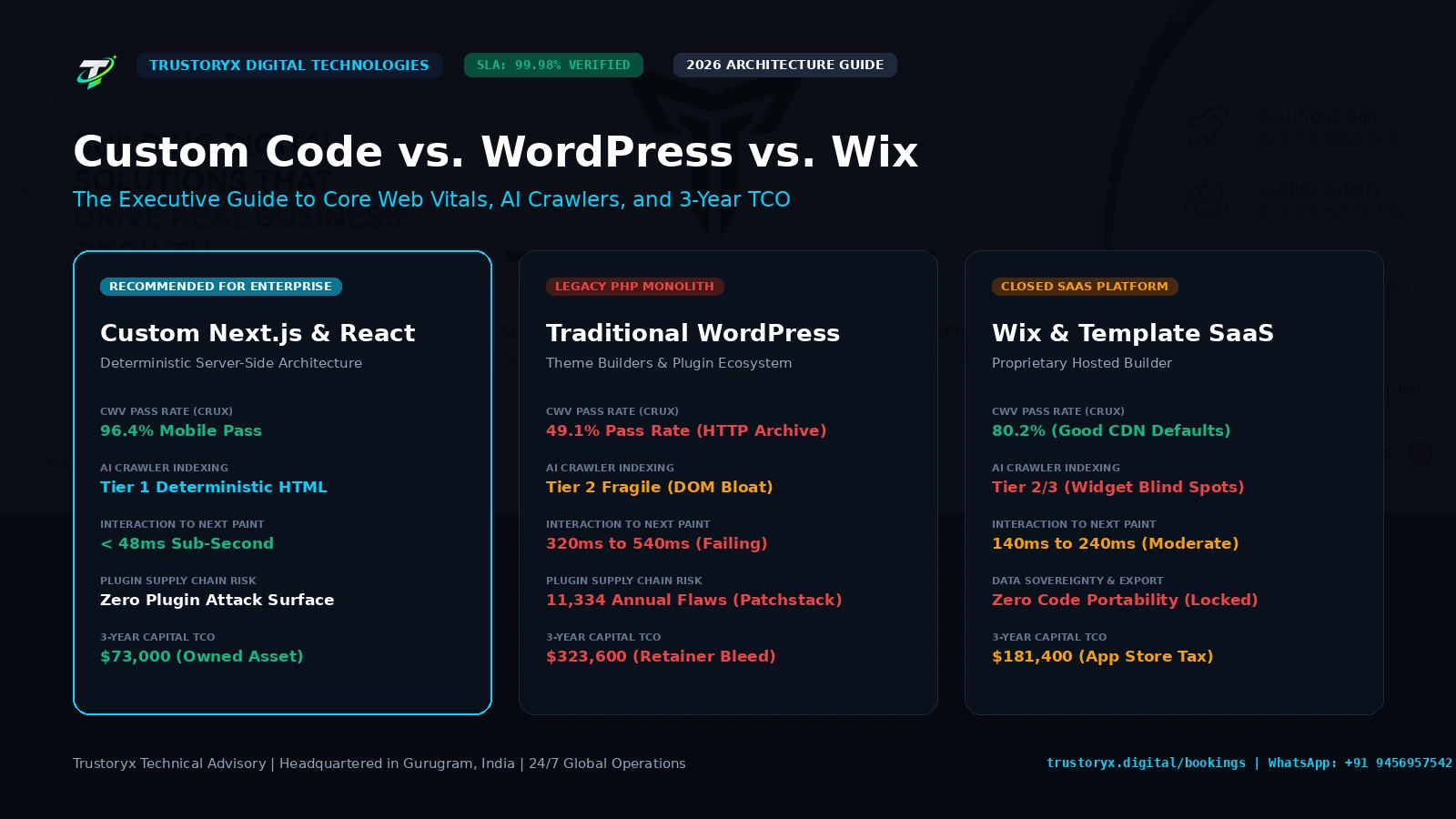
In 2026, custom-coded web architecture outperforms WordPress, Wix, and template builders by eliminating plugin debt, ensuring deterministic AI search indexing, and cutting 3-year TCO.

كيف تفقد الشركات الرائدة في دبي والإمارات ما يصل إلى 35% من صفقاتها الرقمية بصمت؟ الدليل التنفيذي للبرمجة المخصصة والذكاء الاصطناعي وأمن البيانات في 2026
تصل تكلفة النقرة في إعلانات دبي إلى 150 درهماً، بينما يتجاوز متوسط خسائر اختراق البيانات 8 ملايين دولار في الشرق الأوسط. اكتشف كيف تحمي الشركات الرائدة في الإمارات صفقاتها وأمنها عبر البرمجة المخصصة والذكاء الاصطناعي.
Ready to Scale Your Search & Revenue?
Attract, Convert & Dominate Globally.
Get a complimentary 30-point SEO and Growth Audit. We identify competitor gaps, technical bottlenecks, and actionable quick wins in 48 hours.